Sunday I visited Pompeii and what an experience it was. So incredible.
A Bit of History
Pompeii was settled in the 8th century BCE. It went through several battles and changes in culture that I won’t get into until it fell under the Roman Empire around 80 BCE. It’s the Roman influence that has made Pompeii an important historical site.
Throughout its history, Pompeii expanded and developed. It became a wealthy city surrounded fertile lands and in an advantageous position for trade. Then in 62 AD, an earthquake did great damage in both Pompeii and Herculaneum. (Herculaneum was smaller than Pompeii but was wealthier. It was a seaside retreat for the Roman elite. I haven’t been yet, but it’s on my list.)
Earthquakes, I learned, are something that volcanologists and geologists monitor the seismic activity, seeing that as a precursor to an possible eruption.
So, the earthquake significantly damaged both cities so much that neither city had recovered when 17 years later on August 24 and 25, 79 AD when Mount Vesuvius erupted burying both cities.
We know a lot about the eruption because Pliny the Younger recounted the event in two letters he wrote to Roman historian Tacitus. He provided the only surviving eyewitness account of these events, describing the last days of his uncle, Pliny the Elder, who noticed early volcanic activity occurring across the Bay of Naples and organized a rescue mission. However, his uncle died due to a mass of sulfurous gas.
A plume of volcanic material (mostly ash and pumice) fell first upon Pompeii due to the way the winds were blowing, covering the city in about 3 metres (9 feet) of debris. Then the gases and the heat, not lava, killed most of the inhabitants. When it was all done, Pompeii was buried under approximately 6 metres (18 feet) of debris.
Pompeii laid buried until the late 16th century. But it wasn’t until 1860 when the Italian archaeologist Giuseppe Fiorelli became director of the excavations. Unfortunately, between the time Pompeii was discovered and when Fiorelli took over, the site had been looted by treasure seekers and the site had not been properly documented.
Since 1860, the site has been properly excavated, cleared and carefully documented. Pompeii was divided into nine regions; the insulae (blocks) in each region were numbered, and each door on the street was given a number so that each house could be conveniently located by three numerals.
Fiorelli also developed the technique of making casts of bodies by pouring cement into the hollows formed in the volcanic ash where the bodies had disintegrated. Three bodies are on display in Pompeii and others, along with original frescos, mosaics, tiles, sculptures, and other recovered artifacts are on display at the Museo Archeologico Nazionale di Napoli.
The city is still being excavated today.
The City
The ancient city of Pompeii was shaped irregularly because it was built on a prehistoric lava flow. Archeologist estimate the southwestern part of the town is the oldest but do not agree on the stages by which the walls were expanded or on who the builders were. The walls are 3 km (2 mi.) in circumference, enclosing an area of about 66 hectares (163 acres). Seven city gates have been excavated.
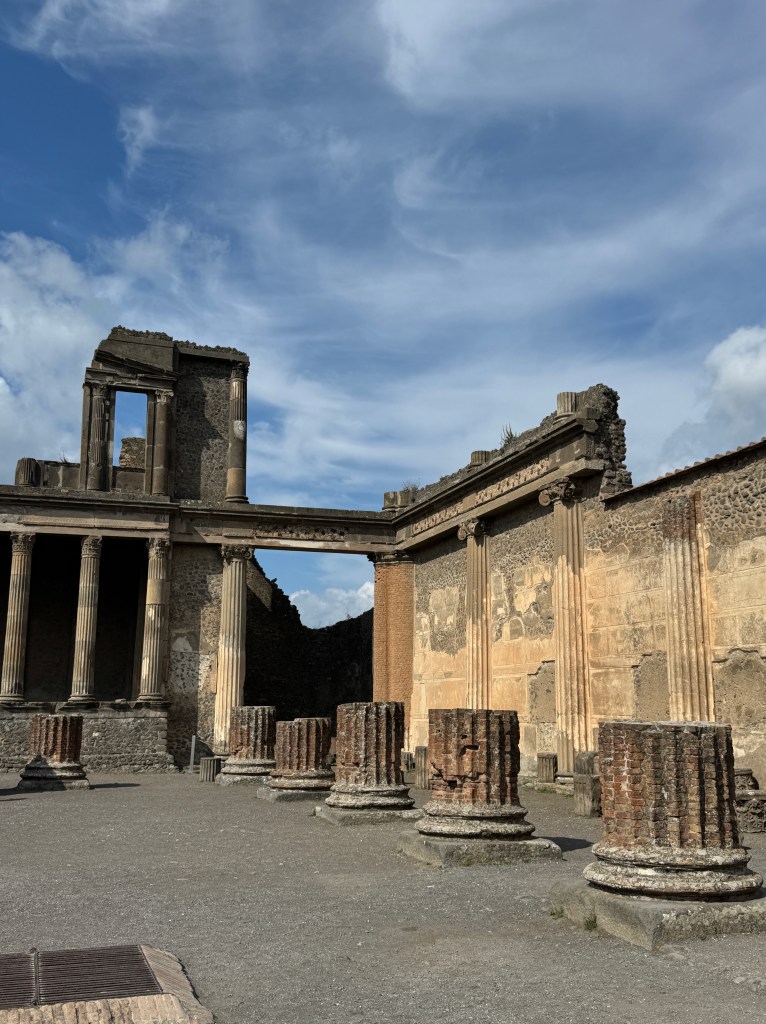
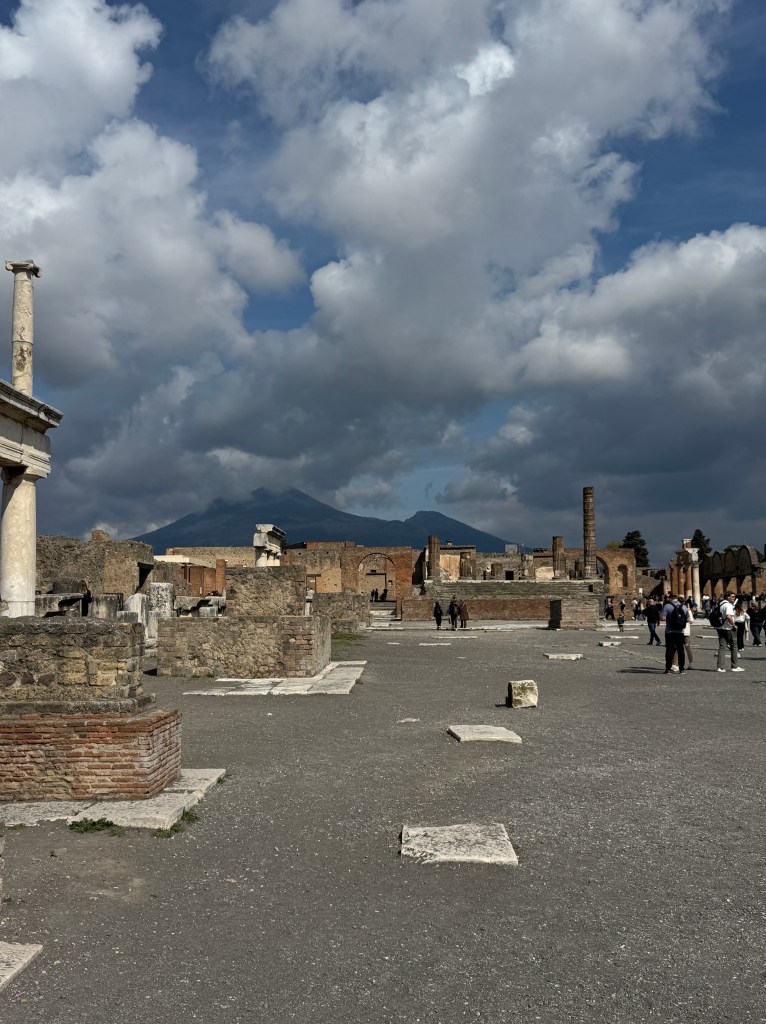
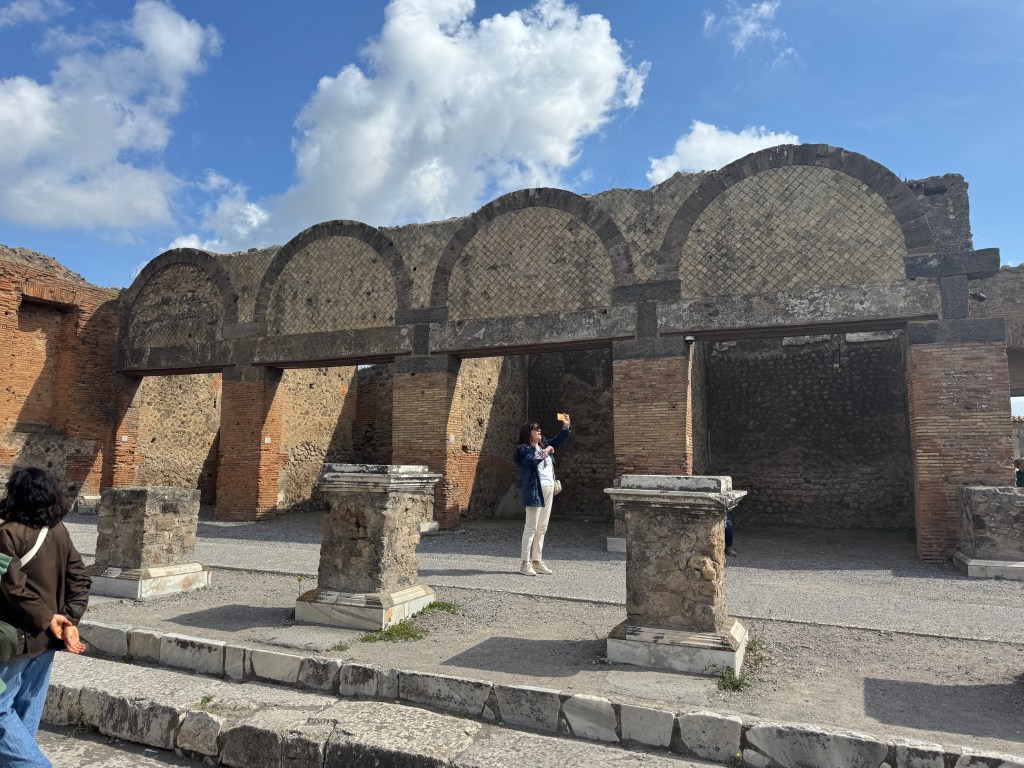
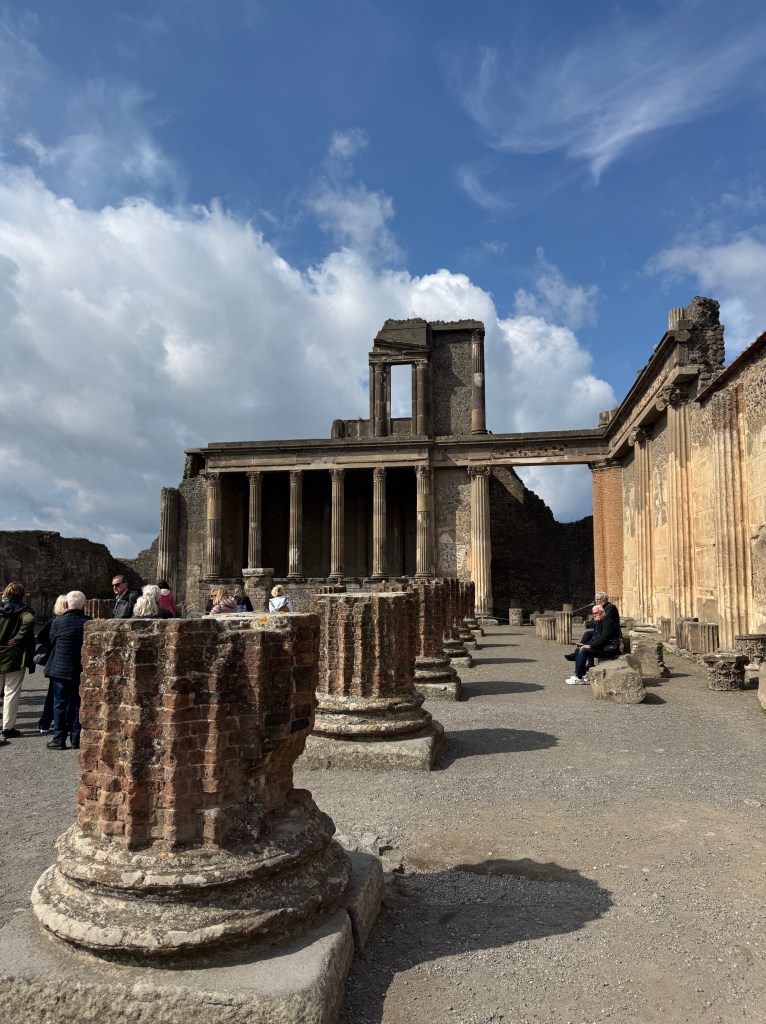
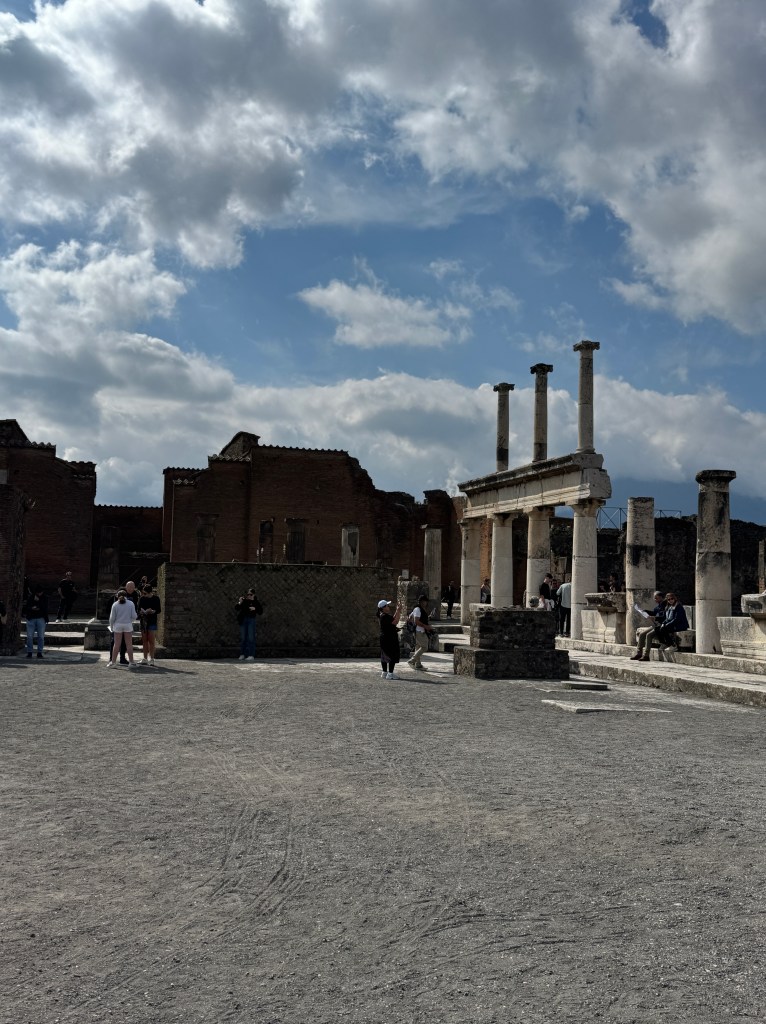
The Forum was the centre of the city’s religious, economic, and municipal life and is a large rectangular area surrounded by a two-story colonnaded portico (one photo shows the top columns). The second story collapsed during the eruptions, so only a few upper columns remain. On the north was the temple dedicated to the Capitoline triad of deities: Jupiter, Juno, and Minerva (photo with Mount Vesuvius in the background). To the east was the Macellum (large provision market, aka a “supermarket”), known by the 4 arches. On the southern end of the Forum were the meeting place of the city council and the offices of the magistrates of the city (photos with the large broken columns). To the west was the Temple of Venus Pompeiana, patron deity of Pompeii. Across from the basilica was the Temple of Apollo, one of the earliest in the city.
The entire city was planned as a grid network of east-west running streets and then north-south running streets which crossed them. Like many modern cities, the shops were faced the street with the shop owner’s house right behind the shop. There were “fast food” or “take-away” food shops (photo below of round holes in a counter), bakeries, brothels, and likely all sorts of other shops.
We went into a house, called the House of the Faun, that was approximately 3,000 sq meters (~32,000 sq ft) and occupies an entire city block. This house has two atria (chief rooms), four triclinia (dining rooms), and two large gardens. You enter through the atrium, which had elaborate decor and tile. Then it opens into an area where there was a rainwater collecting pool with an underground cistern. The bedrooms were small, really only large enough for a bed. Then there were two “wings” which is where the wardobes would have been placed. The walls are decorated in the First Pompeian, or Incrustation, style of painting, which imitates marble-veneered walls by means of painted stucco. The house has the famous Alexander the Great mosaic. What remains of this mosaic is absolutely incredible.
In the streets, you can still see the ruts where chariots and wagons had worn down the stones. The streets had sidewalks and stones to cross the street so you didn’t have to step on the actual street (which would have been muddy and really dirty from the horses, donkeys, and other animals pulling carts). There were also public water fountains (they’ve found 40 so far), and septic systems (we saw some terracotta pipes).
Other interesting parts of the city include a colosseum, smaller than the one in Rome, but used for the same main purposes—gladiator fights and executions. There are two amphitheaters: a smaller one that originally had a roof used for musical performances and a larger, open-air one for plays. And even brothels. So far, they’ve apparently found 40 of them, determined by the erotic art on the walls depicting various sexual acts, which archeologists believe were basically a menu. The tour didn’t go past one, but our guide pointed out where one was and recommended going. But after 4 hours of walking around, I decided to save some things, like the brothel and the colosseum, for another day.
I learned so much from our archeologist guide Gianluca. I can’t even remember it all. The 2.5 hours was crammed full of information. I’ll definitely have to go back. It’s a good sized city and they’re still excavating it, so there will always be more to see.
If you plan to travel to Italy, I highly recommend visiting Pompeii! I recommend doing a guided tour—the city is so large, even with a map, it’s hard to know where to go and what to see. It’s also hard to see everything in one day.
However, a few notes on visiting. First, this is an ancient city, so it’s not disability-friendly nor stroller-friendly (although I did see a few strollers, but it would be a huge pain). In fact, that can be said for most of Italy, including Naples—there are lots of stairs and hills. Many roads in Napoli are paved with stones and the sidewalks are narrow, and there are hills.
Pompeii’s streets are stone and the city is also hilly, and so I recommend wearing comfortable and supportive shoes. While there are “sidewalks”, they are narrow and I often had to step down onto the road to pass people or go around groups. Sunscreen is a must and carry water. You can take small bags into the city—I had a small daypack, which I use mostly to carry my water bottle. But note that the maximum bad size is 30x30x15.
Depending on the time of year and the day, it can get really crowded (another reason to a skip-the-line guided tour.) The first Sunday of the month is Domenica al Museo, which is an initiative launched by the Ministry of Culture to promote access to culture and art for everyone. It allows free entry to over 400 state-owned museums, monuments, and archeological sites across Italy on the first Sunday of each month. So plan your visit accordingly.
Next up, I plan to visit the Archeology Museum in Napoli.
Alla prossima volta, ciao!
 wanderinglynn.com