For my February trip, I visited Tirana, Albania.
Albania is located on the Balkan Peninsula’s southwestern coast along the Adriatic and Ionian Seas and is bordered by Montenegro to the northwest, Kosovo to the northeast, North Macedonia to the east, and Greece to the south. Italy lies directly west across the Adriatic Sea. From Naples, it was only a 75 minute flight. Perfect for a quick weekend trip.
A Little History
(Not interested in History? Skip to the next section or even to my final thoughts.)
Albania’s history, like most of Europe, began before the common era. Tirana, Albania’s capital, has also been inhabited since the Iron Age. Later, during the Roman Empire, Tirana is mentioned in Venetian documents in the 1350s. During the Ottoman Empire, records of the first land registrations in 1430 show that Tirana had approximately 7,300 inhabitants.
Like the rest of Europe, Albania’s history is a cycle of wars and conquests. The country marked its symbolic birth as a sovereign country in November of 1912 when it gained its independence. Then it was only in 1920 when Tirana was proclaimed as the temporary capital of Albania, which later became permanent in 1925.
Even though its foundations date back to ancient times, Tirana is a new(er) city, especially compared to other European capitals. The city plan, including the basis for the modern-day arrangement of the ministerial buildings in the city centre, was first compiled by Austrian architects in 1923. So Tirana does not have the narrow cobblestone streets and ancient ruins that other European cities boast. Tirana is full of modern architecture.
The current Prime Minister of Albania, Edi Rama, was the mayor of Tirana from 2000-2011. During Rama’s tenure, George W. Bush became the first U.S. President to visit the former communist country in 2007. Albania is currently not a member of the European Union (EU), and so I had to go through immigration, which was a different experience. However, Albania is advancing rapidly toward EU membership, with a target to conclude negotiations by 2027 and join by 2030.
Since Albania is only in the process of joining the EU, it still has its own currency, the Albania lek. The lek, like many currencies, doesn’t use a decimal point, so $1.00 is 100 lek.
Tirana has a densely populated but rather small city center with an estimated population right under 550,000 and 850,000 counting the larger metro area. This city is only 41 square kilometers (~16 square miles) and is framed by the Dajti National Park on the east.
Two Nights in Tirana
We had a fairly early flight on Friday morning, leaving at 7. Since the flight was only 75 minutes, we landed a little after 8. Because Albania is not yet in the EU, we first had to navigate immigration, which was something we’ve not had to go through recently. We’ve gotten spoiled by visiting EU countries and the EU open borders. Luckily, we weren’t on a huge flight, Tirana’s airport isn’t that big, and so the immigration process didn’t take too long.
Since we only booked two nights, we both traveled with only carry-on backpacks. After we got through immigration, we hit the ground running.
The airport is located about 30 minutes (by car) outside the city. Since it was raining and a little chilly, we opted for a taxi instead of our normal public transportation option. C likes to take public transportation whenever he can because he says it’s another way to experience the city. I am usually less enthusiastic about public transportation, so I wasn’t disappointed when he suggested a taxi.
We knew rain was in the forecast and came prepared. I wore my waterproof Columbia sneakers, C had his raincoat, and we both had umbrellas. And lucky for us since we did have to use our umbrellas on Friday.
Our taxi dropped us off near our hotel since it was the easiest address to give the driver. After noting where the hotel was, we stepped into the Marilyn Monroe Cafe. Yes, you read that right. A cafe that was all about Marilyn. Sadly, I didn’t think to take any photos of the cafe—I was more focused on getting caffeine and a quick loo break. We then decided to see if we could drop our bags off at the hotel, even thought it was a couple of hours before check-in. Luckily, we were able to check-in, and so we dropped our bags off and headed back out.
When we came out, we found the rain had started again. Since it was nearly noon and we hadn’t had breakfast because of the early flight, we decided it was a good time to get lunch.
Our division of labor for trips is I find the cheap flights and book the hotel, and C does research on food and restaurants. One of the restaurants for Albania food that C had flagged, Restorant Tepelena, was right around the corner from our hotel. Albania, like many southern European countries, tends to eat later than Americans with lunch between 1:00 and 3:00. But although noon was a little early and the restaurant was nearly empty, we were seated.
After ordering some wine, we were perusing the menu when the sky opened and it started pouring. It rained hard, the drops were bouncing off the pavement. So I sat back and enjoyed my wine, a lovely local house white. The menu was predominately meats, and so I ordered kebobs and C ordered lamb. We also had some delicious fresh, housemade bread.
Unsurprisingly, Albanian food is Mediterranean- and Ottoman-influenced and characterized with a focus on meat (lots of lamb) and fresh, seasonal ingredients with olive oil. Key dishes include Byrek (a savory phyllo pie), Tavë Kosi (casserole with yogurt, eggs, garlic and lamb meat), Qofte Korçe (herb meatballs), Dolima (stuffed grape leaves), Jufka Dibre me Mish Pule (handmade pasta with chicken), Täve Kosi e Elbasanit (baked lamb with yogurt), Revani me Portaokall (spongy cake soaked in syrup), and Fërgesë (pepper/tomato stew).
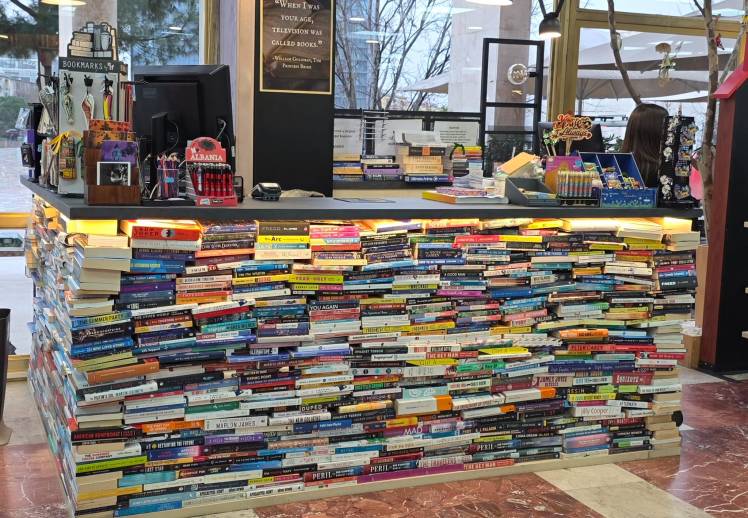
the bookstore’s counter 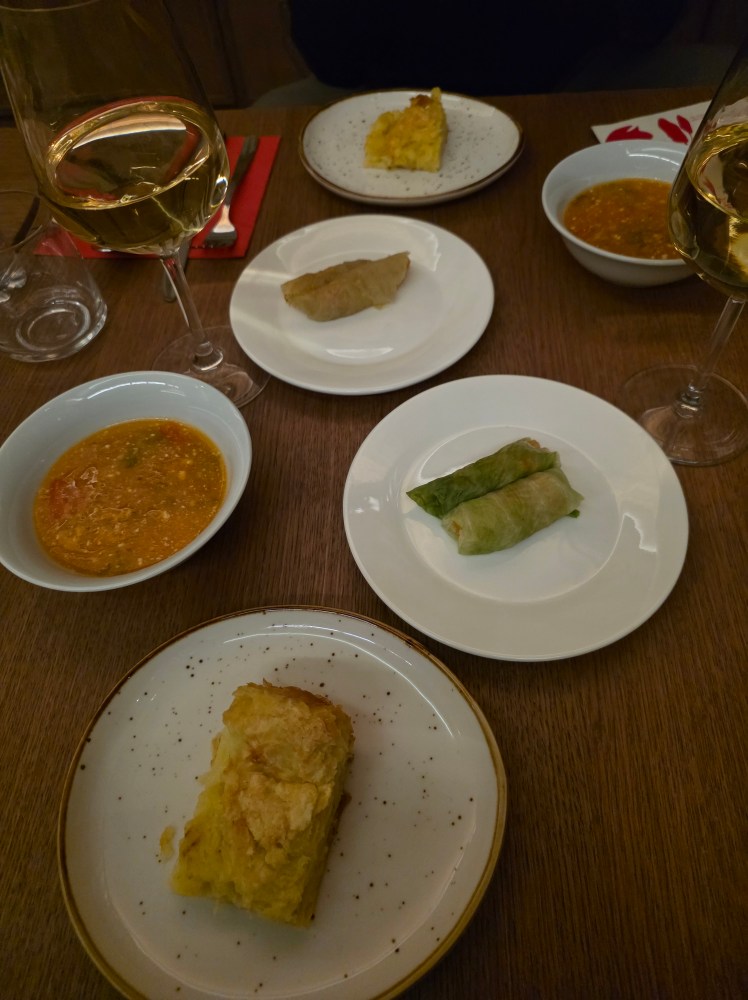
fërgesë, dolima, & byrek 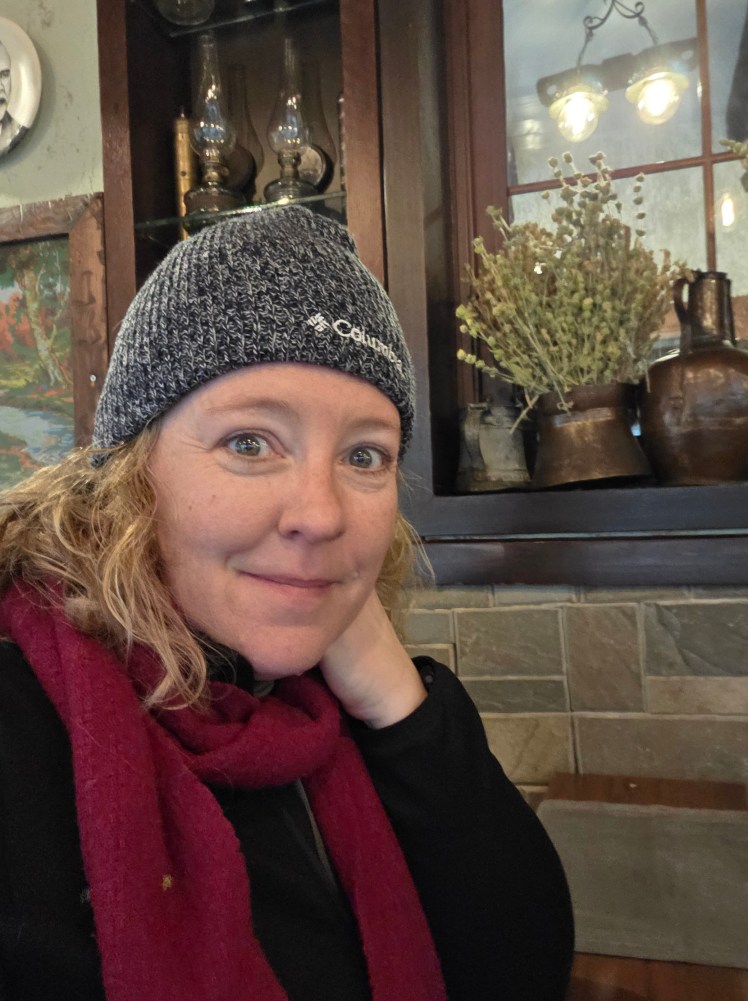
waiting for the rain to pass 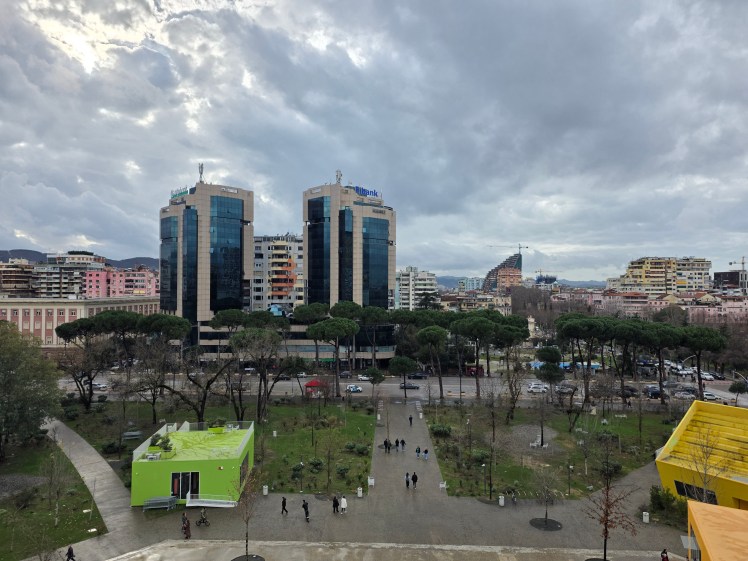
view from the Pyramid of Tirana 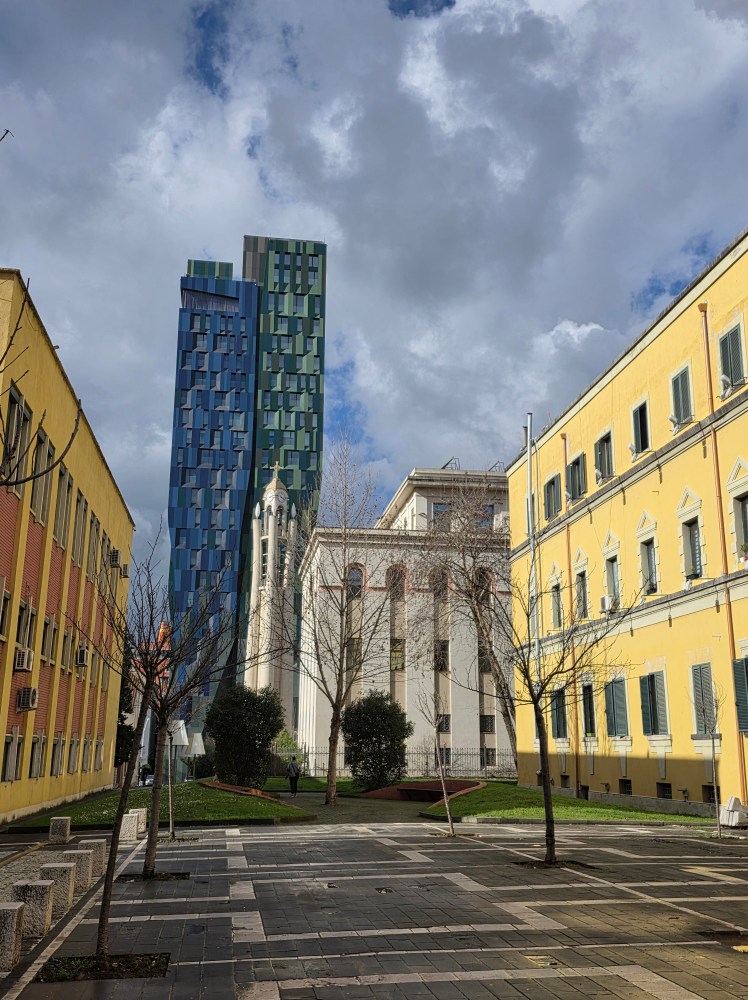
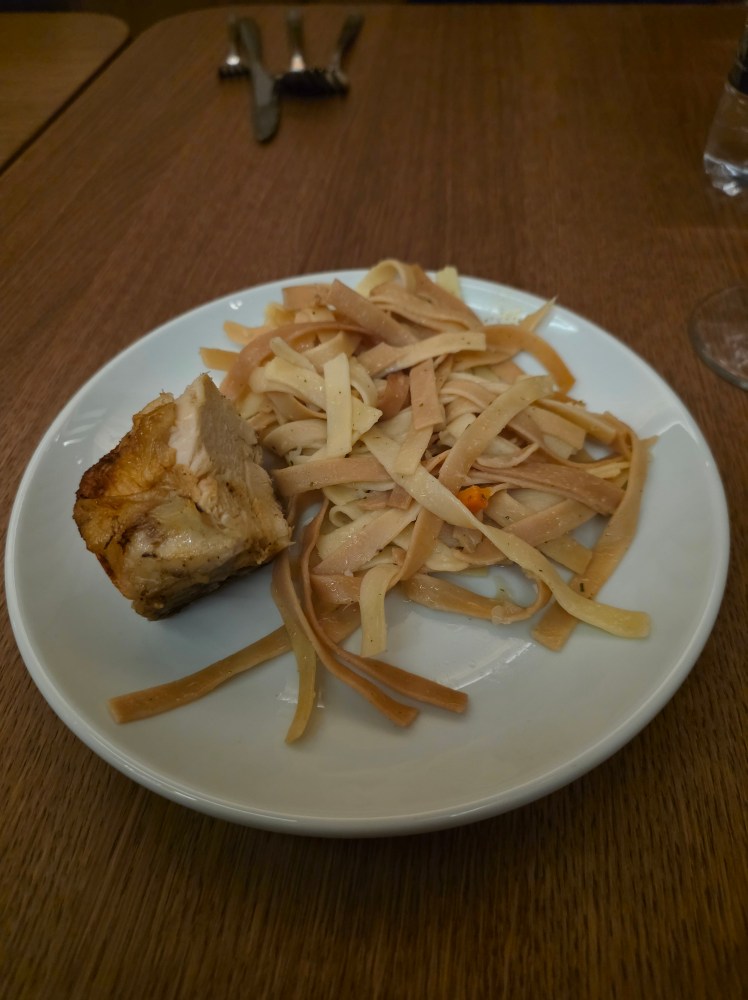
Jufka Dibre me Mish Pule (handmade pasta with chicken) 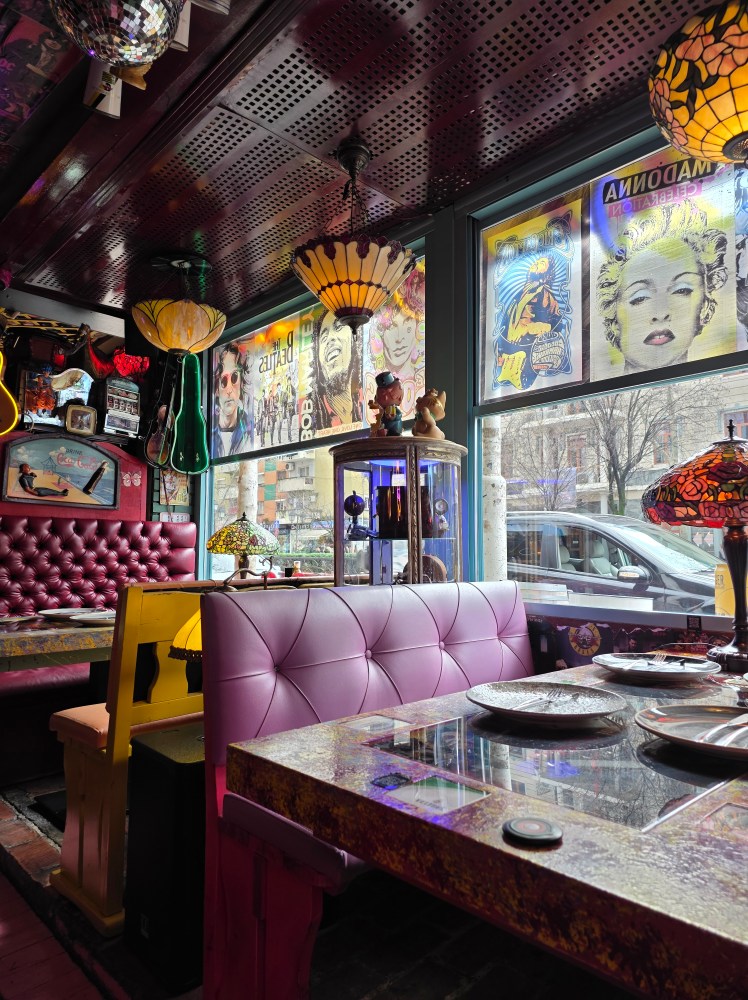
Restorant Tymi 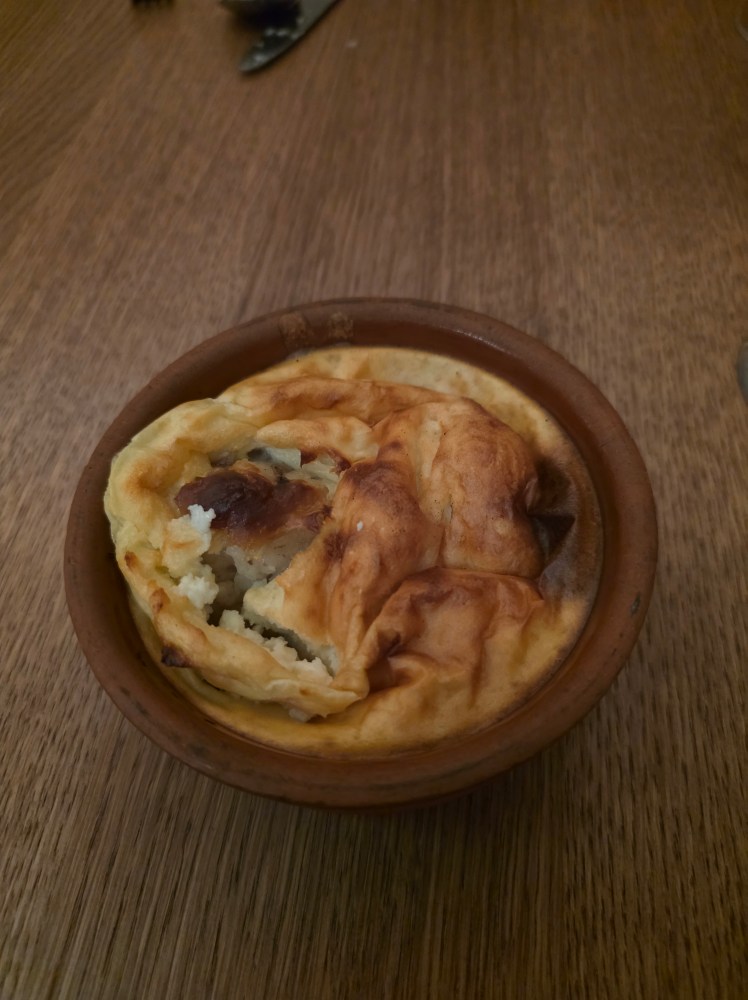
Täve Kosi e Elbasanit 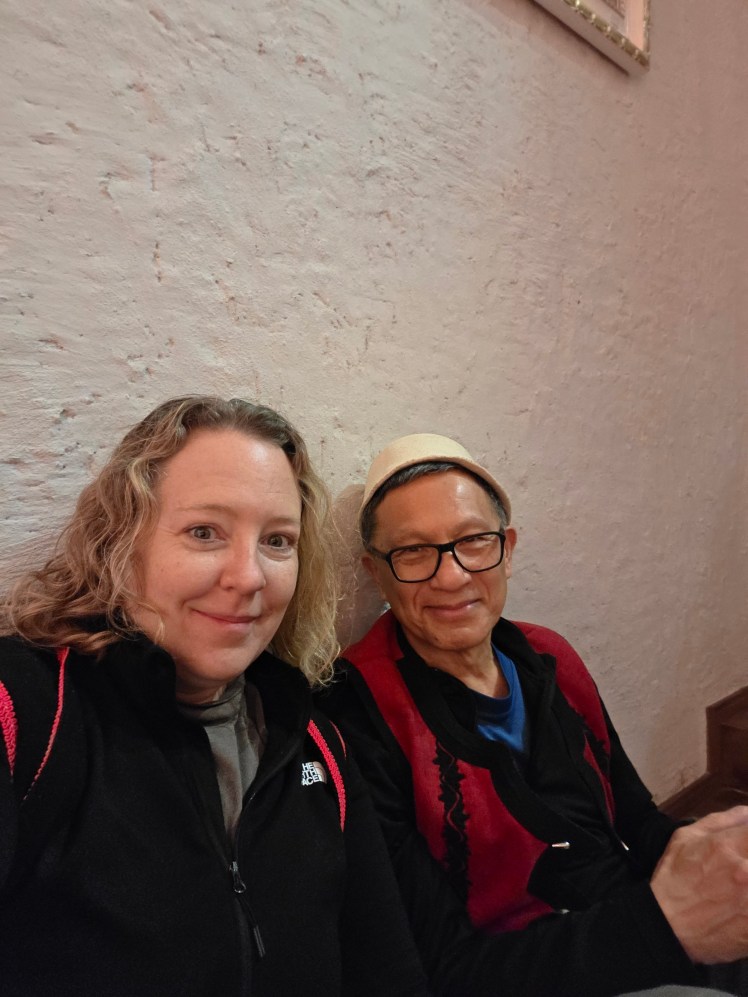
at Albania Night 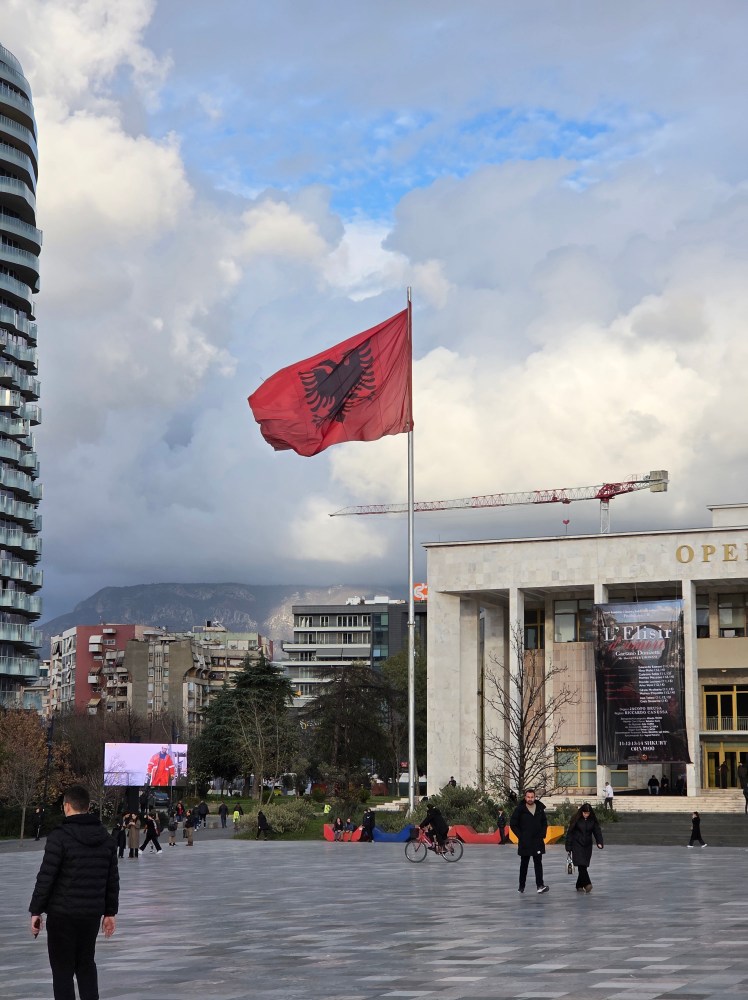
Skanderbeg Square 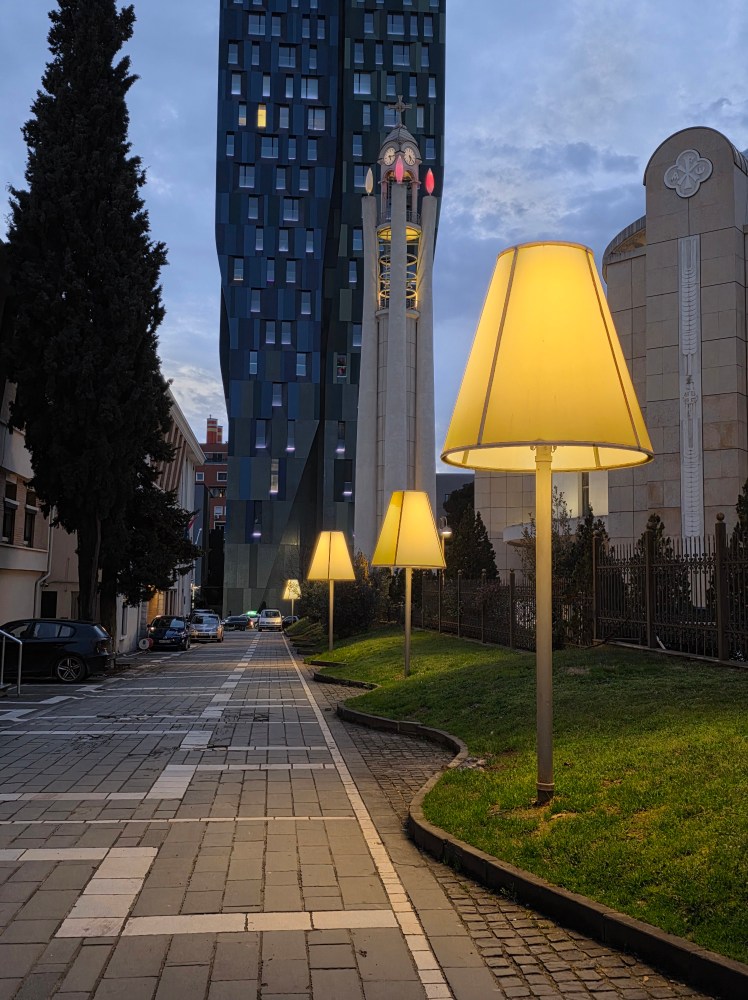
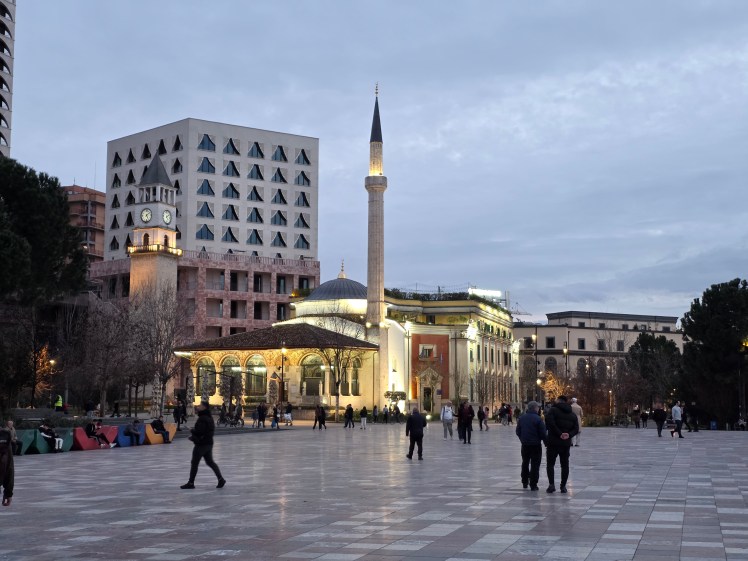
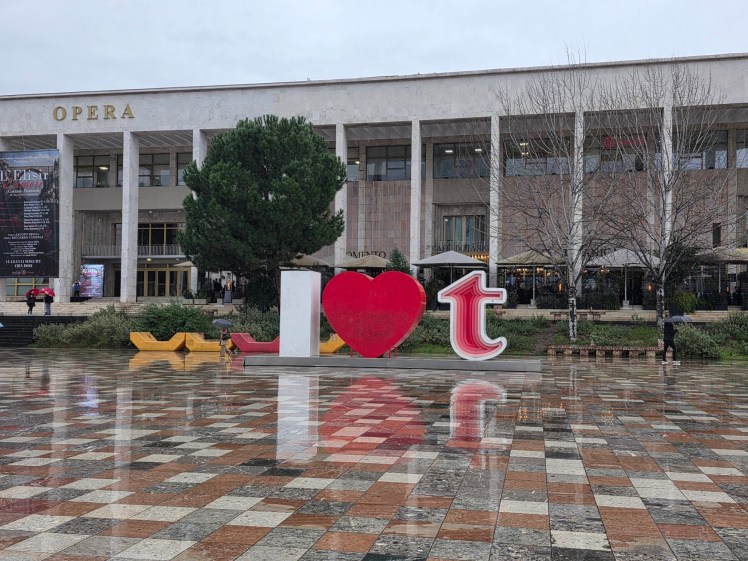
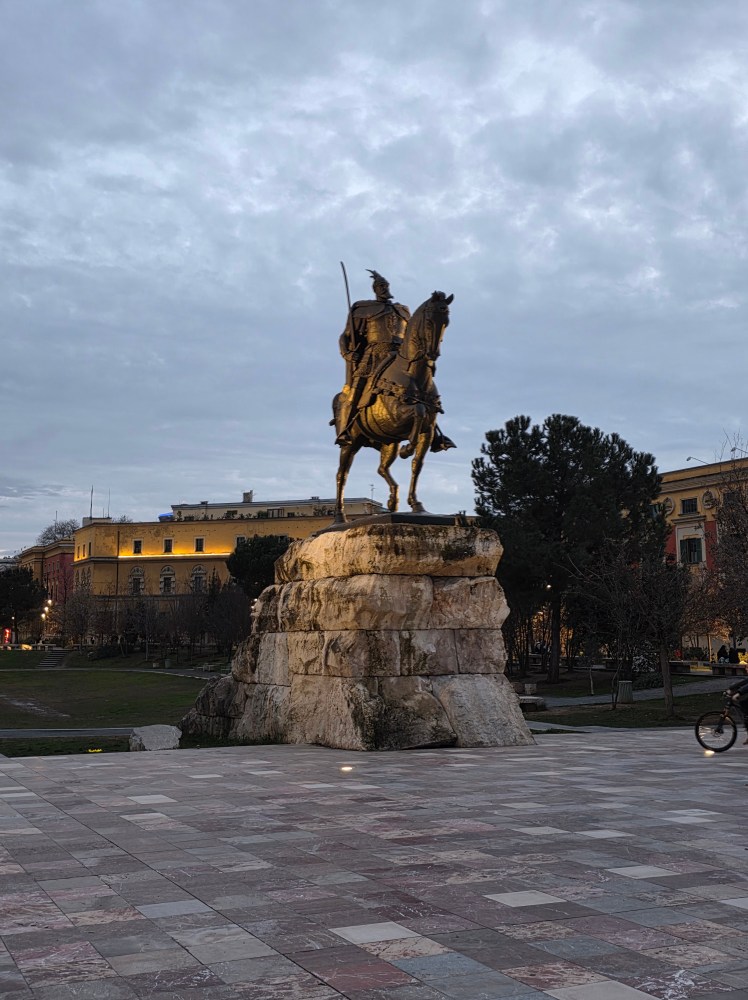
Skanderbeg Square & t 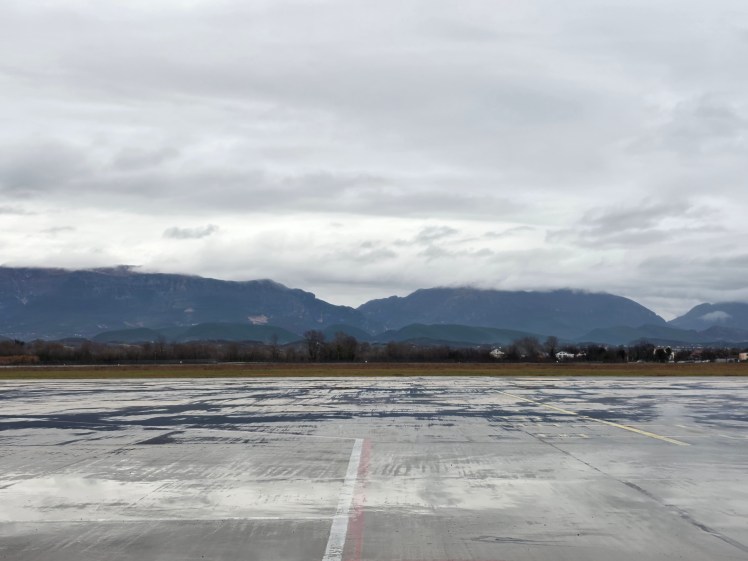
Dajti Mountain range 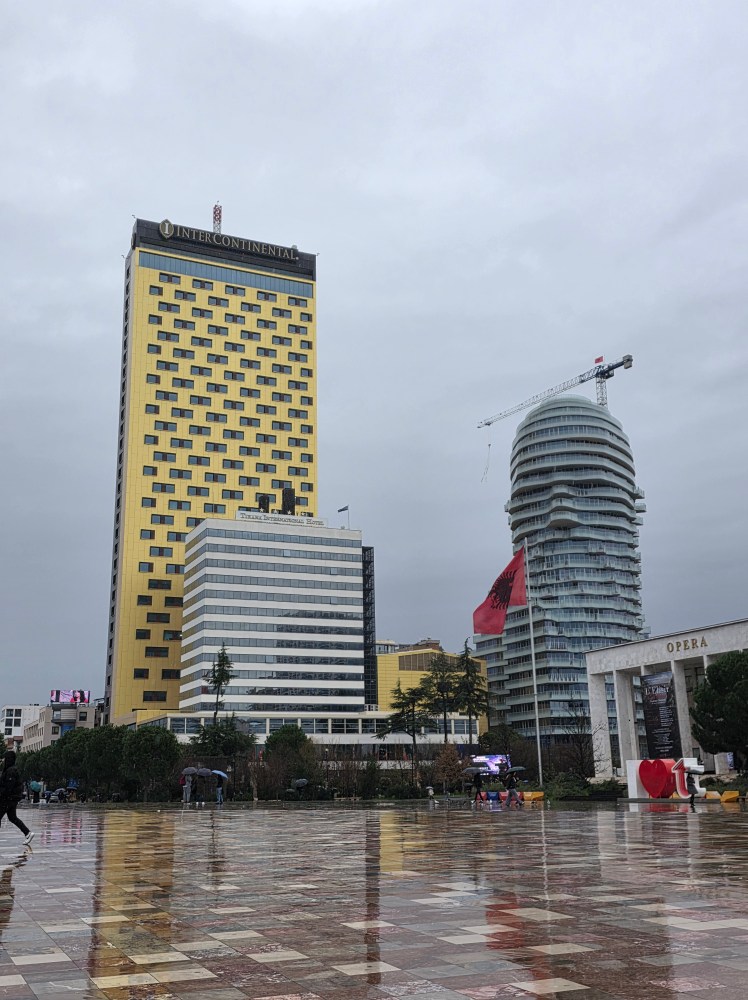
Skanderbeg square & building by the Tirana International 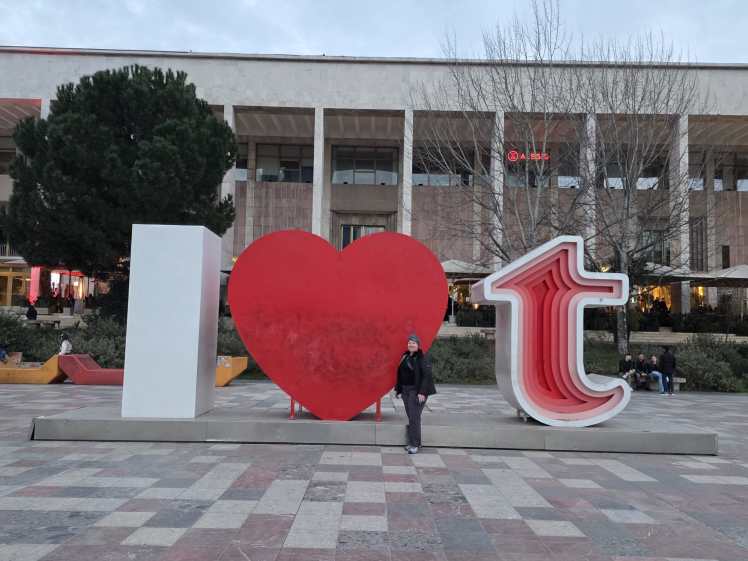
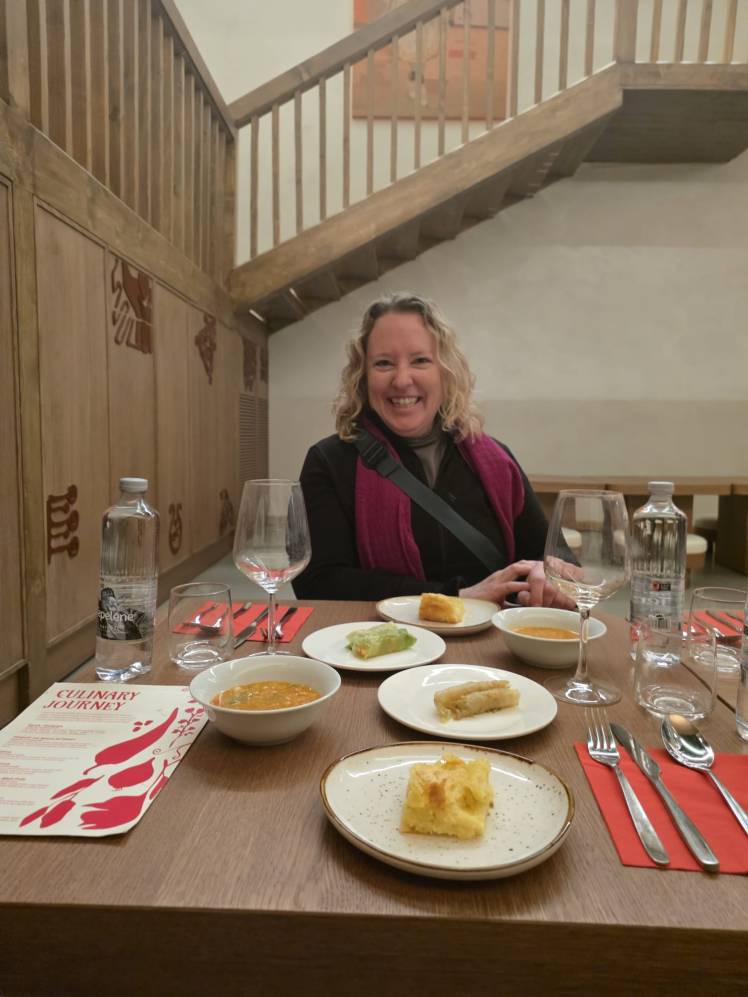
dinner at Albanian Night 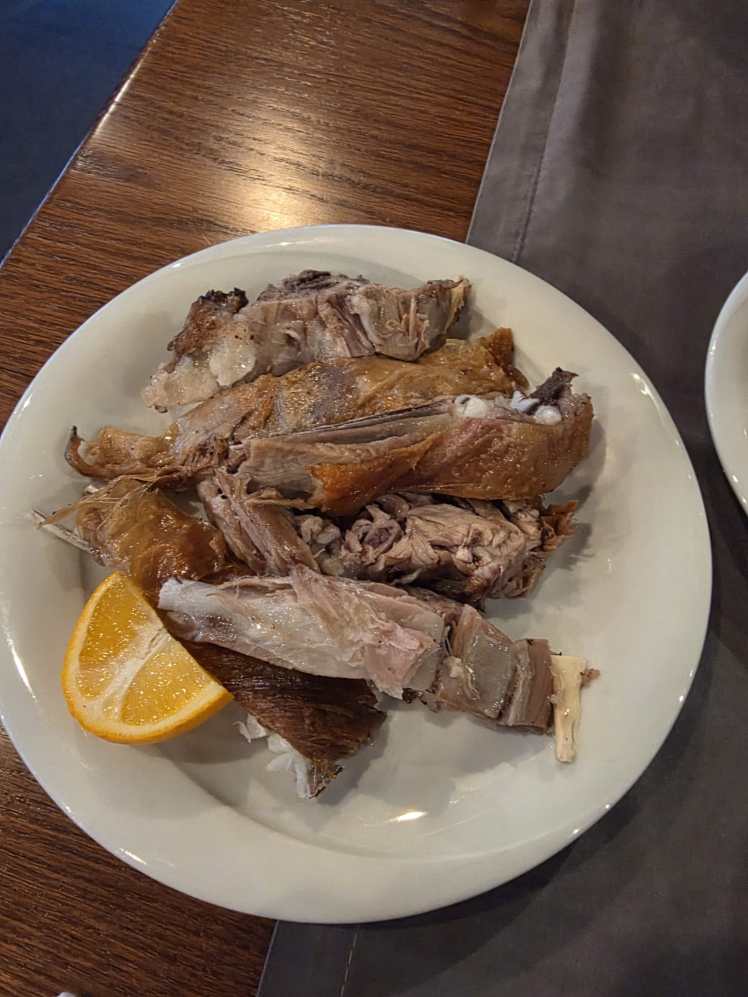
lots of meat 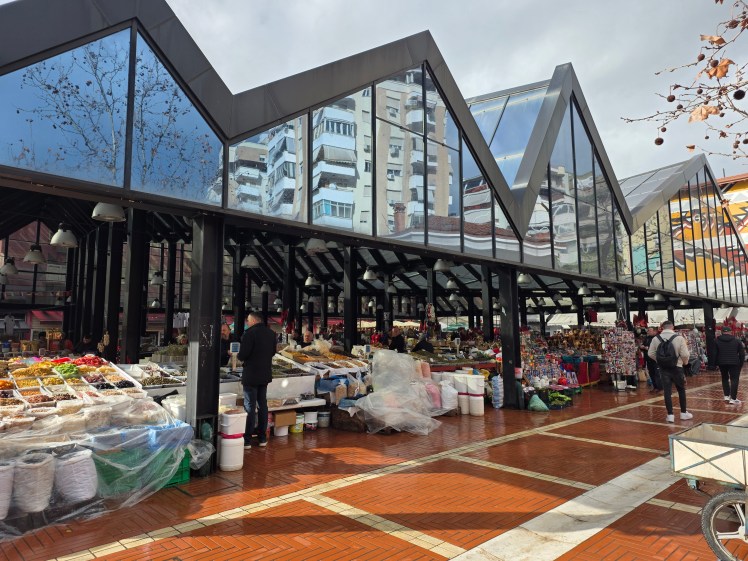
the market 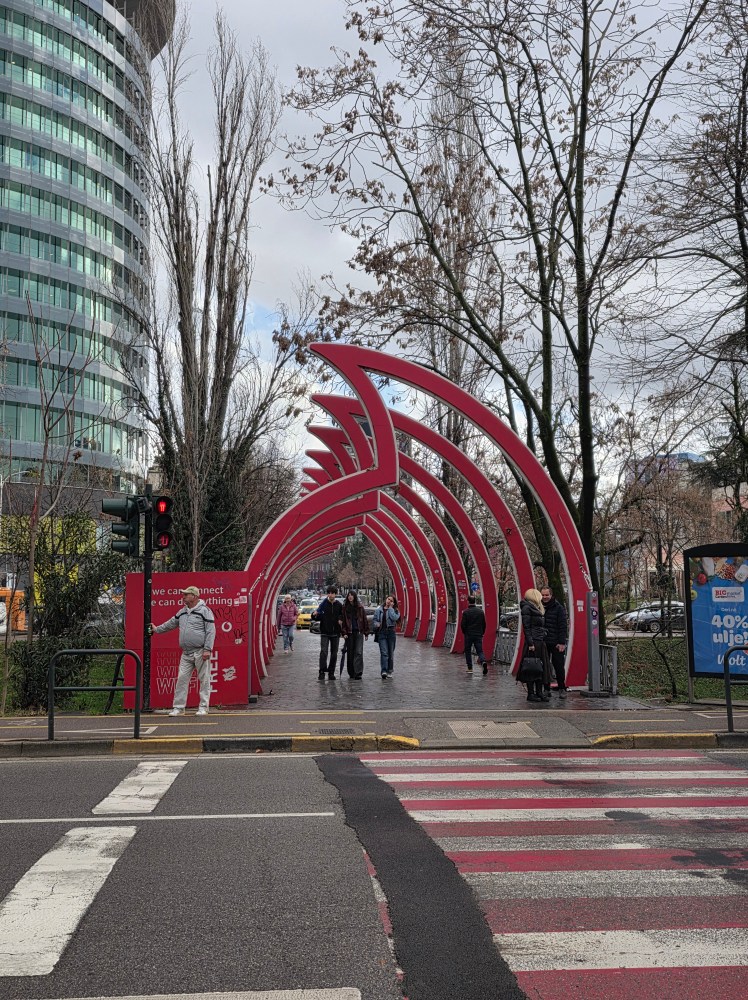
walking around Tirana 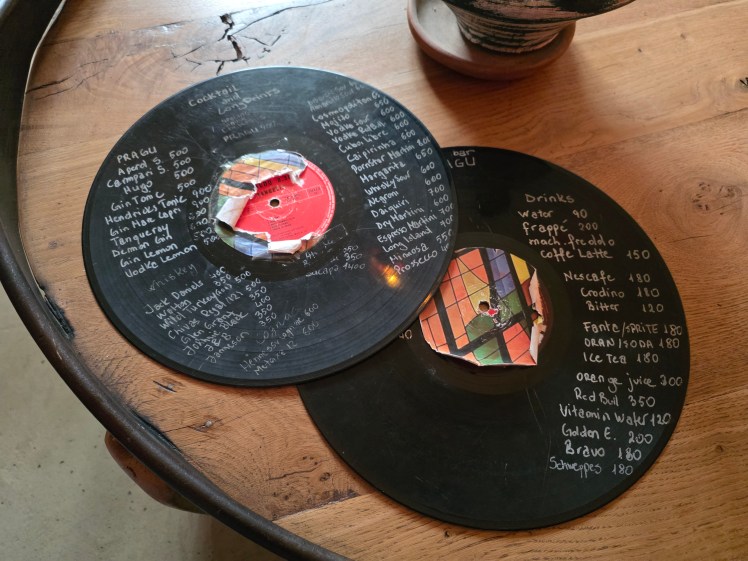
Pragu Bar menu 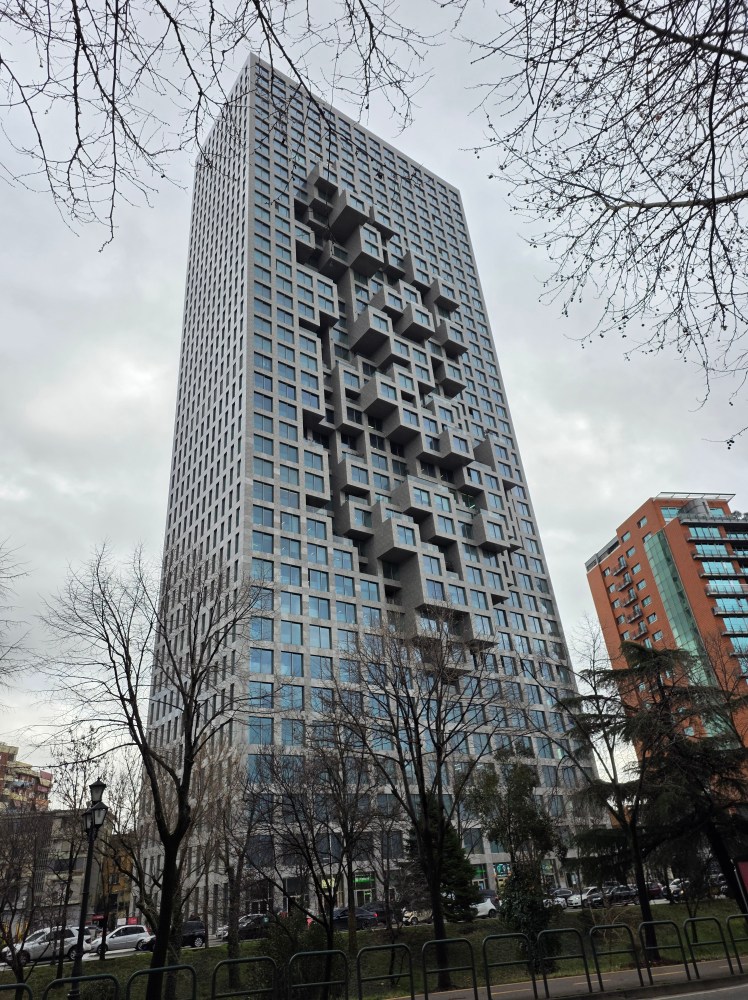
Luckily, the rain stopped right around the time we were finished with lunch, and we headed toward Skanderbeg Square, the main plaza in the centre of the city. It is a huge square surrounded by the National Opera house, the National Library and bookstore (which had English language books too), the Tirana International Hotel, the Palace of Culture, the Bank of Albania, the Ethem Bey Mosque, the Clock Tower, the City Hall, several Ministry buildings, and the National Historical Museum, a statue of their national hero Skanderbeg, and an “I [heart] T” sign.
Many of the buildings are interesting architecturally. For example, one of the newer buildings that’s nearly complete, looks like a man’s (Skanderbeg) head.
From there we simply wandered around, enjoying the city. Tirana is known for its cafe culture and I can report that yes, Tirana’s cafe culture is strong. One corner had 4 cafes all sharing a huge outdoor area.
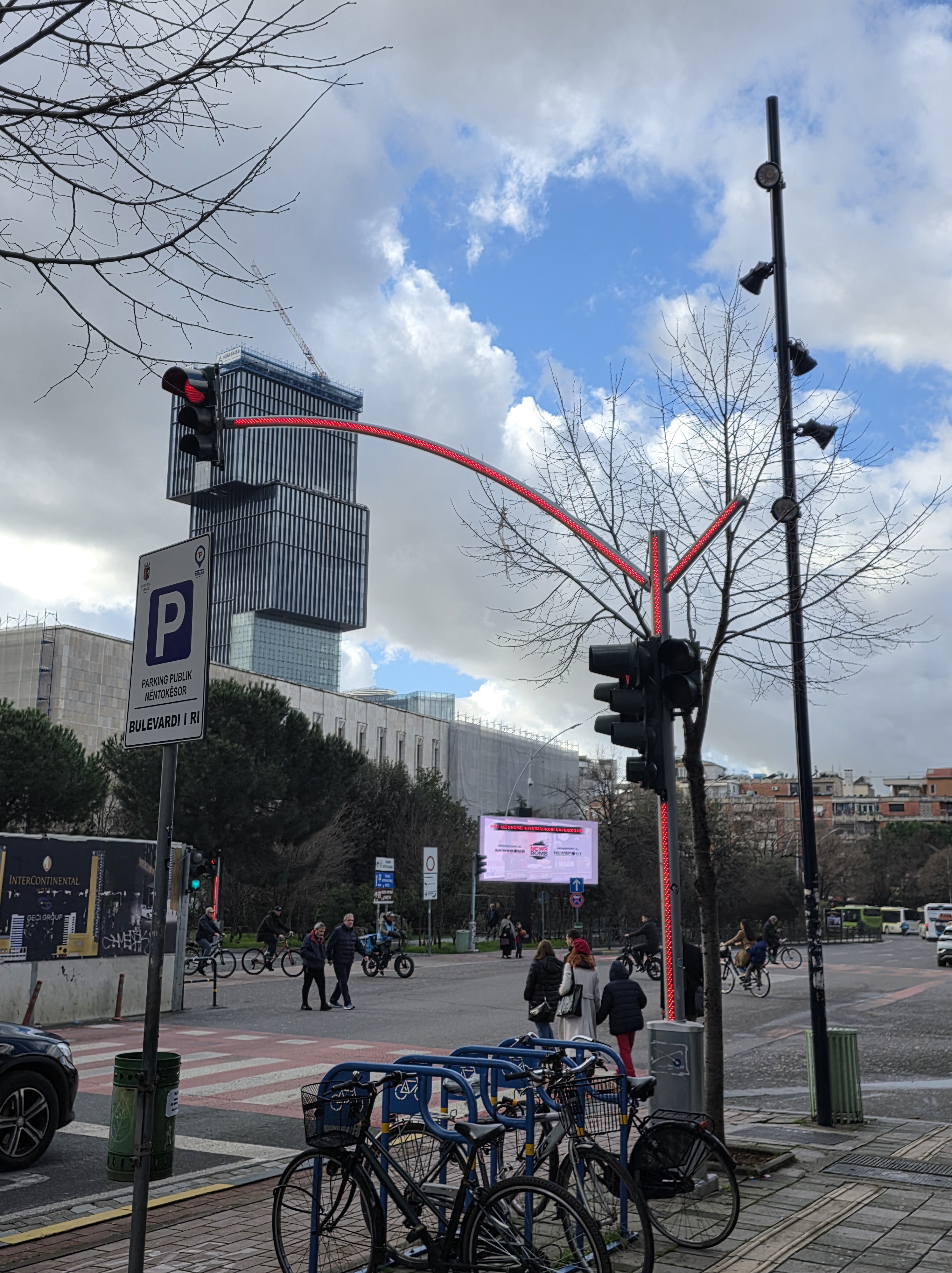
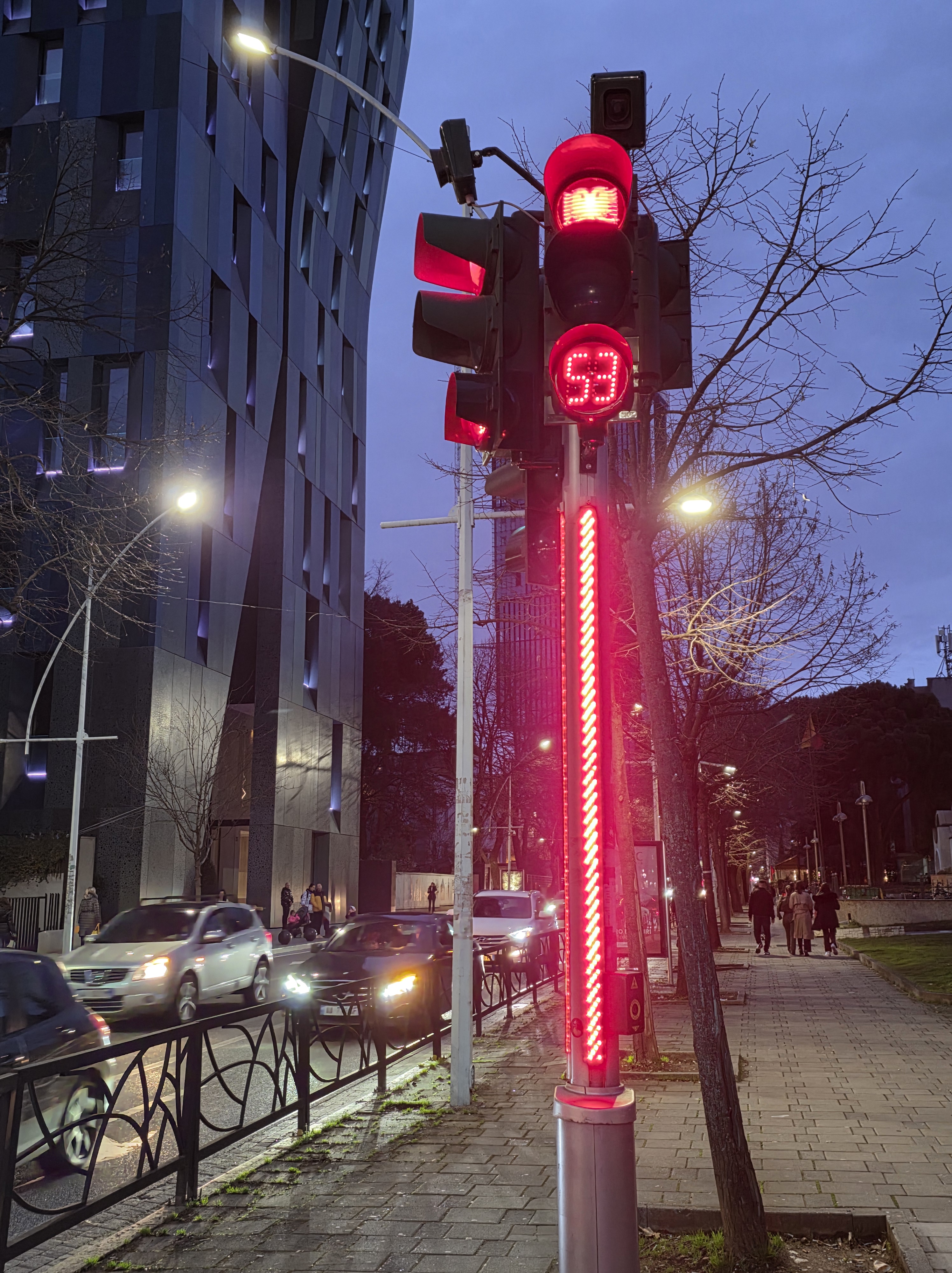
One thing I absolutely loved about Tirana was the traffic lights.
Yes, that sounds like a weird thing to like. But the ENTIRE POLE lit up, which made it so easy to see both for pedestrians, and more importantly, for the drivers. One thing that is always difficult when traveling to new places is seeing the traffic lights. Every city places them in slightly different places. And sometimes, they can be hard to see. Not so in Tirana—there was no mistaking what color the light is.
On Friday eventing, C books us a cultural experience—Albania Night, a traditional dance and music show experience that fully immerses participants in local culture. The show is reenacts a wedding, and showcases traditional garb and dancing of both the southern region and the northern region.
It’s also interactive. First, guests get to dress as Albanian villagers. Some people opted to go full costume. I opted for a vest and C a vest with hat. Then we are escorted into the performance area, which is designed to look like a larger version of someone’s living room. We were told that Albanian culture is big on hospitality and that we were all guests of the family. So as guests, we sat on cushions on the floor and the show started.
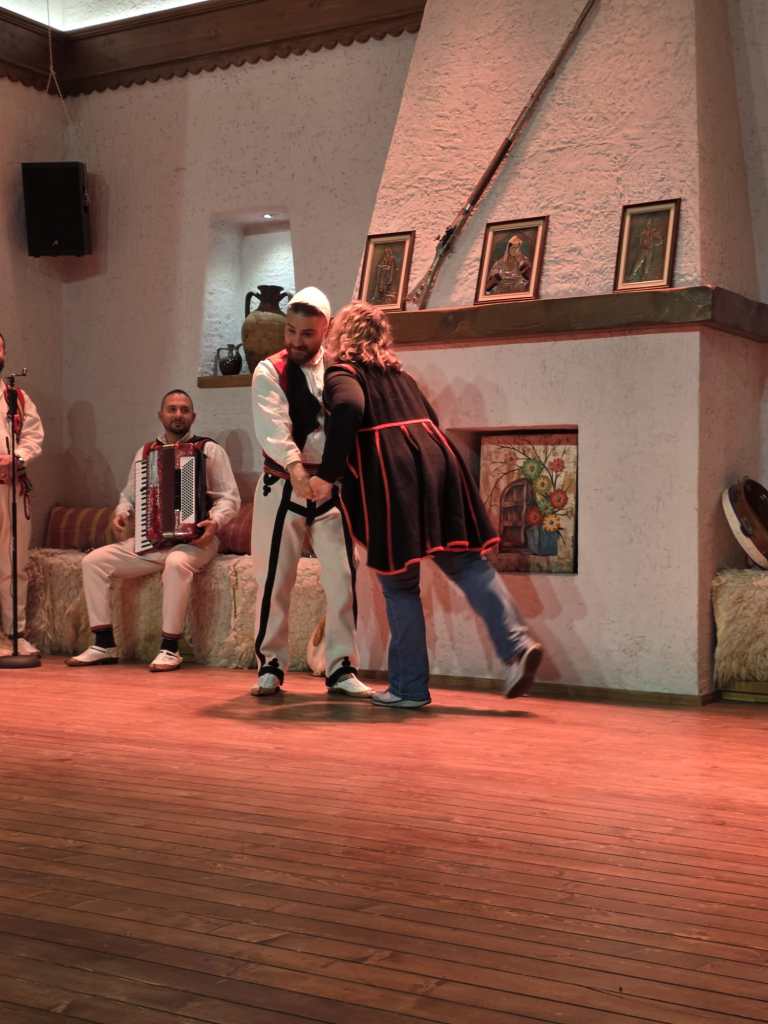
my Albanian stage debutBut wait, I said interactive. That’s right. The narrator, who’s the father of the groom, interacts with the guests. And during the wedding, guests can get up and join the family in the traditional dance, which I did.
But I unbeknownst, I would have another “part” to play. Right after I donned the vest, one of the performers came up to me to introduce himself. He asked me on a scale of 1 to 10 how much I laughed. I said, of course, 10. I didn’t know it then, but I had been “chosen” to participate.
The show is designed to exhibit Albanian culture, from joy to sorrow. And it was a little cheeky. One of the gags throughout was that the narrator (father of the groom) and his wife (mother of the groom) had had an arranged marriage and their son (the groom) had taken 3 years to be born because the father had been away and when he came back, his wife was pregnant. So, the narrator kept yelling at one of the guests, a man named Marc from Germany, to stop staring at his wife. And he kept “flirting” with me throughout the show. Then near the end of the show, the narrator brought me up on stage. That’s right, I had my Albania stage debut.
After the show, those who opted for the dinner where then escorted to a different room that was designed to look like a larger version of a family dining room. We had an 8-course meal of traditional Albania food. My favorites were byrek and qofte korçe.
On Saturday, we continued exploring the city, starting with the market. We ate lunch at Restorant Tymi, a popular restaurant full of pop culture posters, signs, and trinkets that’s known for traditional Albanian dishes and beers. I had an absolutely delicious salad and kebabs.
We continued our walk and ended the day with nearly 25,000 steps. We basically saw the same things we had seen on Friday because Tirana, at least the older part where the sights are, isn’t that big. But we stopped along the way for cafes and treats. We stopped at for drinks at Pragu Bar, where the menu is written on old vinyl records. C tried raki, the traditional clear grape-based brandy, which comes in flavors, so of course, he got more than one. I had one of the bar’s craft cocktails. Then we ate dinner another popular restaurant, EOS Mezze Bar, where they serve traditional Albanian food tapas style. So we got to try more delicious traditional food.
Sunday, we said “Mirupafshim” (goodbye) to Tirana and headed to the airport and back to Napoli.
Final Thoughts
I found two nights in Tirana were more than sufficient to see the city. Tirana is definitely an up and coming city with lots of interesting architecture. While the scars of communism still exist, Tirana didn’t have the heavy defeated vibe that Bucharest had, but had a more hopeful, upbeat vibe. While the city was interesting and I’m glad I visited, I doubt I’ll return as there’s just not that much to do in the city itself. I will, however, check out other parts of Albania, including its coast, which is supposed to have some fairly good and not crowded beaches.
Where am I going in this month (in 17 days, in fact)? Stay tuned to find out!
All content, including photos, © 2026 L. Long/wanderinglynn.com. All Rights Reserved. No part of this website or its contents may be reproduced, copied, modified, or adapted without prior written consent of the owner.
All links are merely for reference and/or for your convenience.
 wanderinglynn.com