Happy Banned Books Week!

Banned Books Week highlights the freedom to seek and to express ideas. As an avid reader, I celebrate banned books week each year by reading at least one book that has been challenged in an effort to remove or restrict access to that book.
And trust me, if you haven’t checked, there are a lot of books on the banned and challenged list.
A lot.
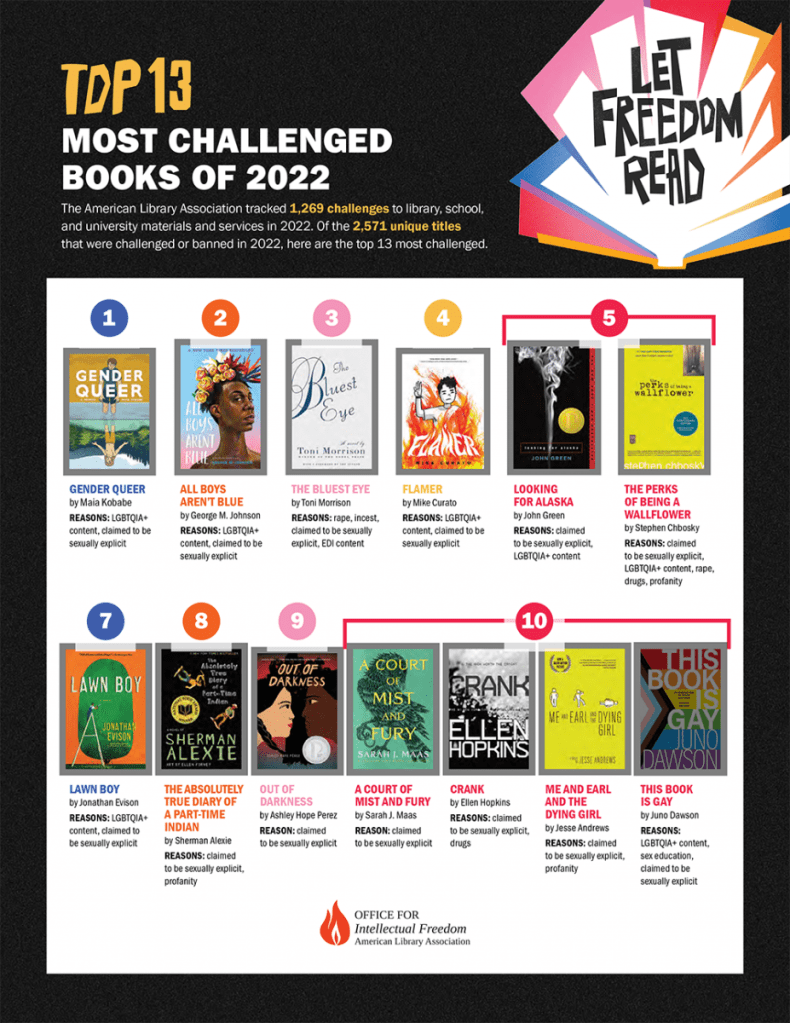
In 2022, the American Library Association (ALA), which hosts Banned Books Week, documented 1,269 demands to censor library books and resources. This was the highest number of attempted book bans since ALA began compiling data about censorship in libraries and nearly doubled the 729 book challenges reported in 2021.
And unfortunately, 2023 is shaping up to beat 2022. ALA’s Preliminary data shows a 20% increase in challenges for the period between 1 January and 31 August 2023.
Most frequently targeted are books written by or about members of the LGBTQIA+ community, Black people, Indigenous people, and people of color. Books written by minority voices are exactly the ones that need to be heard, need to be seen, and deserve a platform to share their stories.
(And I won’t even get into the challenges that minority voices have in even getting their stories published in the first place.)
Banned Books Week normally takes place the last week of September, but this year it’s the first week of October.
I have a little Spooktober Puzzle Challenge going this month, where I have 16 Halloween-themed puzzles set aside to complete (you can see all my puzzles on my Instagram).
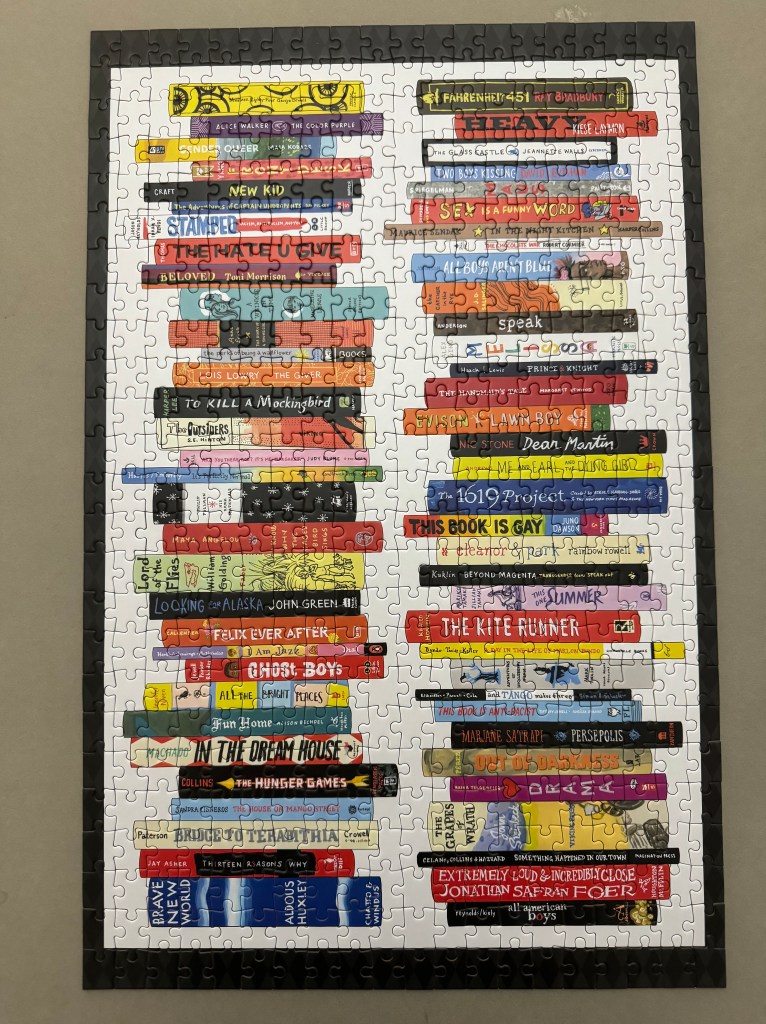
But I took some time out this evening to do my Banned Books Bibliophile puzzle.
Although . . . now that I think about it, this might be the scariest puzzle I do all month.
This 500 piece puzzle, art by Jane Mount and published by Chronicle Books, features 66 books, new and old, fiction and non-fiction, that have been challenged. And Chronicle Books is donating a percentage of profits from this puzzle to PEN America, which stands at the intersection of literature and human rights to protect free expression in the United States and worldwide. Its mission is to unite writers and their allies to celebrate creative expression and defend the liberties that make it possible.
Some of my favorite books, including The Perks of Being a Wallflower, The Hunger Games, and I Know Why the Cage Bird Sings, have been challenged. Why? Because:
- Wallflower: drugs/alcohol/smoking, homosexuality, offensive language, sexually explicit/nudity, unsuited for age group, anti-family, religious viewpoint, suicide
- Games: religious viewpoint, unsuited to age group, anti-ethnic, anti-family, insensitivity, offensive language, occult/satanic, violence
- Sings: sexually explicit, offensive language, sexually explicit, racism
Personally, I love that someone challenge Maya Angelou’s book because of racism. That might be the bestest worst reason ever. I can only assume that some of these troglodytes people who submit these challenges live in some sort of weird Twilight Zone, Pleasantville, idealized bubble where nothing bad ever happens and firefighters only ever rescue cats from trees. Because that’s the only explanation I can come up with.
So let’s fight censorship and celebrate banned books!
Celebrate diverse voices.
Celebrate the freedom to read.
And go read a banned book this week.
I promise, you will be able to find at least 1 book on the list that’s likely already on your TBR. Check out the ALA’s Top 10 Banned Books by Year. And here’s my Bookshop.org shelf of banned books.
Happy (banned book) Reading!
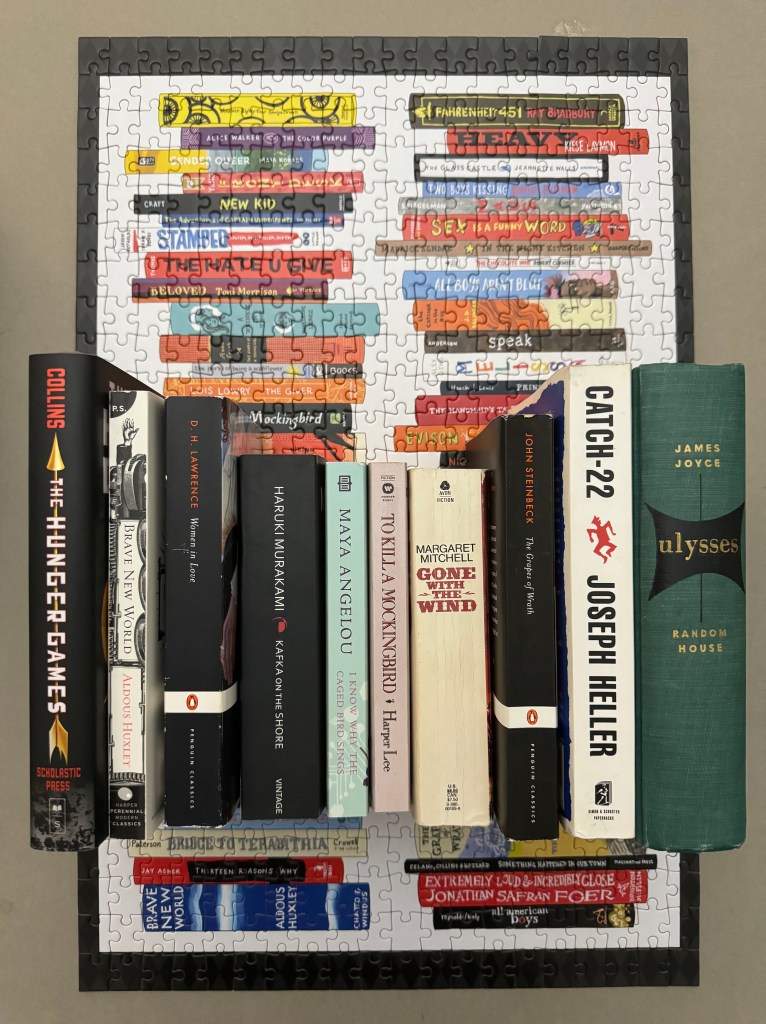
some of my banned books wanderinglynn.com
This is such an interesting (albeit disheartening) post, Lynn. As a university lecturer in US constitutional law, this is something that I still find hard to explain.
Why do you think some people, in modern day USA, want to ban books? In a country where the First Amendment is predicated on the free marketplace of ideas and where even hate speech (hey, even holocaust denial) is considered protected speech, why do you think some interest groups seek (and are allowed to) ban some books completely, from that very marketplace of idea so cherished under other (usually not LGBTQI+ related) circumstances?
LikeLike
I wish I could explain it. And I wish I understood this recent uptick in challenges in the last couple of years. Maybe it’s some psychological need to control the narrative. It seems that despite being able to access even more information today, despite being able to instantly connect with people from all over the world, some seem intent on continuing to put up walls, to block access to learning unless it is learning that fits in their specific narrative (which to me, is not learning at all). It is ironic given why the colonists came here to begin with, and yet sadly, America has a long history of suppressing minority/non-white/non-Christian/non-heterosexual voices.
LikeLike
This is such an interesting (albeit disheartening) post, Lynn. As a university lecturer in US constitutional law, this is something that I still find hard to explain.
Why do you think some people, in modern day USA, want to ban books? In a country where the I Amendment is predicated on the free marketplace of ideas and where even hate speech (hey, even holocaust denial) is considered protected speech, why some interest groups seek (and are allowed to) ban some books completely, from that very marketplace of idea so cherished under other (usually not LGBTQI+ related) circumstances.
LikeLike