I love to randomly meet fellow booknerds and have a booktastic conversation. I attended a work conference this week and randomly met such a fellow booknerd. I don’t even remember how the conversation got started but once we identified as fellow booknerds, we had great book discussions and shared some fave reads.In particular, I shared several fave Science Fiction (SciFi or SF) reads.
SciFi is one of my favorite genres (along with fantasy, urban fantasy, and paranormal). Consider a sub-genre of speculative fiction, SF typically deals with imaginative and futuristic concepts, such as advanced science and technology, space exploration, time travel, parallel universes, extraterrestrial life. And like many genres, there is discussion on what classifies a book SciFi.
Issac Asimov said, “Science fiction can be defined as that branch of literature which deals with the reaction of human beings to changes in science and technology.” Robert A. Heinlein wrote “[a] handy short definition of almost all science fiction might read: realistic speculation about possible future events, based solidly on adequate knowledge of the real world, past and present, and on a thorough understanding of the nature and significance of the scientific method.”
But since there are no limits to changes in science or tech, there’s really no limit to what SF is or can be.
Even more fun, there are sub-genres of SF. (But since I already pointed out that SF already is a sub-genre, maybe this should be SF sub-sub-genres?) Regardless, BookRiot did a nice job of discussing some of SF’s sub-genres (or sub-sub-genres), so I won’t further delve into the SF sub-sub-genre rabbit hole.
SF also has its own literary awards—the Hugo Awards and the Nebula Awards. The Hugos are given annually for the best science fiction or fantasy works and achievements, including illustration, of the previous year. Presented at the World Science Fiction Convention, the awards are chosen by the World Science Fiction Society members. Named after Hugo Gernsback, the founder of the pioneering science fiction magazine Amazing Stories, the first Hugos were given in 1953, and have been awarded every year since 1955. The Nebulas are organized and awarded by the Science Fiction and Fantasy Writers Association (SFWA). First given in 1966, the Nebulas annually recognize the best works of science fiction or fantasy published in the United States.
Now, in no particular order, my 7 Must-Read SciFi Books and find all of my 7 SF Must Reads on Bookshop.org
Way Station by Clifford D. Simak

Way Station was published in 1963 and won the 1964 Hugo Award. It is about Enoch, the last veteran of the American Civil War who, for close to a century, has operated a secret way station for aliens passing through on journeys to other stars. But as Enoch studies the progress of Earth and tends the tanks where the aliens appear, the charts he made indicate humanity’s impending destruction. Enoch’s alien friends can only offer help that seems worse than the dreaded disaster.
For a book only a bit over 200 pages, there’s a lot packed into this story. Simak speaks to larger issues such as conflict, loneliness, and humanity. This story was ahead of its time, and it’s easy to see how this book influenced SF, including Dr. Who and Star Trek. So much packed into one little book!
I also picked this book for my list because Simak is not as well known today as some other classic SF writers, like H.G. Wells (The Time Machine, War of the Worlds), Heinlein (Stranger in the Strange Land, Starship Troopers), or Asimov (I, Robot, Foundation). Simak also won two other Hugo Awards and one Nebula Award, and the SFWA made him its third Grand Master. So Simak is a must-read SF author.
Starter Villain by John Scalzi
Anyone who knows me knows that Scalzi is one of my auto-buy authors. (For those not familiar with the term, “auto-buy” means the minute I learn a new book is coming out by one of my auto-buy authors, I immediately pre-order it. I don’t even need to know the title, much less what it’s about. I just order it.) So when I learned that Starter Villain was coming out this September, I couldn’t wait. And then I saw the cover and I really couldn’t wait. And when it finally arrived, I read it in one sitting.

Starter Villain is about down-on-his-luck Charlie, who learns his long-lost uncle Jake has left his supervillain business (complete with island volcano lair) to Charlie. But Charlie soon learns that becoming a supervillain isn’t all giant laser death rays and lava pits because Jake had enemies, and now they’re coming after Charlie. So it’s up to Charlie to win the war his uncle started against a league of supervillains.
From the synopsis, this might not seem that SF, especially when compared to Scalzi’s other works (Old Man’s War, Agent to the Stars). But this book has foul-mouthed unionized dolphins and hyper-intelligent talking spy cats. This is Chuck Bartowski (without the Intersect) meets Gru. Add to that great character development, excellent world building, and fast pace fun all while satirizing capitalism, and how can you not be checking it out right now?
And trust me when I say the cats are the best part.
I‘m a cat, I can handle risk. Worst-case scenario is I lose everything and I still get fed and have a place to nap. . . . Sometimes it‘s better not to be a human, Charlie.
Hera the Cat
All Systems Red by Martha Wells

All Systems Red focuses on a self-aware SecUnit that has hacked its own governor module and refers to itself (though never out loud) as “Murderbot.” Scornful of humans, all it really wants is to be left alone long enough to figure out who it is. But instead, it is currently stationed on a distant planet to protect a team of scientists. When a neighboring mission goes dark, it’s up to the scientists and Murderbot to get to the truth.
In only 149 pages, Wells has created an incredible character. And she wrote the story in first person point-of-view (POV) no less. This book centers on the underlying human question of “who am I?” Add in the set-up, the tension, the conflict—this novella is a masterclass in writing. Simply brilliant.
I warn you now, this is only book 1 in the Murderbot Diary series, and once you read this one, you will immediately want the rest. So plan accordingly. The series is composed of 2 short stories (you do not need to read these to understand the series), 5 novellas (which are the first 5 books), and 2 full length novels (book 7 will be released in November). But if you want to read the series in chronological order, you should start with the short story Compulsory, which was published on Wired.com in 2018. It is also available on Kindle.
Recursion by Blake Crouch
The time present of things past is memory; the time present of things present is direct experience; the time present of things future is expectation.
St. Augustine

Recursion starts off describing an epidemic that spreads through no known means, driving its victims mad with memories of a life they never lived. But it’s not caused by a pathogen and what’s in jeopardy is not our minds but the very fabric of time itself. In New York City, Detective Barry Sutton is closing in on the truth, and in a remote laboratory, neuroscientist Helena Smith is unaware that she alone holds the key to this mystery.
This trippy story is like being in an episode of the Twilight Zone! While I was initially hesitant because the synopsis didn’t quite engage me, I picked it up because it was recommended to me as one of my 12 months, 12 books, 12 friends challenge. So I started the book and surprisingly, found myself quickly getting lost in the story. I couldn’t put it down. It’s a crazy blend of science fiction and adventure-thriller with a slice of romance.
Life can only be understood backwards, but it must be lived forwards.
Soren Kierkegaard
Broken into 5 books, the story flips between Helena’s and Barry’s POVs, between different times and alternative timelines. I listened to the audiobook and Jon Lindstrom and Abby Craden did a fantastic job narrating the dual POVs.
Since I was listening to the audiobook and was doing other things (like puzzling), I would think the story was about to conclude and BAM! Another twist. Another angle. Right up until the end, I was hooked. I wasn’t sure Crouch was going to be able to pull it off, but he did. It made me question everything and now I want to go back and reread all the philosophy books I read in college.
The Ones We’re Meant to Find by Joan He
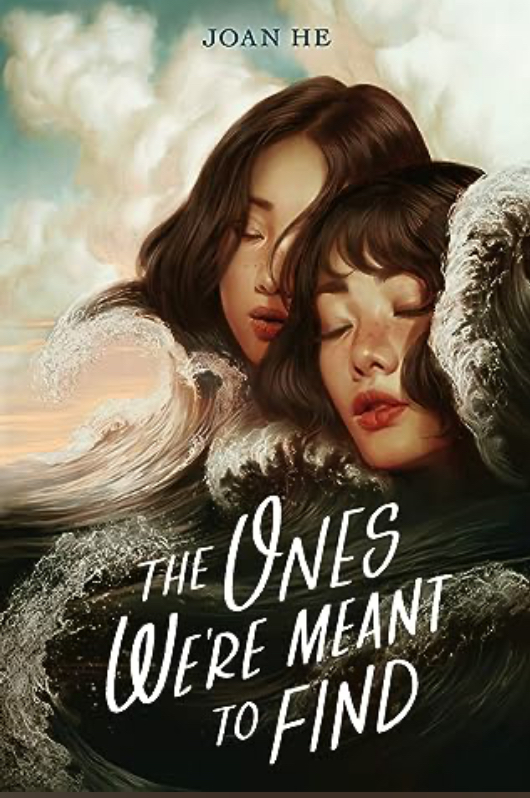
The Ones We’re Meant to Find is set in a climate critical future Earth and is about 2 sisters—Cee, who awoke on an abandoned island three years ago with no idea of how she was marooned and only a single memory that she has a sister and Cee needs to find her, and STEM-prodigy Kasey, who wants escape from the science and home she once trusted.
I normally wouldn’t have picked up this book because it’s labeled as “YA” and I have lots of thoughts about YA. I got it in a book subscription box, and then it sat on my shelf for nearly nine months. I finally picked it up because of a reading challenge . . . and I couldn’t put it down.
While I started this book a bit hesitantly, I quickly became intrigued in the alternating storylines—Cee’s (written in first person) and Kasey’s (written in third person). And I didn’t even pick up on the first POV versus third POV, until chapter 8, when I also realized that Kasey’s chapter numbers were written natural numbers and Cee’s were in hashmarks.
The world building is a complex and arduous exploration of a world that’s too close in one way, and yet divergent in others from our own reality. It is a world that is difficult to feel comfortable with and yet transfixes. As I finished the book, part of me wondered what the heck I had just read. While a kind of dystopian SciFi story, at it’s core, I think this is a more philosophical work questioning what we owe each other. Asking tough questions about freedom to live as one chooses versus living for the collective good, about international harm versus societal good, and even about what makes a human human. And yet, this is also a story about a individuals, their journey of discovering who they are and what it means to be family. About the bond between sisters and finding commonality beyond DNA, about each exploring differing world views through the lens of the other. Two sisters who seem quite different, who see the differences and each feel less, and yet. . .
Logic ended where love began.
Joan He
Star Splitter by Matthew J. Kirby

In Star Splitter, Jessica Mathers wakes up in a lander that’s crashed onto the surface of Carver 1061c, a desolate, post-extinction planet fourteen light-years from Earth, and the planet she was supposed to be viewing from a ship orbiting far above. The corridors of the empty lander are covered in bloody hand prints; the machines are silent and dark. And outside, in the alien dirt, there are fresh graves carefully marked with names she doesn’t recognize.
This book explores the concept of what makes us who we are. In this world, teleportation goes beyond the Star Trek “beam me up” to the idea that people are more than the physical body and therefore, one’s “essence” or “data” can be put into another 3D-printed version of you, but a body that could be millions, billions, or even more miles away.
Kirby has created a set of limitations and rules on what can and can’t be done (the science) and what should be and shouldn’t be done (the ethics) regarding this form of space travel. And yet he does in in such a way that isn’t overly technical. The story is told in a dual timeline—DS Theseus (before) and Hades (after). And the dual timeline is really well-done and adds so much to how the story unfolds.
Even though this book is also labeled as YA (because the protagonist is 17), I don’t consider this a YA story. Mostly because when I read YA, it just makes me feel all of my my middle-aged years. Instead, having a 17-year-old as the MC works here because 17-year-olds are still trying to figure out who they are and are more open to the possibilities with all the philosophical questions that are asked. But I never once felt “old” when reading this story. This is just SciFi at it’s best.
A Long Way to A Small Angry Planet by Becky Chambers

A Long Way to a Small Angry Planet is about a motley crew on a journey through space where one adventurous young explorer discovers the meaning of family in the far reaches of the universe.
I initially put off reading this book. Mainly because so many people recommended it that I feared it wouldn‘t live up to the hype. And a little because you can only read a book for the first time once. But this book is everything I love about sci-fi. Wonderful world-building, excellent character development, intriguing plot, great pacing with the right balance of action and story development. Once I finally picked it up, I couldn’t put it down and finished it within 24 hours.
This book is considered book 1 in the Wayfarers series; however, while all 4 books in the Wayfarers series take place in the same universe and are linked by brief appearances by other characters, each book has its own set of main characters and its own plot. So it can be read as a stand alone.
Honorable Mentions
I can never just name X number of books. There are always more I love.
- HHGTTG by Douglas Adams – by far an absolutely fave. I think I have 4 copies of this book. I will always, always recommend it but since I do always recommend it, I decided not to make it one of these 7.
- #1 In Customer Service: The Complete Adventures of Tom Stranger by Larry Correia – although read by Adam Baldwin and it made me laugh out loud, two reasons I didn’t include this. First, it is 5 short stories. While fun, they are short. Second, and more importantly, this is only an audiobook and only available through Amazon as it is an Audible Original. I don’t judge authors for doing this but I do dislike that Amazon tries to monopolize book publishing.
- Fuzzy Nation byJohn Scalzi and Little Fuzzy by H. Beam Piper – Fuzzy Nation is Scalzi’s reimagining of the Piper’s 1962 Hugo-nominated science fiction novel. Just read them both.
- Just One Damned Thing After Another by Jodi Taylor – is it historical SF? Is it steampunk? I don’t know. I do know that it is a series but I’ve only read the first book. While I liked book 1, I can’t comment on the rest of the series yet (although several of them are currently sitting on my bookshelf staring at me).
What SF books do you recommend? Share your faves in the comments below.
Links to Bookshop.org and Amazon are affiliate links, which means I earn a small, very tiny commission if you use my link to purchase. Honestly, I don’t earn enough to pay for my book habit, much less anything else. But if you want to know more, see my Terms.
 wanderinglynn.com