All everyone sees is the awesome parts of living abroad.
The carefully curated photos with the polished descriptions. The seemingly glamorous life that plays into the romantic idealism and dreams of a living life abroad. I fully own it’s on me for only sharing the awesome bits.
And while there are a lot of awesome parts of living abroad, there are also the not so great bits.
Today’s post is about the not so great bits about living in Italy (and living abroad in general).
When you grow up in America, even if you extensively travel to many destinations, meet all kinds of people, and even if you stay in all sorts of accommodations from 5 star hotels to hostels, from plush beds to sleep bags, in the end, you still return home to America. And with that, there’s a certain expectation of how things work.
When you choose to live abroad, the first thing you have to adapt to is life doesn’t work like it does in America. Even if you’re in England, which for all intents and purposes is where a great deal of what I call the “core” American culture stems from. (I say that because most of America’s founding fathers hailed from England/the United Kingdom or their fathers’ fathers came from there.)
So in efforts to provide a more balanced perspective, here are some of the not so great parts of life abroad.
1. Nothing Is Easy
I was warned before even landing in Italy that nothing is easy here. This is more towards Italy than living in abroad in general. But this can apply in other places, often for difference reasons.
In my experience, I like to call it the domani effect. Domani means tomorrow in Italian. And sometimes it seems like Italians push off worries about problems until tomorrow.
- My household goods arrived (after waiting over two months for them). When can I get them delivered? Oh, not for another two weeks. Domani.
- I must register my car. Oh, first there’s the registration check, which will take 10-12 days. Then there’s another step that will take another week. Then you have to come back to drop off more paperwork. Domani.
- I need to schedule [fill in the blank] as soon as possible. When do you have availability? Oh, not until next week. Domani.
Life does not move fast in Italy. Everything takes time, sometimes a lot of time. And it’s often overly complicated. Yes, everyone everywhere complains about beauracracy, but Italians have made it an art form.
Take for instance the train station. Today I’m taking italotreno. There are 4 platforms at Napoli Afragola Stazione. Each platform then has digital signs to indicate where to stand for each coach. The station knows which way the train is coming from (or should know) and they should adjust the signs accordingly.
Today, we were on coach 3, so we found the coach 3 sign. But guess what. When the train pulled in, we saw the sign was wrong, and we had to book it down to the other end of the train. (Because trains wait for no one.)
Like swimming upstream because all the people who had gone to signs for the other coaches (there are 12 on this train) were also trying to now get to the right spot.
Nothing is easy.
Add to that the language barrier and it sometimes gets that much more complicated. In Japan, while things were more effecient, it was the language barrier that made things more difficult for me. But the Japanese efficiency can’t be beat. So with google translate and patience, I got thing done.
Here in Italy, well, domani.
2. Driving
Japan’s challenge was driving on the wrong side of the car on the wrong side of the road. But once you master that (and also remember that the turn signal and windshield wiper levers are backwards for Americans), the rules of the road are basically the same. And the Japanese culture encourages rule following.
In Italy, there are rules . . . but they’re more like suggestions. Really flexible suggestions.
Take for instance the Tang. (The Tangenziale di Napoli, “Tang”, is a major toll highway around Naples.)
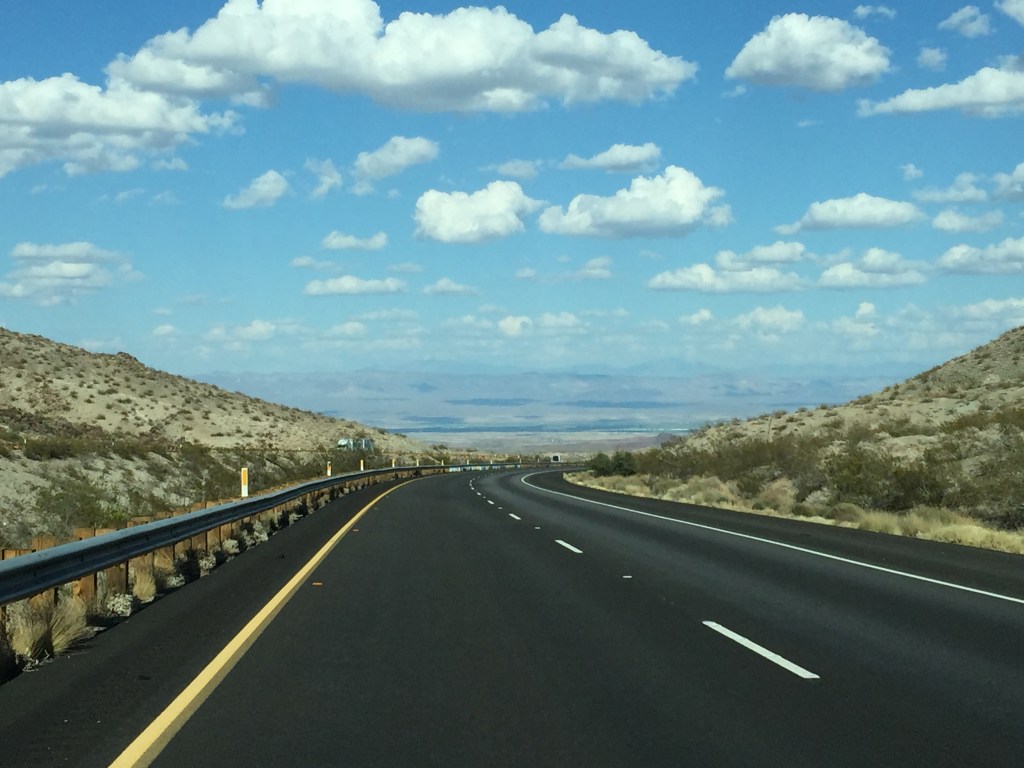
If you look at the Tang with no traffic, it appears to have 3 lanes. Lanes being designated by white dashed lines, much like this photo I took of Interstate 5, where the yellow line on the left indicates the shoulder and the dashed white line in the middle designates the two lanes, and the solid white line on the right indicates the other shoulder.
Everyone has driven or at least been in a vehicle on a road with multiple lanes or is at least familiar with this concept. Right?
Well, the Tang has 3 lanes, except sometimes it has 5 or 6 or even 7 “lanes”. Because, as I’ve learned, the dashed white lines are merely suggestions.
Even when traffic isn’t backed up (resulting in the aforementioned 5-7+ lanes), I’ve still seen cars straddle the white dashed line, neither in one lane or the other but driving in both. And no, they weren’t changing lanes. They simply drove straddling the line.
There are no apprent rules of the road except go. Because if you don’t go, you get honked at. (Honking can also mean “hey, watch out, I’m here.”)
Even then, the “go” is optional because I’ve also seen people stop along the left side of the road. (In fact, that just happened today.) Yep. Just stopped for no apparent reason. Maybe they had car trouble, but they didn’t have their hazards on. So who knows.
This just doesn’t happen on the highway. It happens on regular city streets.

from google mapsThe best part: a road clearly marked one-way with a “do not enter” sign may not always be actually one-way.
Also Italy, like much of Europe, loves roundabouts or traffic circles and eschews traffic lights. A “rotatoria” or “rotonda” (Italian for roundabout), if you’re not familar (which I wasn’t until I moved to DC), refer to the circular intersection where traffic flows around a central island. But in DC, even the roundabouts usually had traffic lights, only allowing certain lanes to go. But here, roundabouts are a free-for-all.
Roundabouts are a pro-level driving test—not for the skiddish or cautious.
Seriously, the rules of the road here are uber flexible. Really more like suggestions. And you will draw attention as an “outsider” if you actually try to follow the rules.
3. Parking
I thought about including parking with driving but parking really deserves it’s own category.
Here in Naples, there are some parking lots as Americans think of parking lots—large, usually flat, paved areas with white lines identifying spaces for cars to park.
Simple. Right?
Not so much.
While some larger shopping centers, usually malls, have what the traditional parking lot, most places do not. Italy still has a lot of smaller, individual stores, like a bakery for baked goods, a pescaria or pescheria (fish market), a macelleria (butcher), a fruit and veg seller, etc. Many of these smaller stores are in buildings right on or near the street. Streets that may or may not have actual designated parking spots. But does the lack of official parking spaces stop Italians?
Not one bit.
Even places, like malls or the train depot, where there are traditional parking lots, you will find cars parked often rather inventive ways.
This also adds to the aforementioned driving craziness because you may have to serve into the oncoming lane to avoid someone who randomly parked.
In other words, driving and parking are not for the faint of heart.
4. Smoking
Smoking is probably my biggest pet peeve as I’ve totally embraced the chaos that is driving. Many more people smoke here.
While most resturants and business don’t allow smoking inside the building (unless they have outdoor patios), you will find people smoking right outside.
For example, I went to IKEA the other day. Directly to the left of the entrance door is a trash can with the cigarette disposal. So of course, people were smoking right there and I had to walk through a cloud of smoke to go inside IKEA.
You will also find people smoking while walking down the street or while riding bicycles or even scooters.
As a non-smoking American who is use to smokers being relgated to far-off places, or at least 20 feet from entrances of buildings, I have to say I don’t care for all the smoking here.
5. Restaurant Hours
Ah, the joys of eating in Italy. The food is delicious and amazing. That being said, you do need to understand when to eat.
If a resturants serves both lunch and dinner, many open for lunch around noon and then will close around 2-30-3:00 pm. They will not open for dinner until 6:30 or even 7:00 pm.
There are no early-bird dinners here.
During my day trip to Amalfi, we stopped to eat a late lunch. It was around 2:15 when we entered the restaurant. By the time we were served our meals, it was probably around 2:45 pm. We weren’t the only table still eating, but we were one of two or three, as the rest had finished while we waited.
Not too long after we were served our meal, someone tried to open the door to enter only to find it locked. The resturant locked the door at 2:30 to prevent any new customers from entering.
Can you imagine an American restaurant locking the door? An American restaurant in a significant tourist destination? On a weekend? During summer tourist season?
No, no you can’t.
But Italian restaurants have no worries about locking doors when lunch service is done.
For dinner, doors open around 6:30 or 7:00. But even though the restaurant may be opened, actually showing up then is considered early by Italian standards. Prime dinner rush starts around 8:30 – 9:00 pm. And meals are not to be rushed (which is something I actually love).
If you plan a trip to Italy, be aware of restaurant hours. That’s not to say cafes or bars won’t be open. But most sit-down restaurants do close.
Final Thoughts
While international travel and living abroad have their perks, there are also challenges. Language barriers being top of that list. But cultural norms, customs, and traditions also play a part in it.
Living abroad also has the added challenges of loneliness and isolation (especially when one isn’t fluent in the language).
In my experience, I’ve found being humble, smiles, research, and at least trying to speak the language go a long way to bridging the gaps. But there will always be challenges. Just remember, there are challenges to living in America too—but we’re just used to them as the norm.
 wanderinglynn.com