That’s right. First trip outside of Italy!
When I realized the week before that Thursday, June 19 was a U.S. holiday, I decided to find another long weekend trip. So I spun the skyscanner wheel* and found a cheap flight on a budget airline* to Bucharest. (* See my Travel Tips at the end.)
I had Bucharest in the top 10 of my non-Italy trip list. So I immediately booked the ticket.
A Bit of History
(Not interested in history? Want me to get to the point? Skip to the next section or even skip to my final thoughts.)
Romania has a rather crazy interesting history, so I’ll skip over the ancient and early history and start with the 13th century. Romania was 3 separate principalities—Walachia (where Bucharest is), Moldova, and Transylvania.
Wallachia and Moldova spent a good chunk of time under the Ottoman (Turkish) Empire starting in the 13th Centure. Translyvania, with its lovely Carpathian Mountains, evaded the Ottomans until 1526. Then the short version of several hundred years of history is that Romania got stuck in the middle of a bunch of conflicts (i.e., whoever was fighting the Turks, including the Hapsburg Empire).
Finally, in 1859, Walachia and Moldovia unite, get a German-born prince (because Romania had no real royalty), bring in Transylvania, and finally become the Kingdom of Romania in 1877.
What united the 3 regions was the language.
Romanian is one of the Romance languages along with French, Spanish, Italian, and Portugese. But, you may be thinking, Romanian has those weird accent marks, like ă, ș, and ț. Good question. While a Latin-based language, Romanian was strongly influence by the Cyrillic alphabet. And one of my tour guides explained those additions were to account for the Slavic-sounds.
Romanian also differs from the other Latin-based language where the definite articles are enclitic. In other words, the definite articles are attached to the end of the noun instead of in front (proclitic). It als has, in addition to male and female gender, a neuter gender. What’s unique is that in the neuter form, it adopts the masculine form when the noun is singular but the feminine form when the noun is plural.
Basically, our tour guide Boggi said no one but Romanians can ever properly speak Romanian.
Anyway, back to history. Life in the Kingdom of Romania was okay until WWII. Romania first lands on the side of the Axis powers, but near the end, switches to the Allies. As a result, Romania was bombed by both sides.
In 1945, the Yalta Agreement makes Romania part of the Soviet System and a communist-dominated government is installed. In the 1950s, after Stalin’s death, Romania begins to distance itself from Moscow, then finally declares autonomy (albeit within the Communist Bloc) in 1964.
In 1967, Nicolae Ceaușescu becomes President. Life is pretty good for the first decade, but as the saying goes, absolute power corrupts absolutely. Life degrades starting in the mid-70s into the 1980s. People are starving while Ceaușescu becomes obsessed with repaying Romania’s foreign debt while building a palace which, at the time, was the 2nd largest building in the world. The Palace of the Parliament (today, still the 3rd largest administrative building in the world) has over 1,100 rooms and cost $1.75 billion (in 1989 dollars).
Needless to say, the people finally had it and local demonstrations in December 1989 turned into a national uprising that started on 21 December and resulted in Ceaușescu’s execution on 25 December. (And you can watch it on YouTube as it was televised. A bit maudlin today, but at the time, it seems it was welcomed by the people.) In 1990, the first free, multi-party elections occurred. Think about that, Romania has only been free of communism for 35 years. Today, Romania is part of the EU and NATO.
Thursday
We landed on Thursday morning and headed towards our hotel in Sector 3. Bucharest is divided into 6 sectors, each with their own local mayor and administration.The 6 sectors are numbered clockwise and are disposed radially, so that each sector has a certain area of the city center.
Our hotel was in Sector 3. We took a bus from the airport to a stop within 3km of our hotel. From there, we decided to walk to get our first real look of Bucharest.
Walking through Sector 3, I definitely felt the communist hangover. The communist-era buildings are wicked obvious—huge concrete blocks with no personality. Each had a sign stating the sector and bloc number. I mentioned more than once that Bucharest needs a PR make-over. At the minimum, change the word “sector” to “neighbor” because wouldn’t you prefer to say “I live in Neighborhood 3″ rather han “I live in Sector 3″?
Thursday was a hot day, the heat wave still affecting Europe. The temperature reached 33°C/92°F, so we stopped at a bakery along the way. The proprietor spoke no English and we spoke no Romania, and yet we were able to communicate through some broken Italian, some smiles, and pointing. She was simply lovely.
We both ordered coffee and I had a cake, which turned out to be some delicious but uber-sweet rum-based chocolate cake with some sort of sugar-based icing/confection on top. Then the proprietor insisted on giving us what she called tea but what tasted like hot lemon sugar water to me. Whatever it was, it was good.


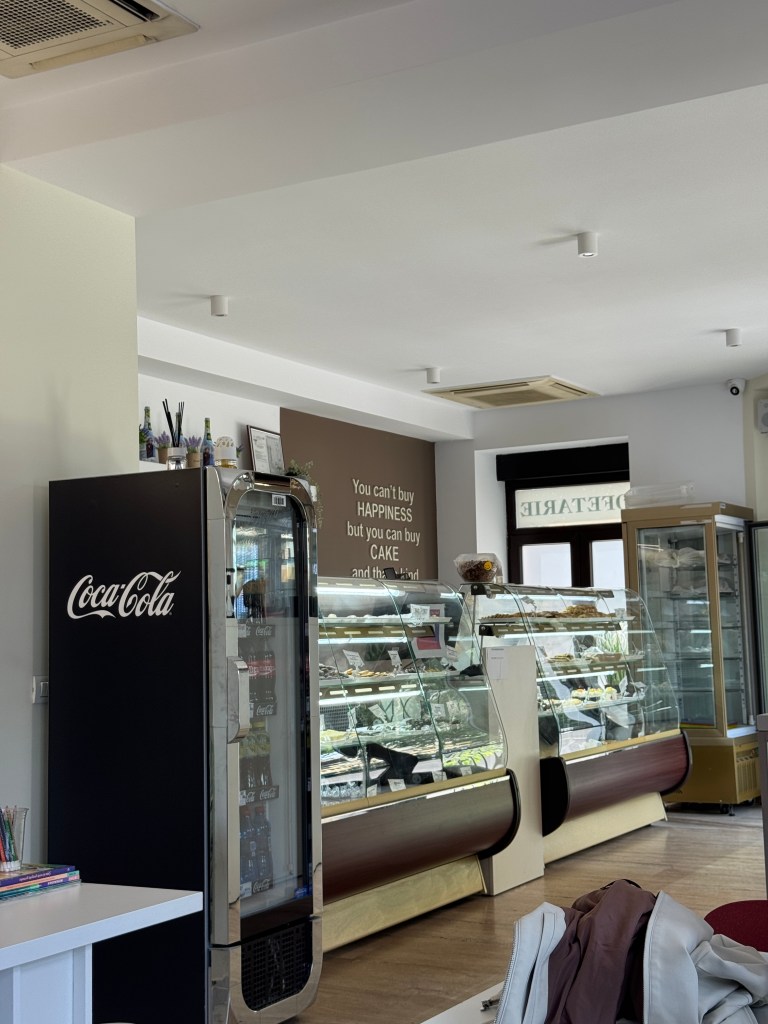

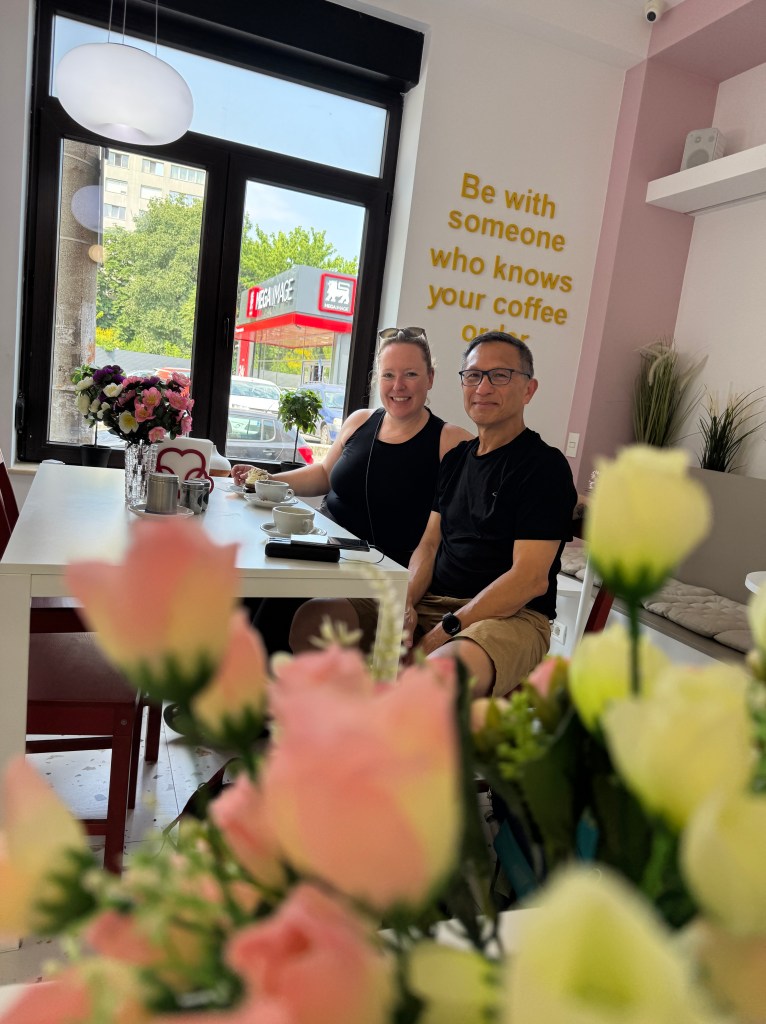
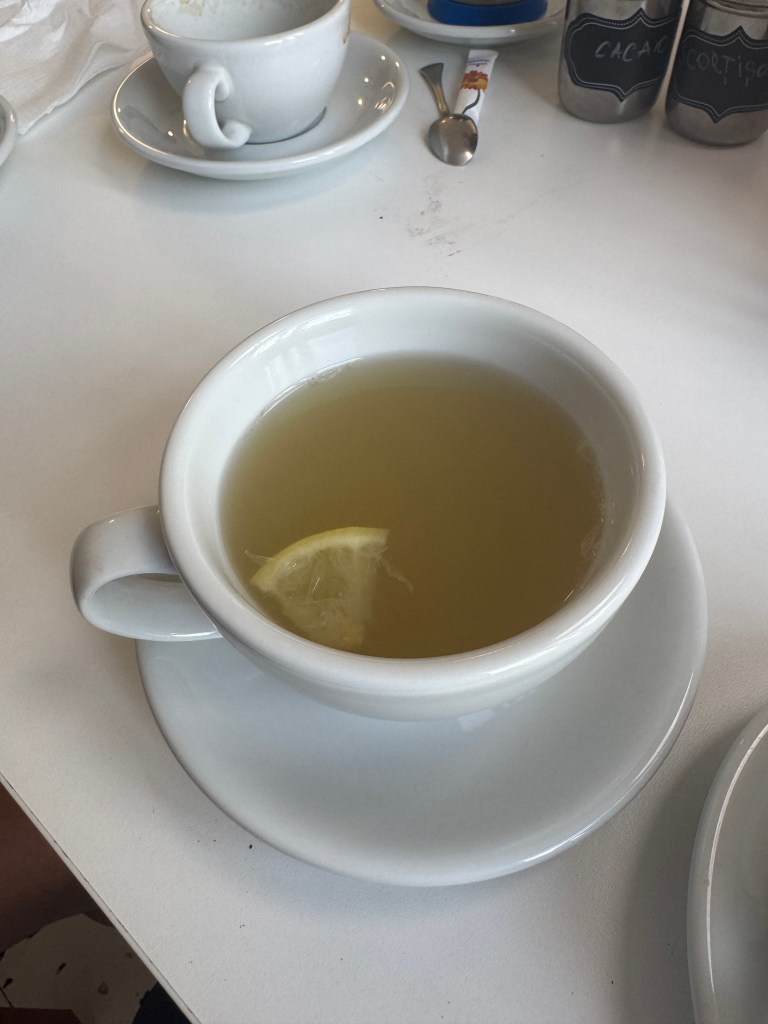


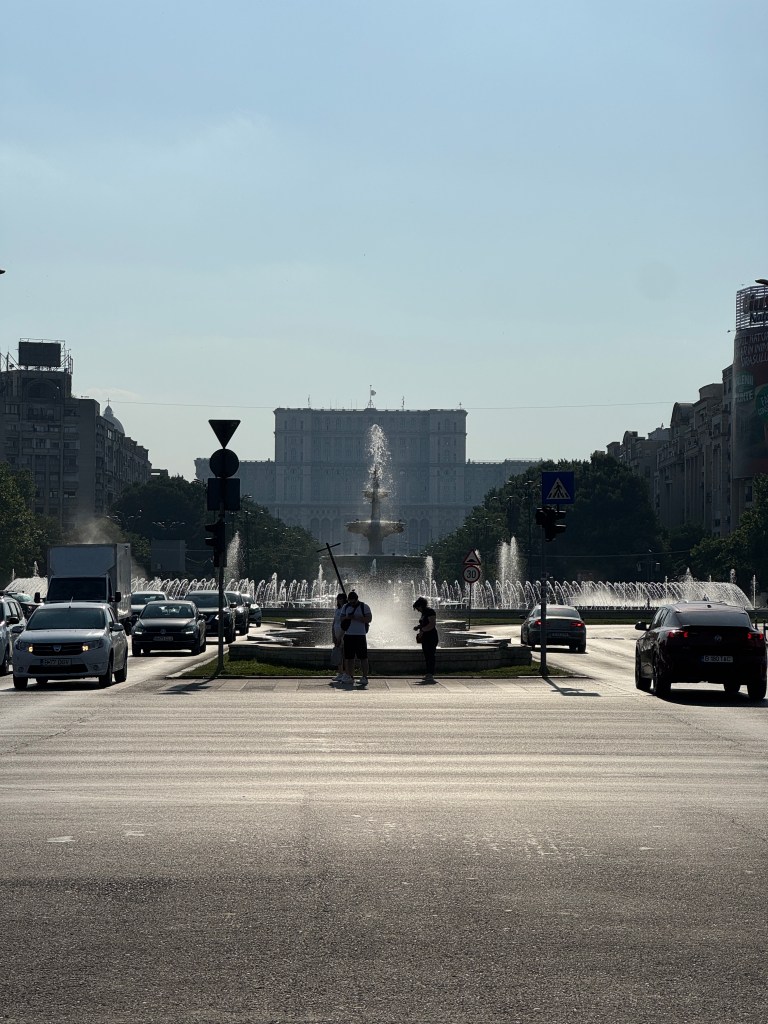

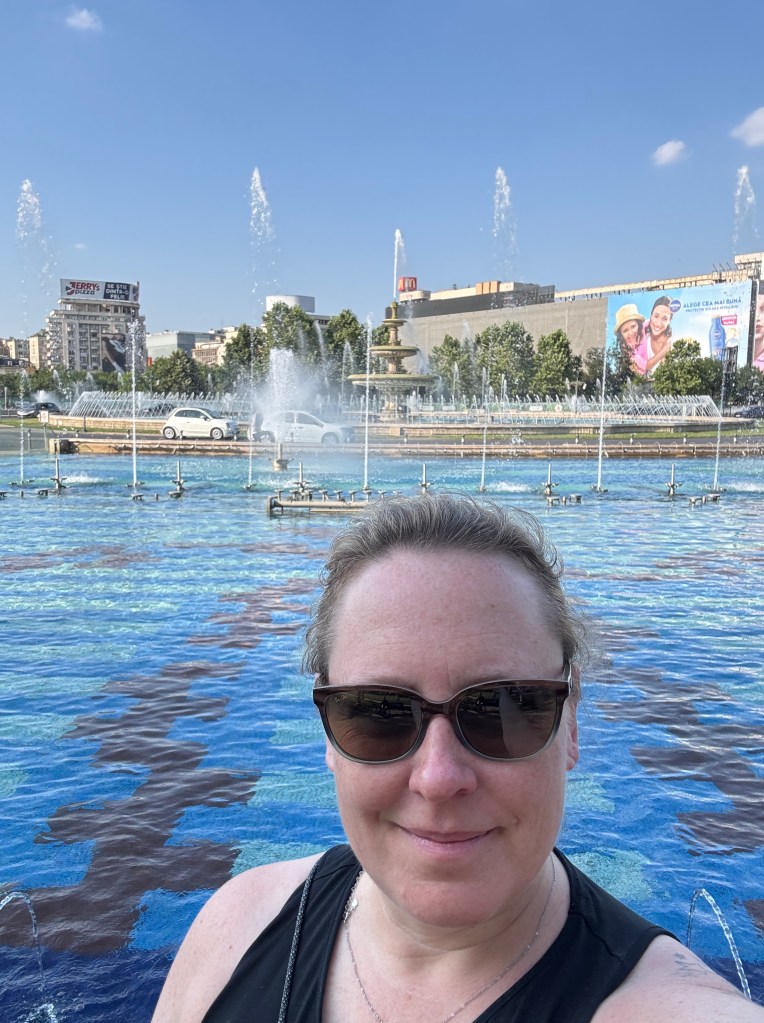


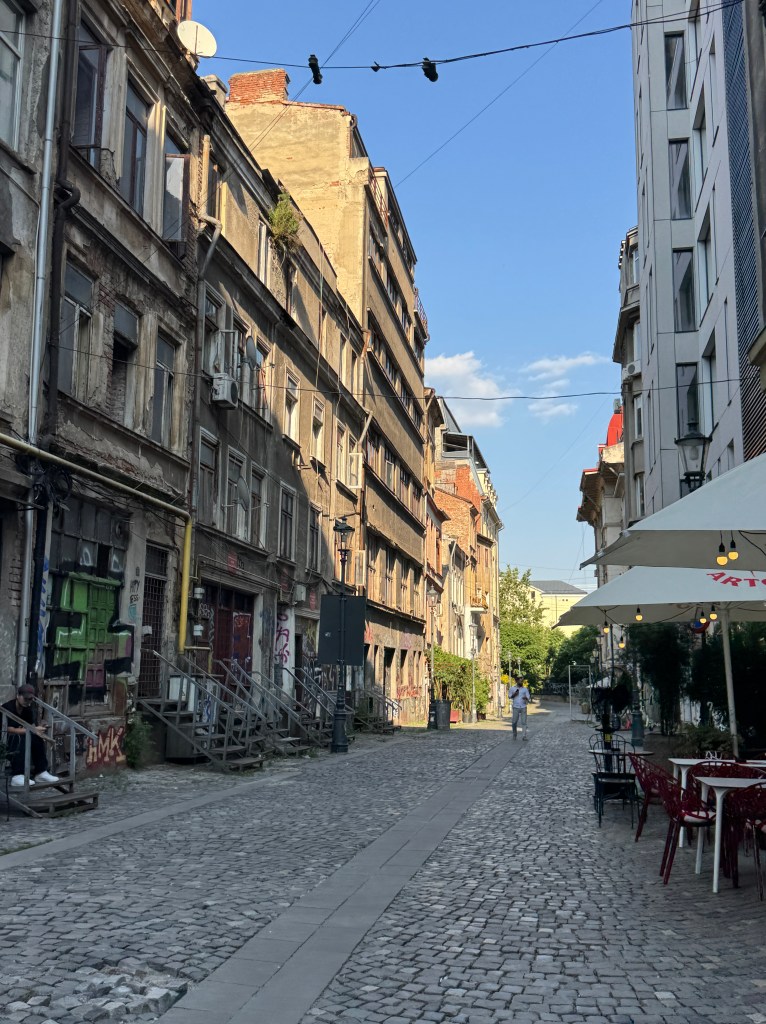

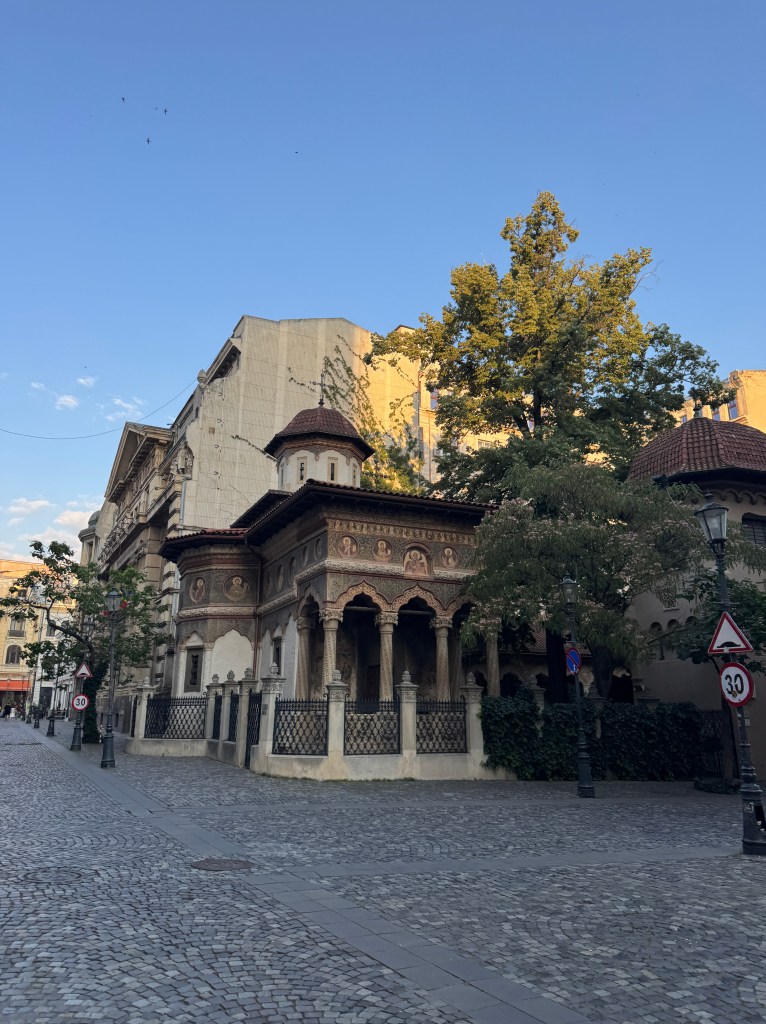

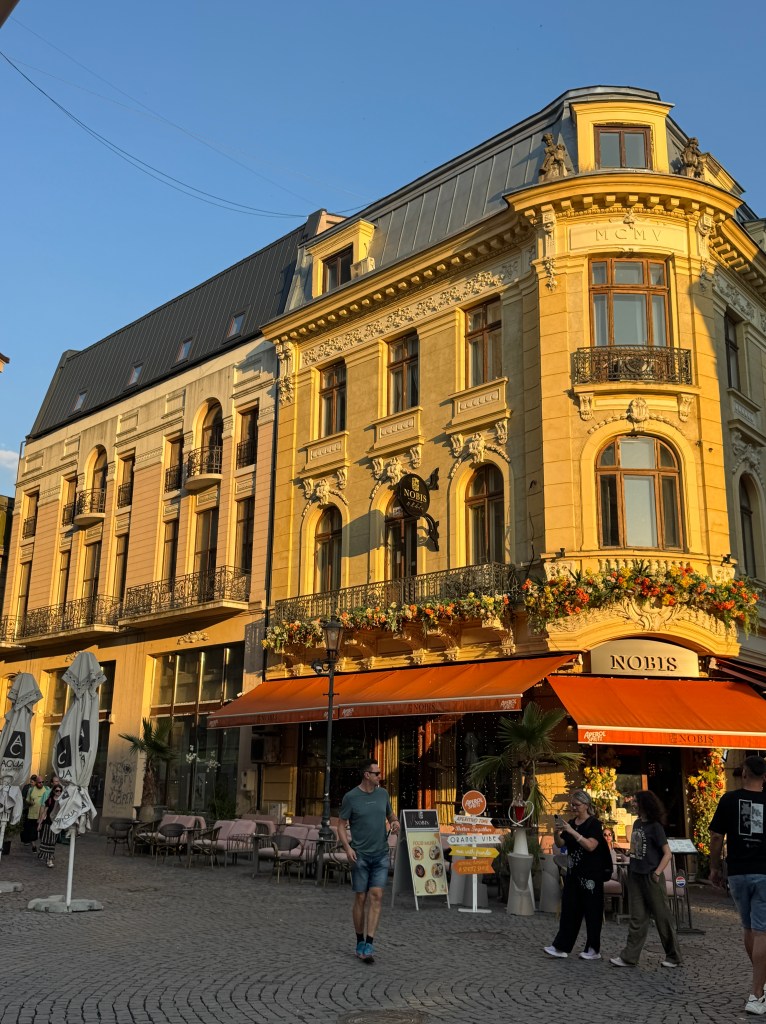

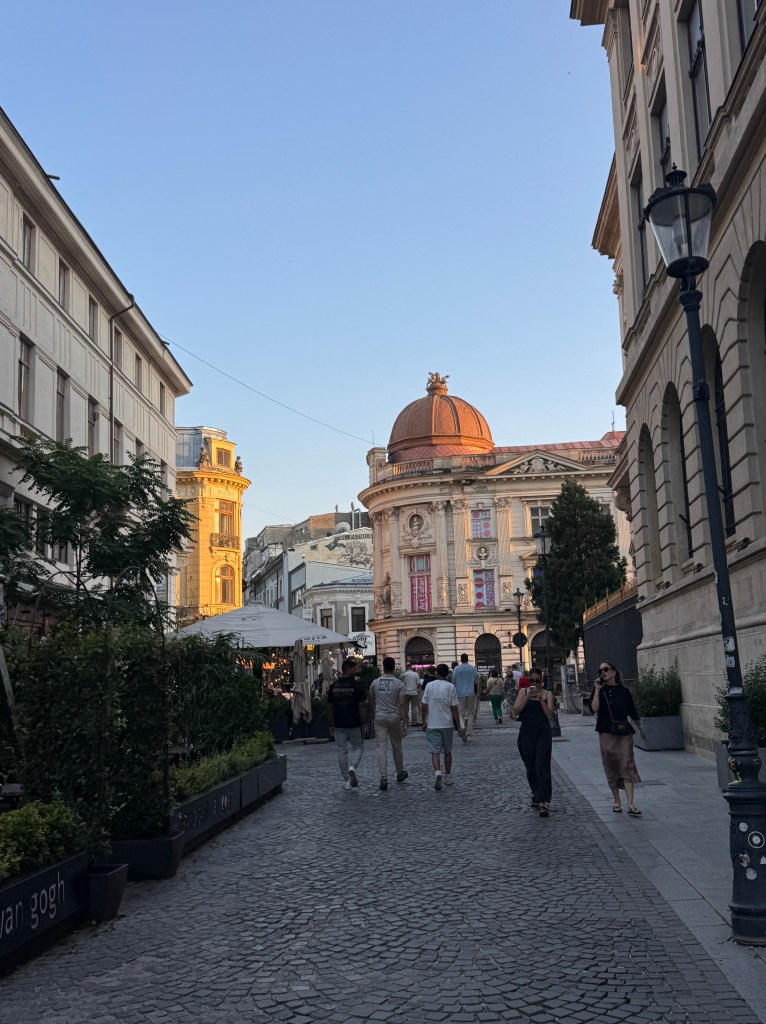

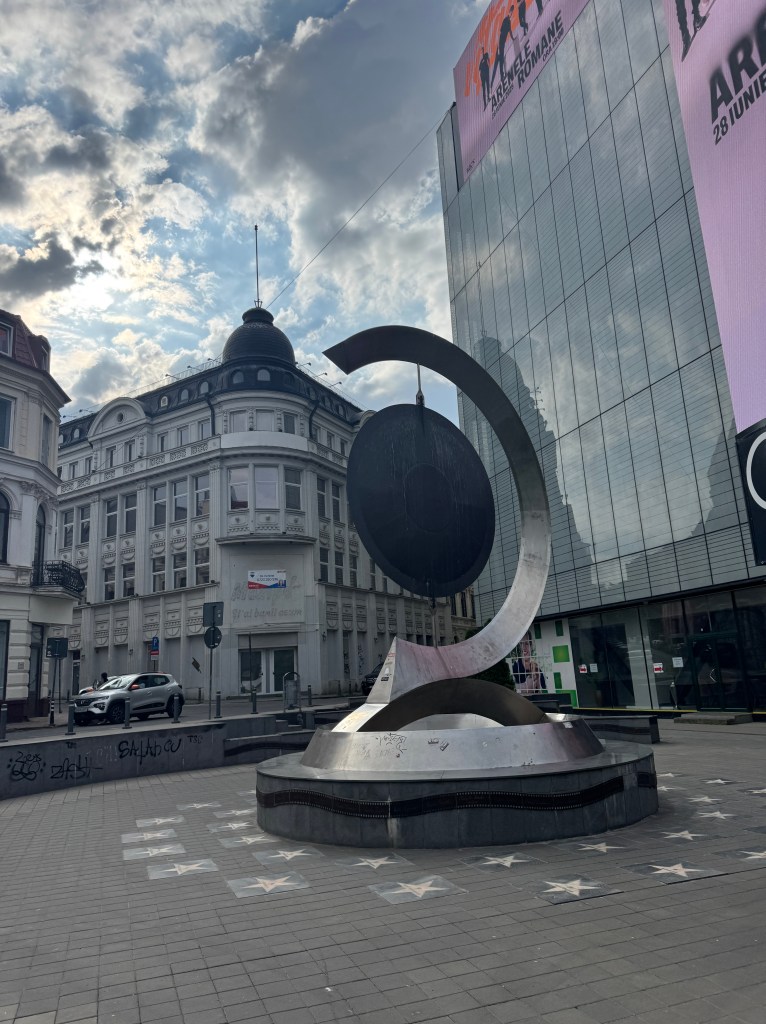
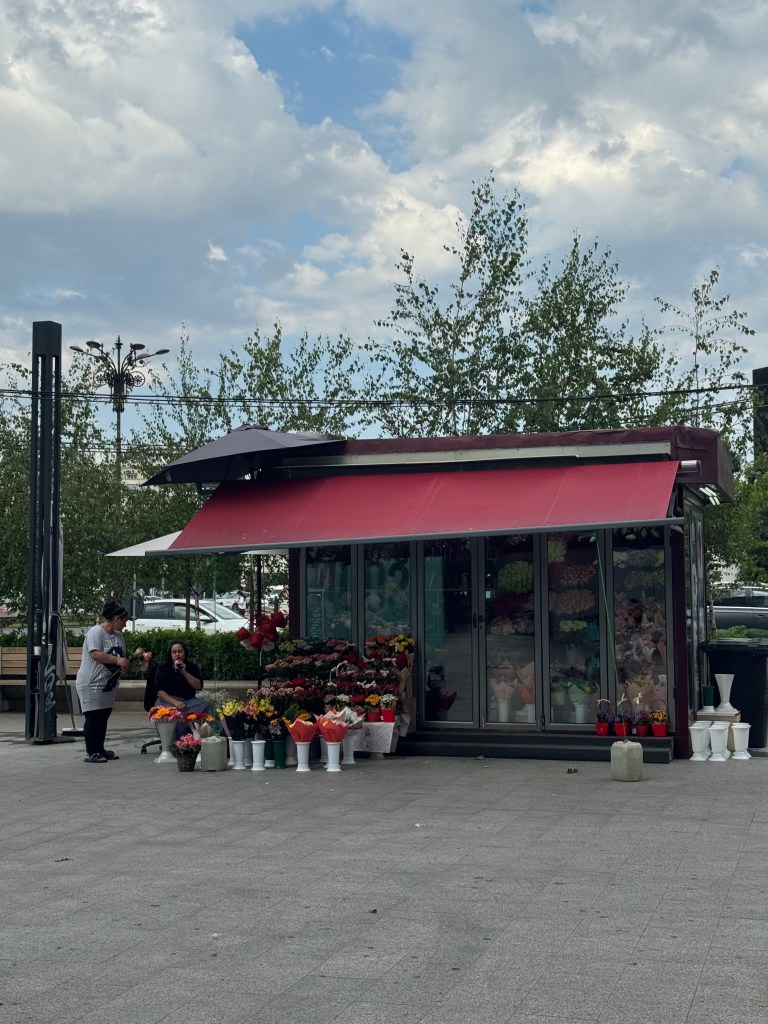
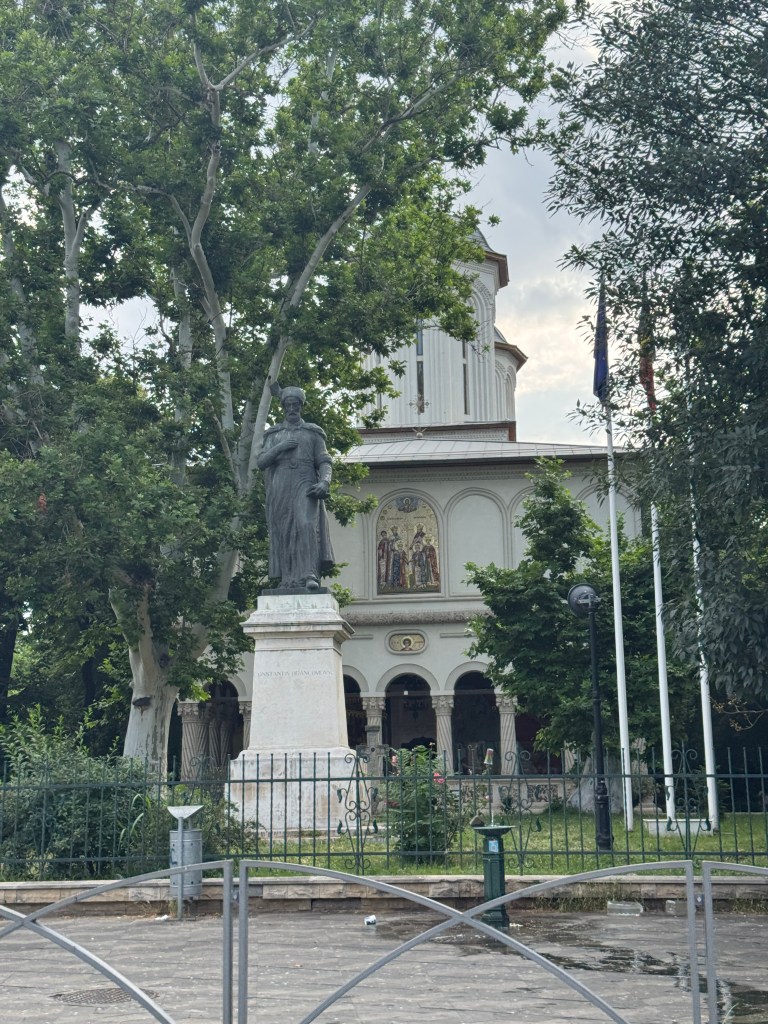

After cooling off, we continued our trek to the hotel area. Luckily by the time we got close, the hosts messaged to that we could check-in. The Aristide House is a converted town-house and so has no traditional lobby. Check-in was done via the booking.com app, and the hosts were responsive to every message.. The house is set-up with electronic locks, so no keys or keycards, only codes—one for the front door and a different one for our room. I really liked this because it’s inevitable that I will, at some point during a trip, misplace the keycard.
The room was the size of standard hotel room. Clean and nicely furnished, it had a decent-sized bathroom with a rain shower head (which I loved). Situated in a quiet neighborhood, Aristide House was convenient to the historic parts of the city we planned to visit.
After dropping off our bags, we headed back out to start exploring in ernest. From our hotel, the “old town” was about 3km.


We found a restaurant in the old town called Le Bab and had a delicious hummus, which I followed with chicken yaji (grilled marinated chicken thighs with yaji spices served with mint & coriander sauce and cous cous). Absolutely incredible. After we thanked Ali and the staff at Le Bab, we decided to call it a day and start out fresh in the morning.
Friday
Friday we opted to do a food walking tour. I travel for food and a food tour, which combines history and culture with food, is always a great way to explore a new place.
Since our tour wasn’t scheduled to start until 10, I decided to find a place to have breakfast.
Breakfast isn’t really a thing in Italy, where only a caffé (espresso) and cornetti (similar to a croissant) is considered breakfast. So I wasn’t sure what I’d find in Bucharest. Luckily, the historic section had several restaurants that advertised real breakfast. (Although I have a feeling these are more aimed at tourists.)
After breakfast, we wandered for a bit, exploring a bit more of the city before heading to the National Theater where we were to meet our tour guide. There we found that there were only 2 other people who had signed up for the tour.
Our guide introduced himself as Bogdan (or Boggi). Boggi started with some history of the Theater and the sculptures in the courtyard. He also showed us the memorial of Cristian Pațurcă, a Romanian singer/songwriter renowned for his significant role in the Golaniad, a series of anti-communist protests that took place in 1990, in Bucharest. He is best remembered for singing “Imnul Golanilor”, which became an anthem for the demonstrations. The whole song can be found here.


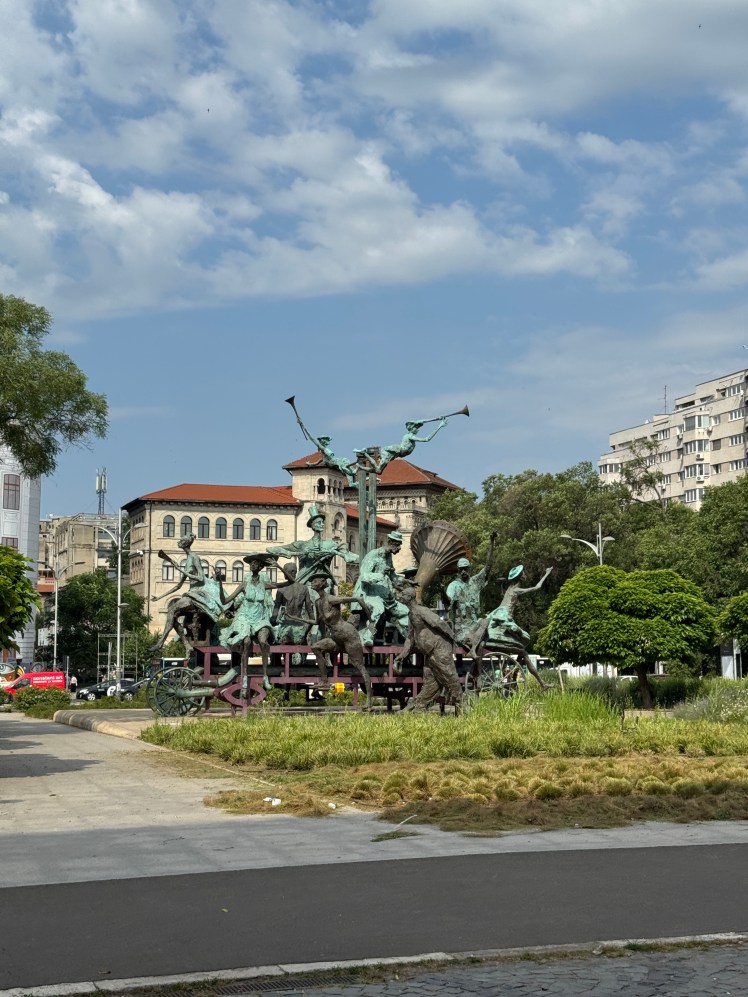
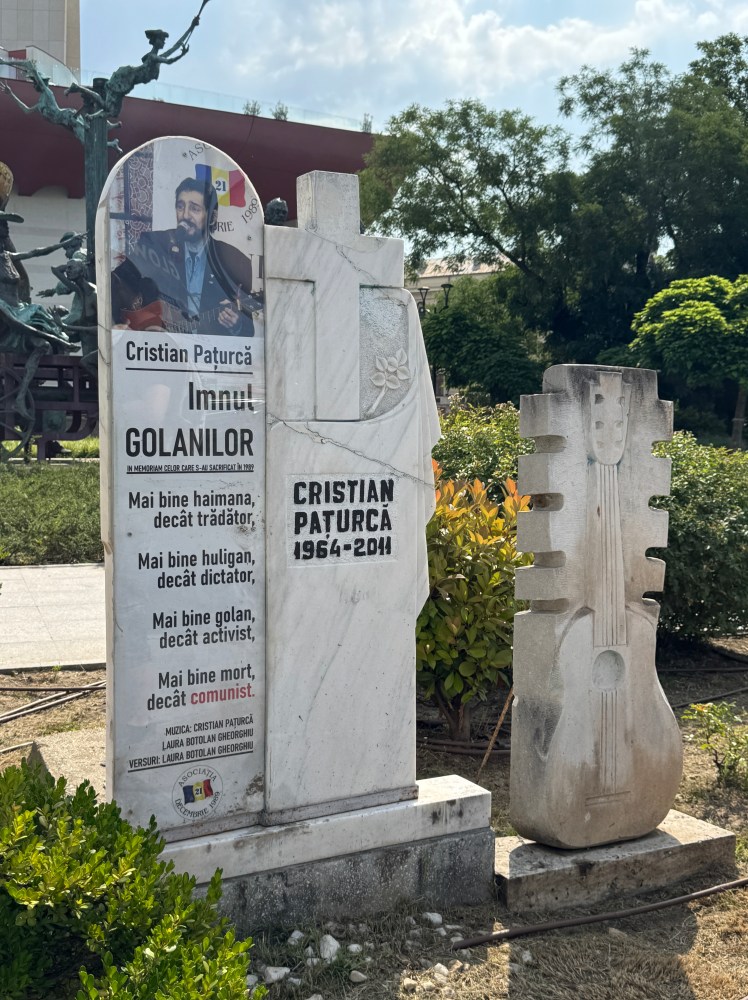
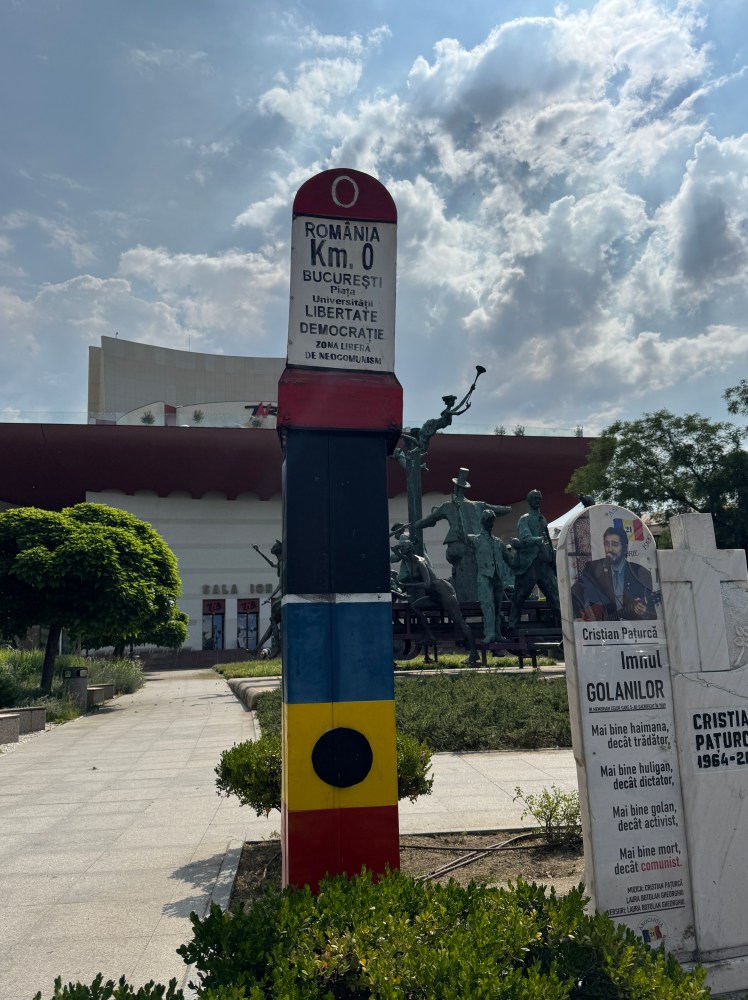


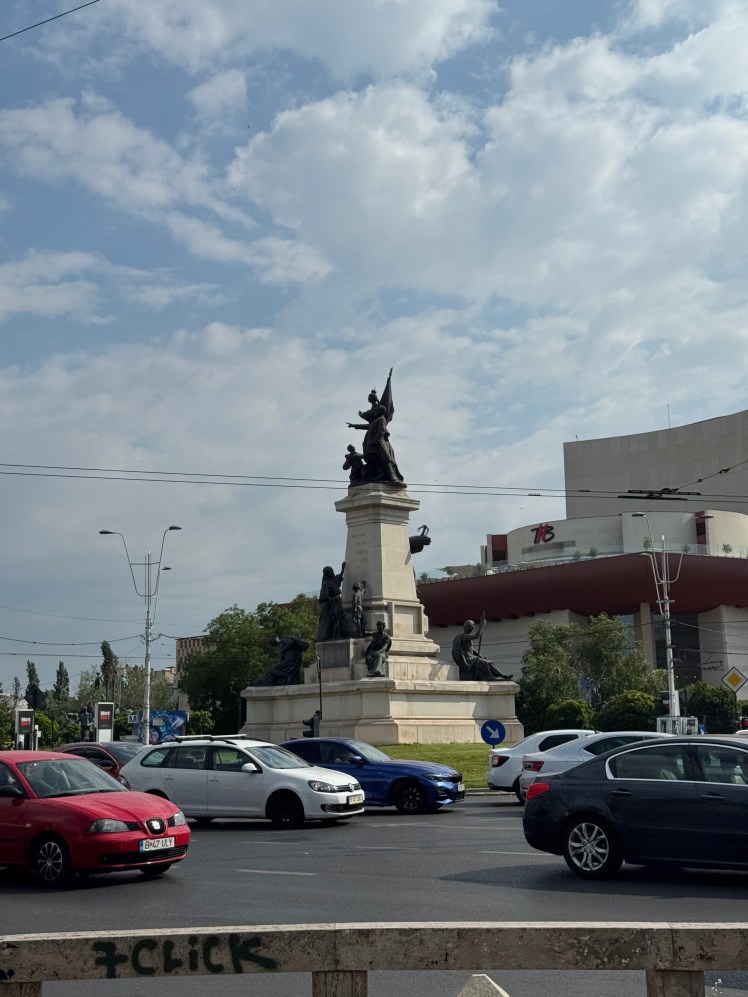






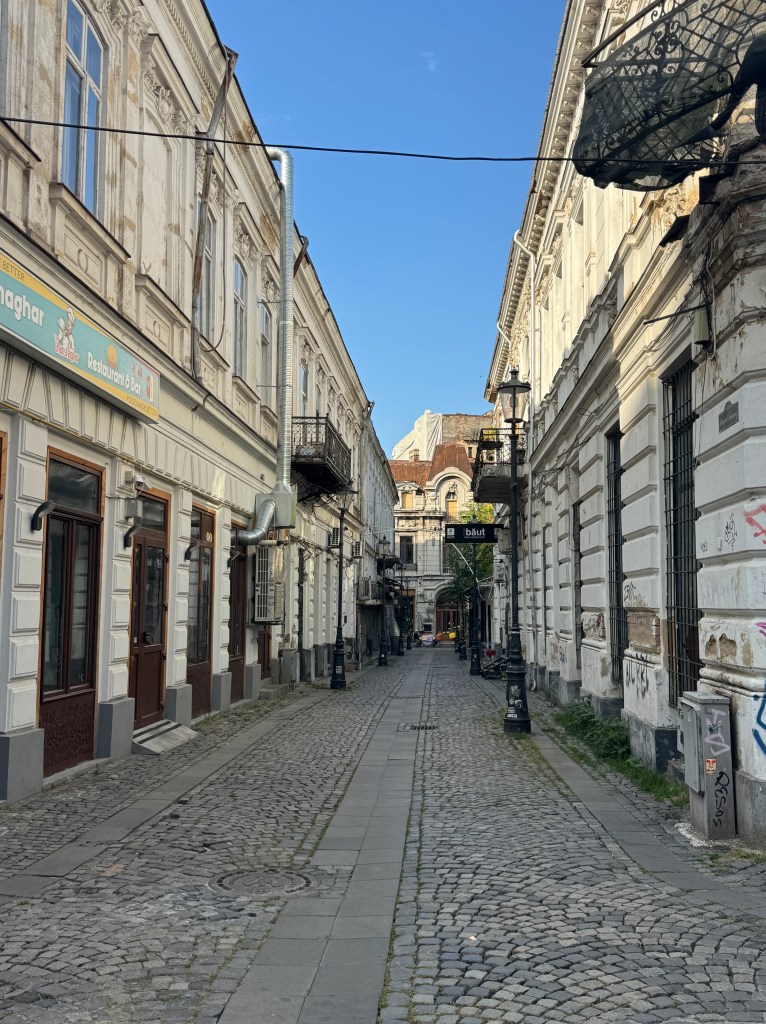
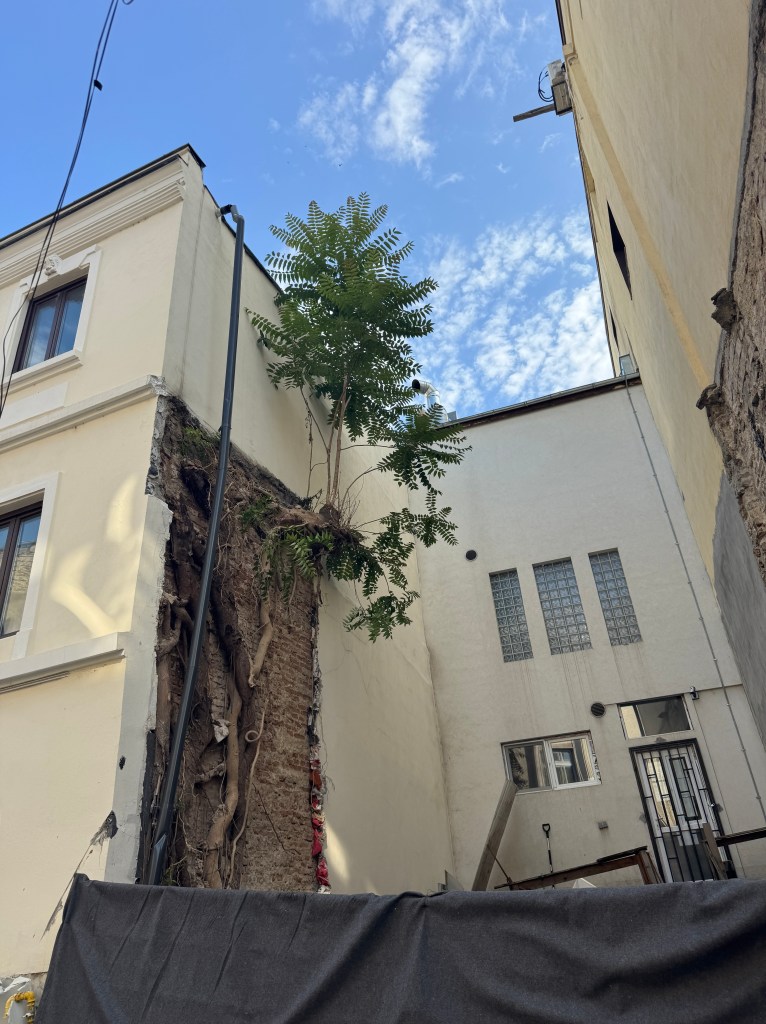
As we started our walk, Bogdan explained the history of Bucharest and Romania at large, much of what I related above. He also explained why some of the large beautiful houses that survived the communist era look so terrible today. Basically, the families who owned the large homes were forced to surrender them to the state, and those that weren’t torn down to build the large block apartment buildings, were subdivided into apartments. Many families left Romania, most to escape communism. When Romania finally became free, the new democratic controlled government had a hard time finding the original owners to claim their property. Apparently, the new Romanian state allowed another 15 years to give families a chance to claim their former property. But those homes had suffered over the 45 years of communist rule. It’s a big job to renovate a home. Much less have to renovate a large mansion-like home after over 50 years of neglect. Add on top of that the fact that Romania is an earthquake-prone area (the red dots on homes and buildings indicate that they are not structurally sound enough). So sadly, unless a new buyer is found, many of these home will eventually be torn down, or the next decent earthquake will likely destroy them.
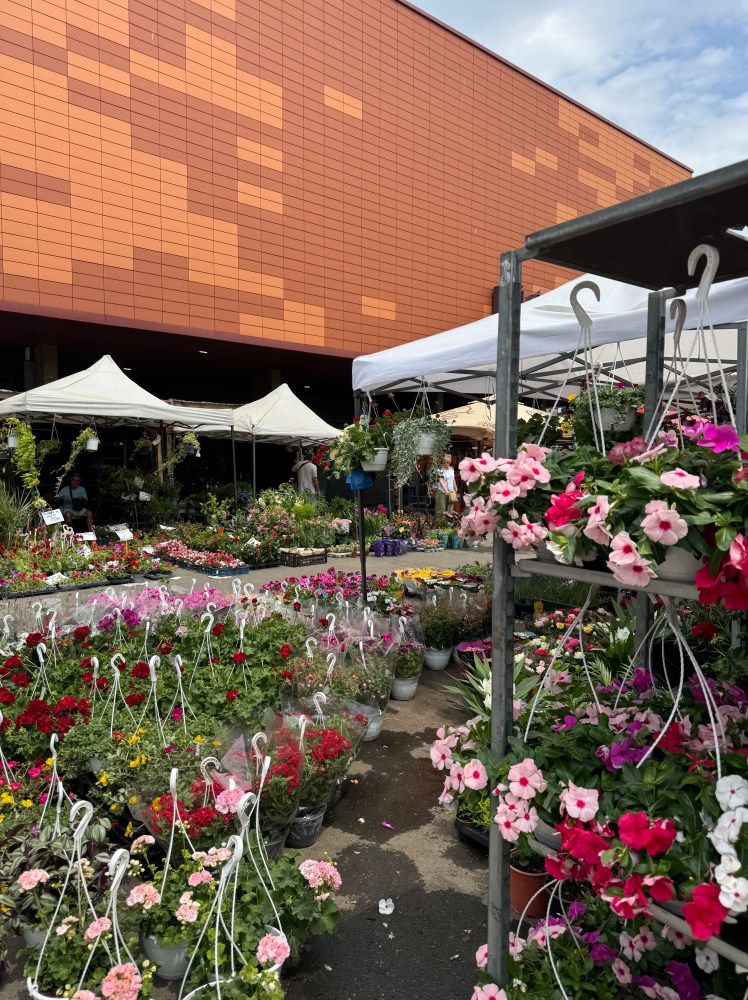
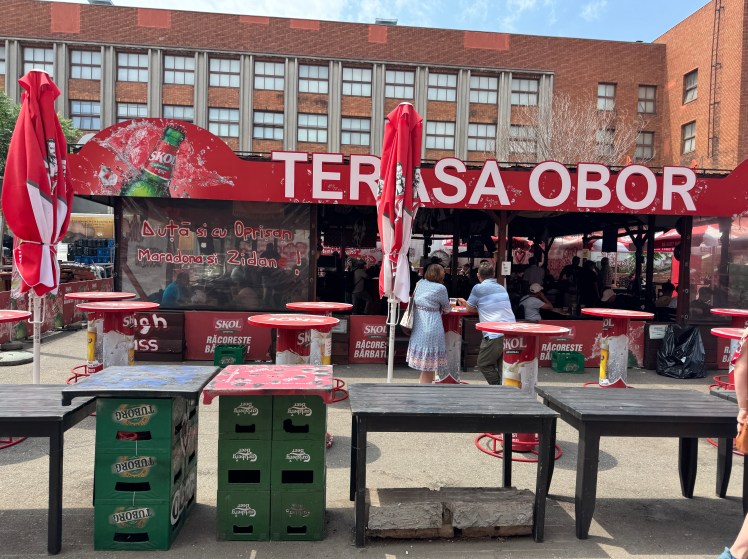
We then headed to Obor Market, a staple of Bucharest. We weren’t allowed to take photos inside the market (one or two in the gallery above shows the outside). But imagine a traditional farmer’s market combined with a flea market. It’s a vibrant place full of amazing scents, incredible produce, and a wide variety of other products from cheap Chinese plastic toys to bolts of cloth.
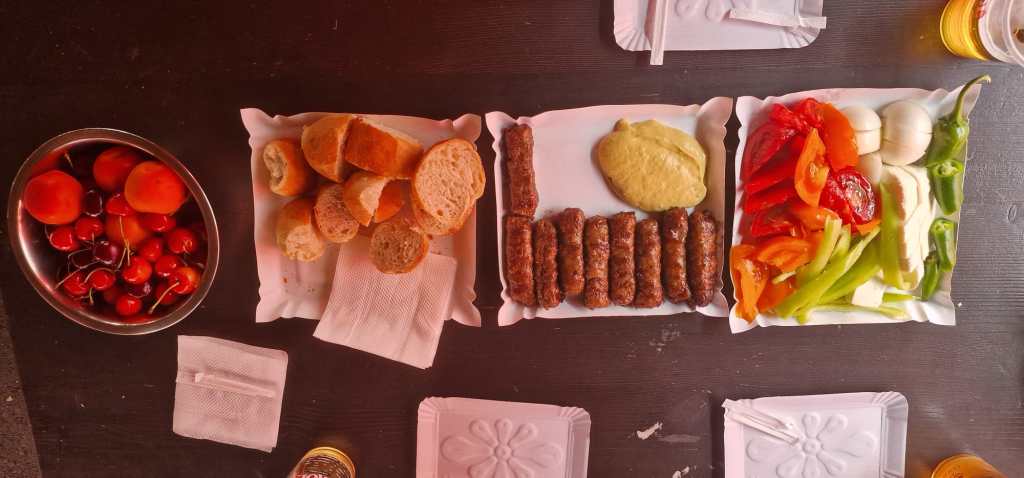
I realized I as was writing this that I didn’t take pictures of the actual food. Mostly because I was too busy eating. Luckily, C did and he happily shared his photos with me.
The left photo is where we stopped to try Țuică, an alcoholic drink made from prunes and considered to be the national drink of Romania and had a charcuterie board. The right photo is from Obor Terrace at the Obor market where we tried mici, a popular, traditional Romanian food of skinless, grilled sausages made from a mixture of beef, lamb, and pork, often with garlic, black pepper, and other spices and enjoyed with mustard and bread.

After the tour, we took a break and headed back to the hotel to rest a bit before dinner.
Saturday
Saturday we started out somewhat early and headed to back to the old town. We had breakfast, then wandered around until it was time to meet our next tour guide for a walking history tour of Bucharest with Alexandra.
We found this tour from GuruWalk, a great resource to find walking tours or just find a good map to do your own.
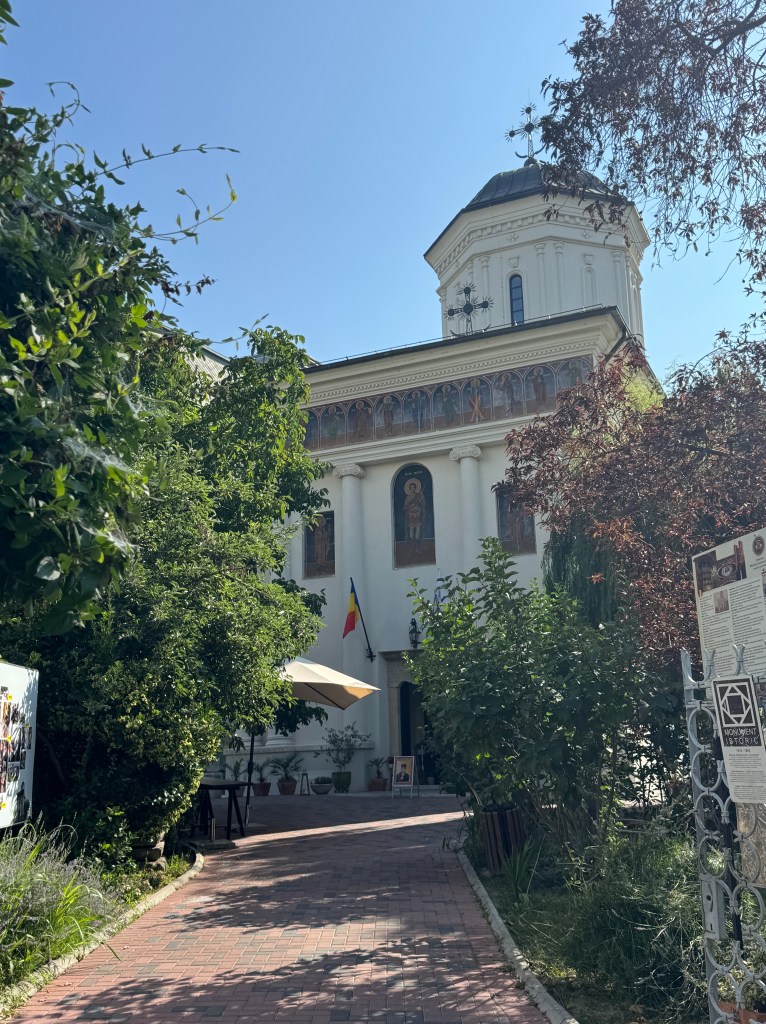
This tour hit all the major sights from the Romanian Athenaeum to Revolution Square to the Palace of Parliament with Alexandra providing detailed history. The tour lasted nearly 3 hours, although it didn’t feel that long. It was a incredible look into a country that has been through so much.



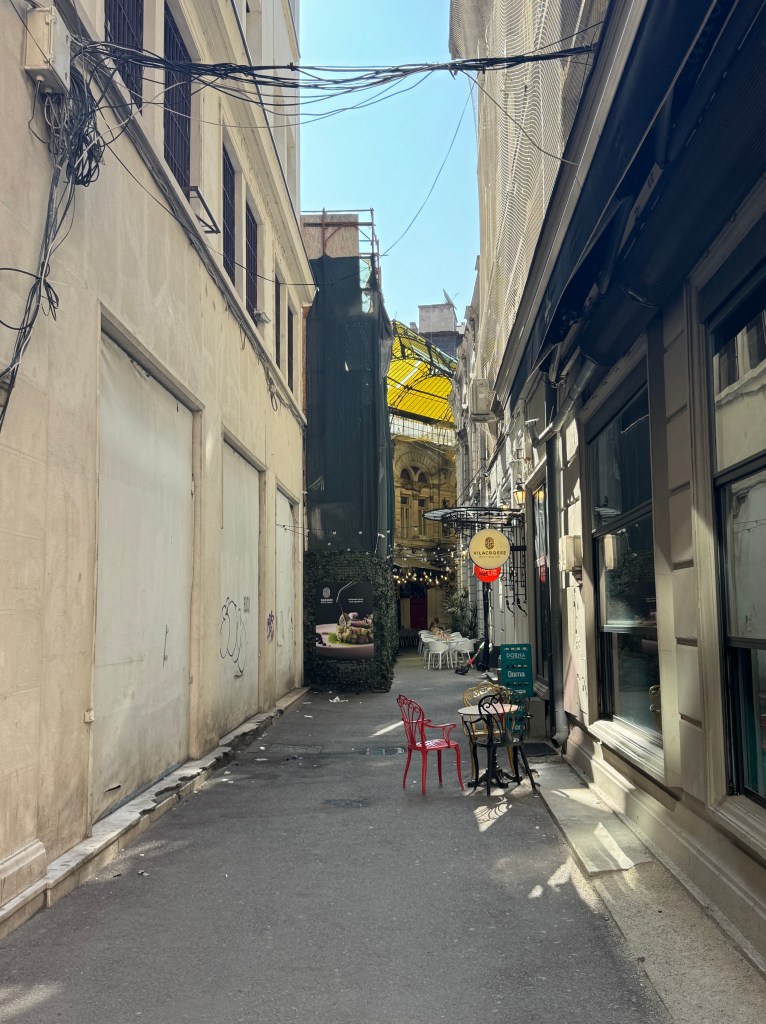

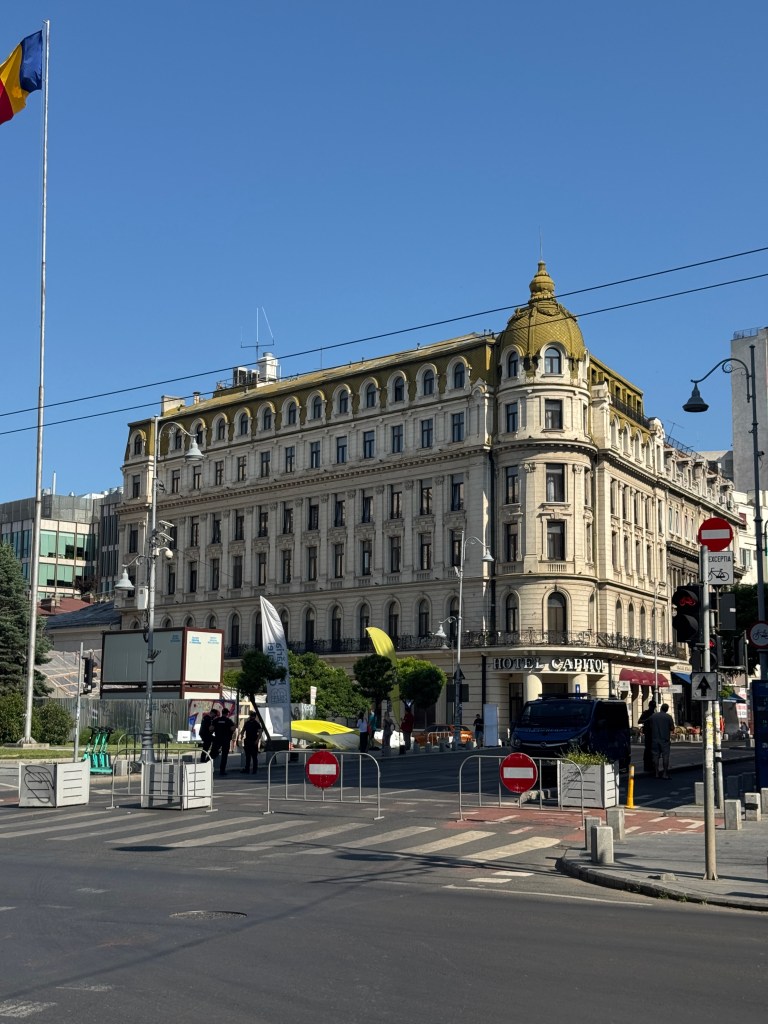
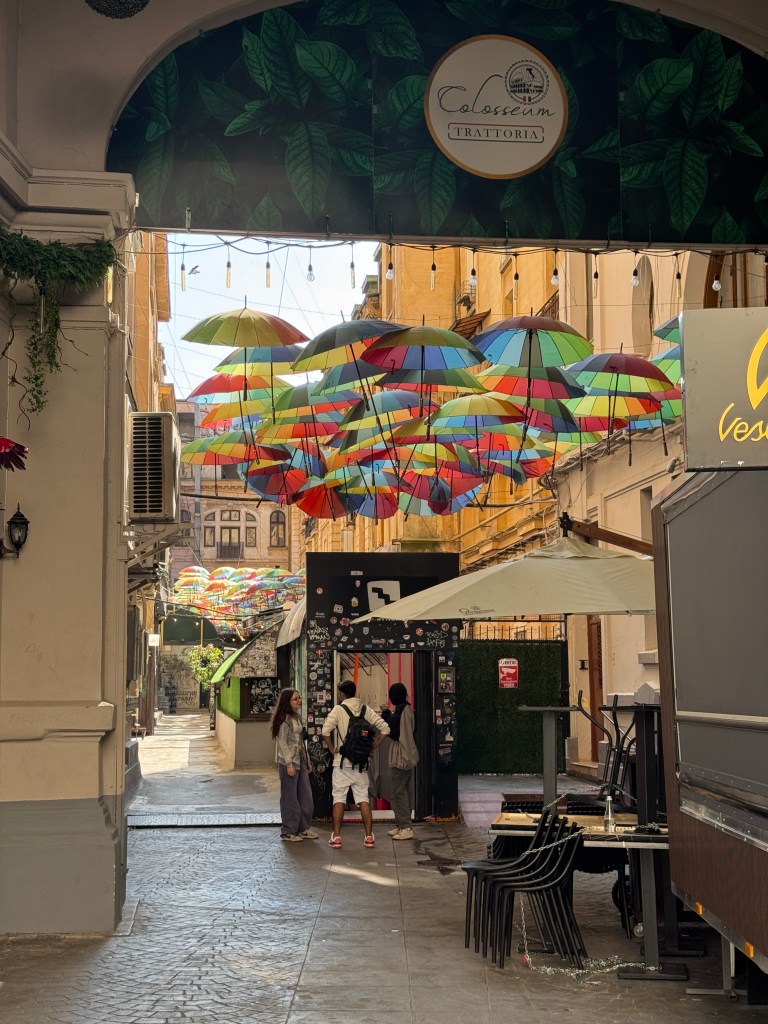

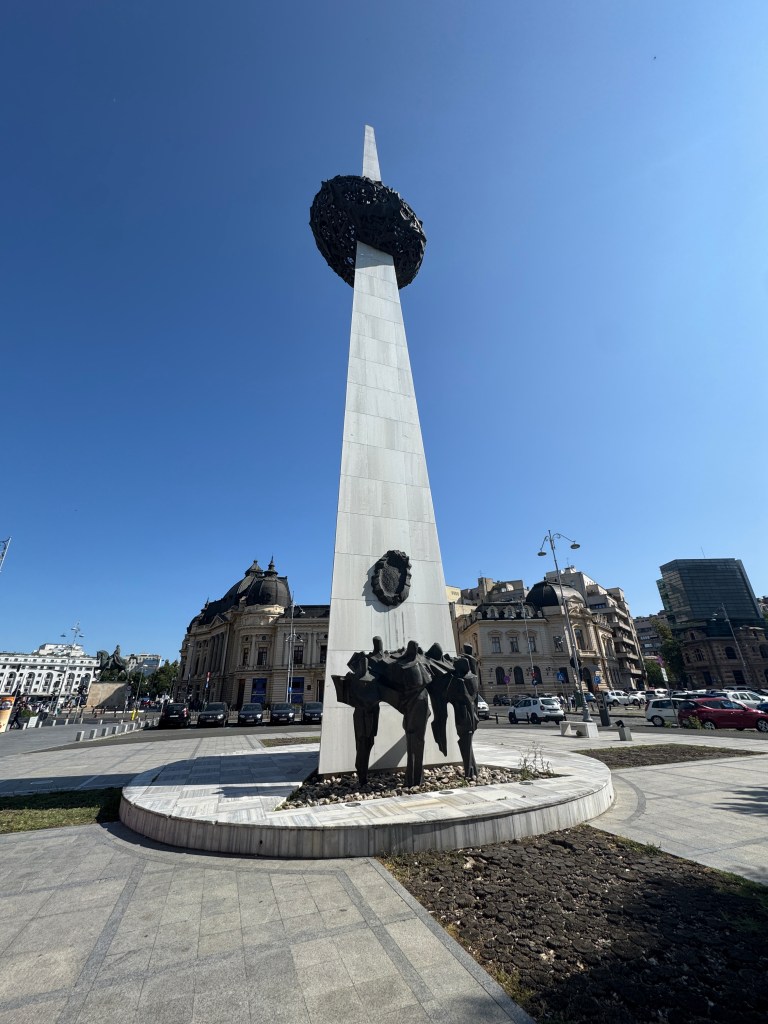
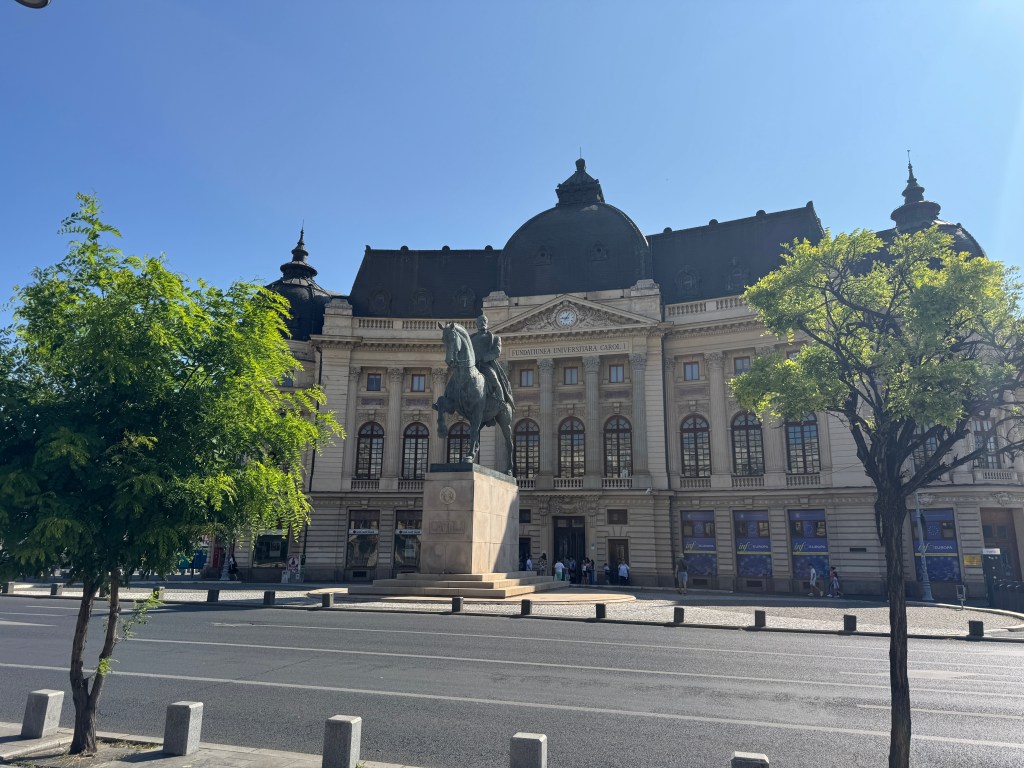

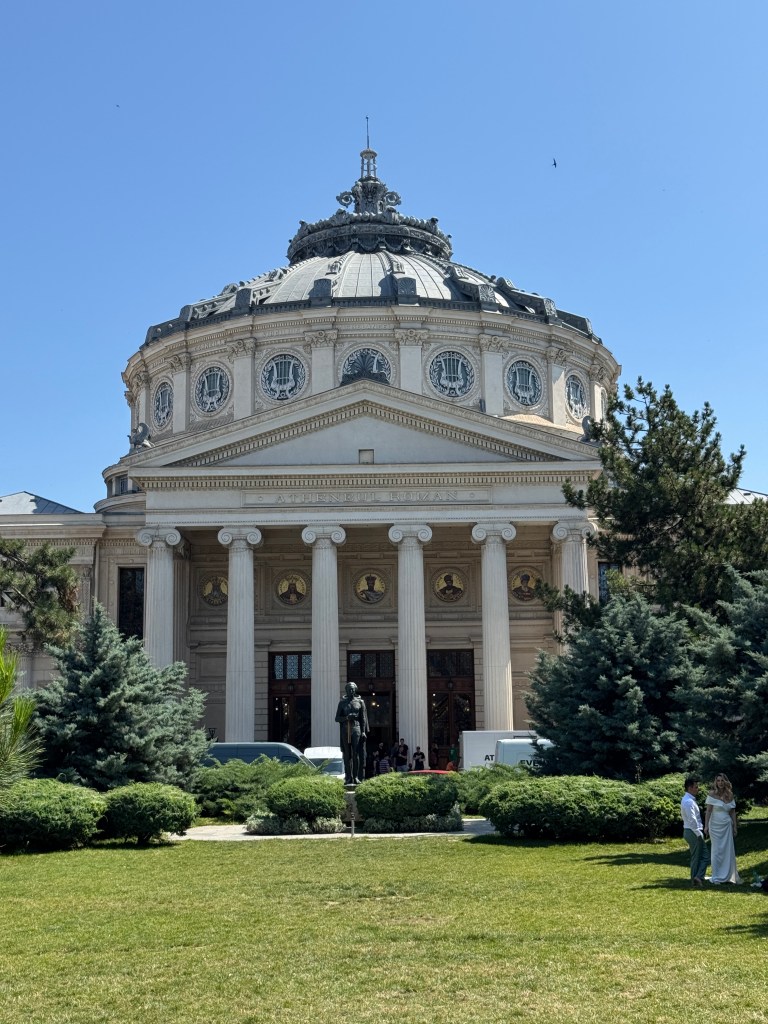

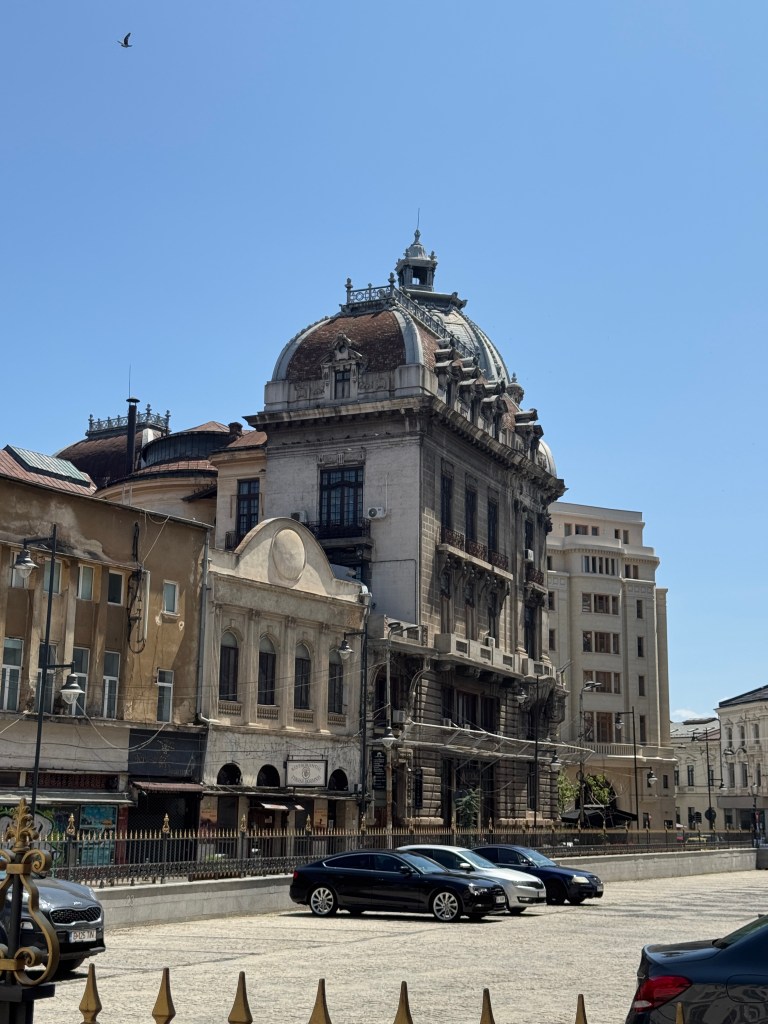
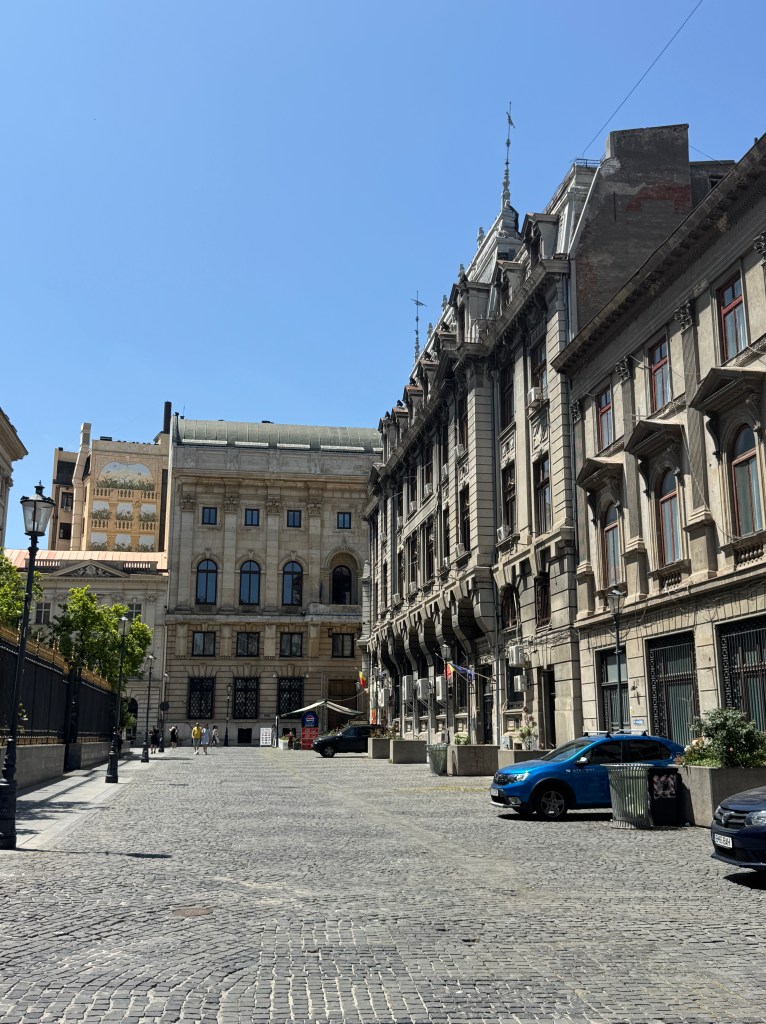
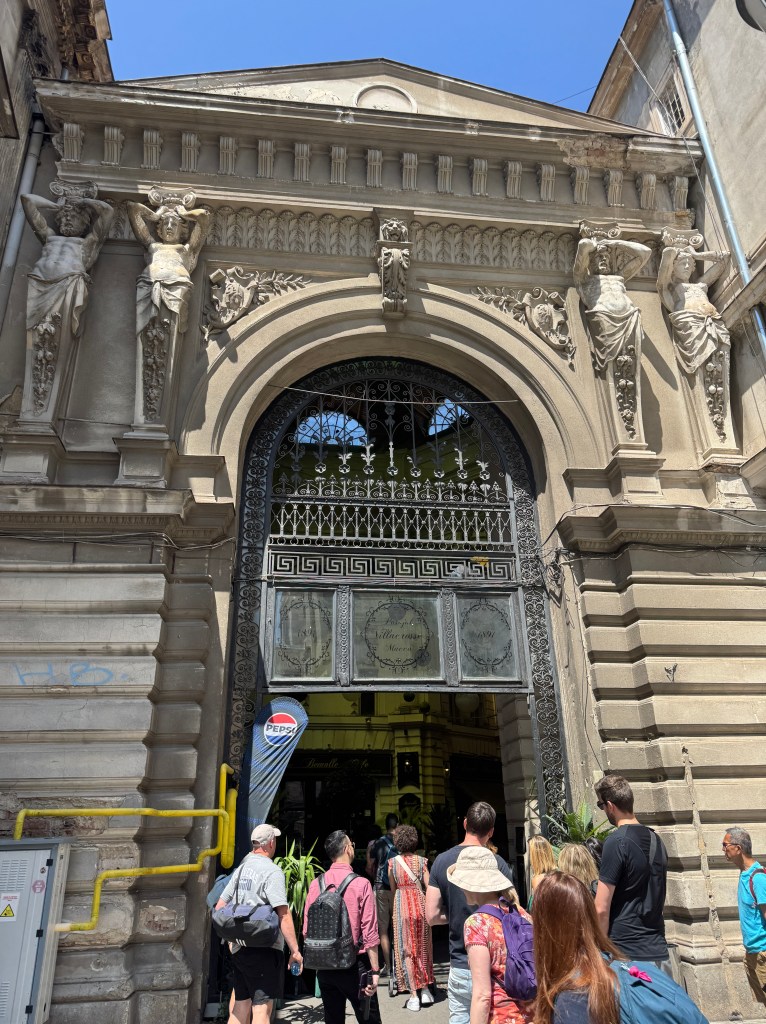

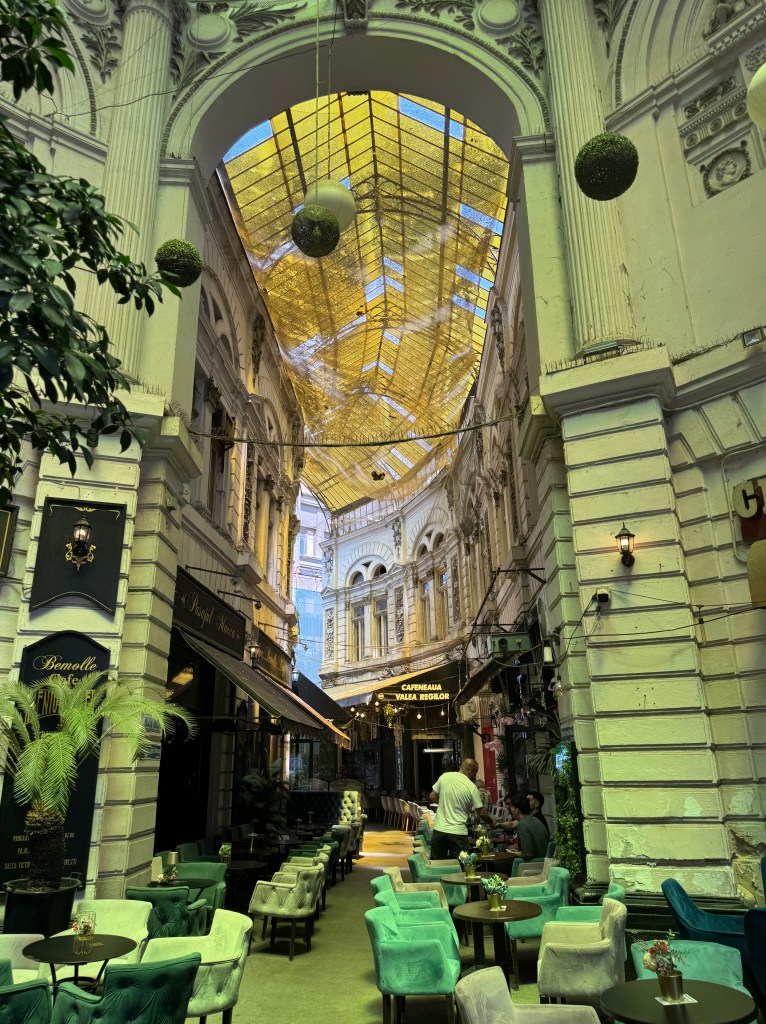

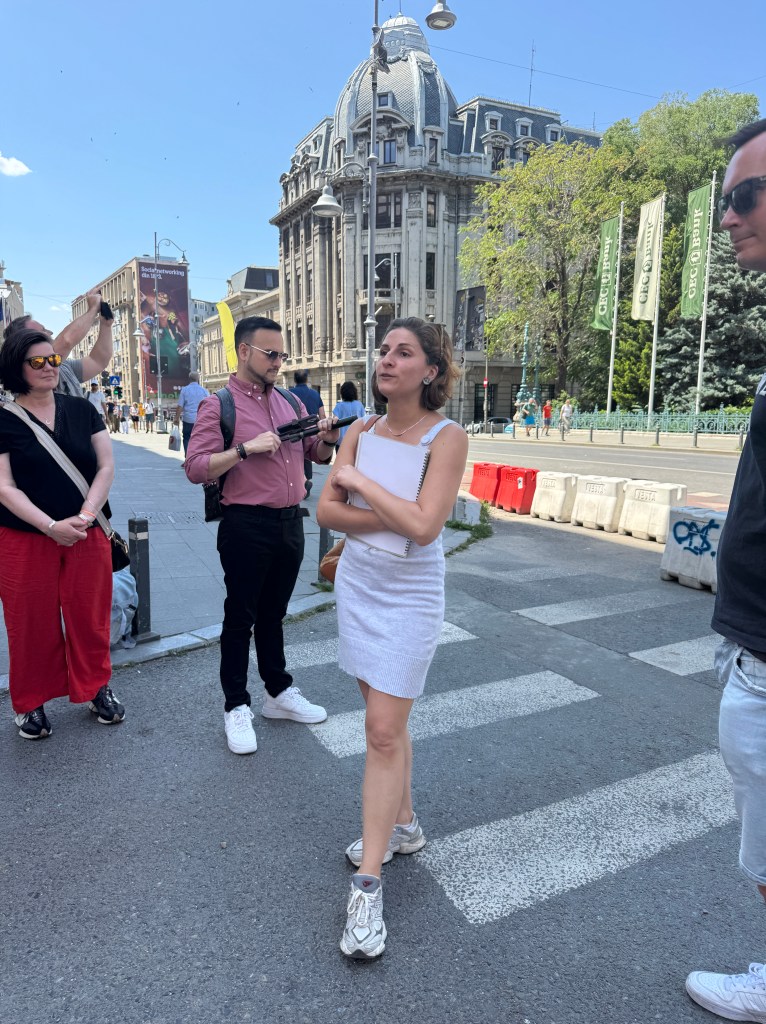


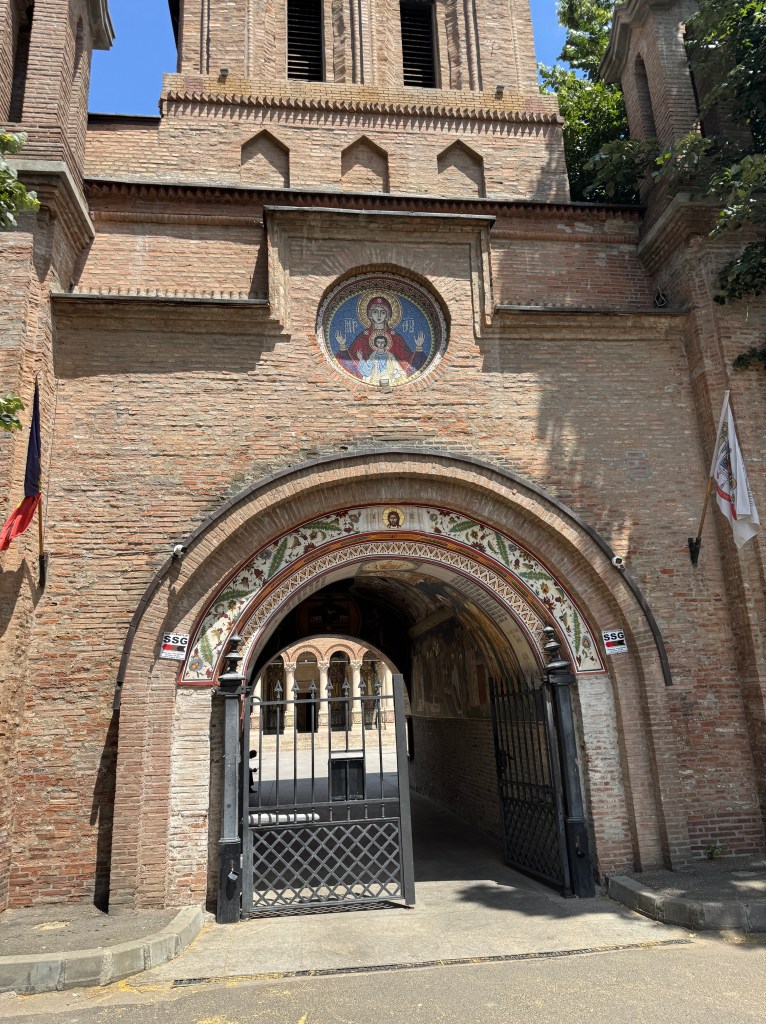

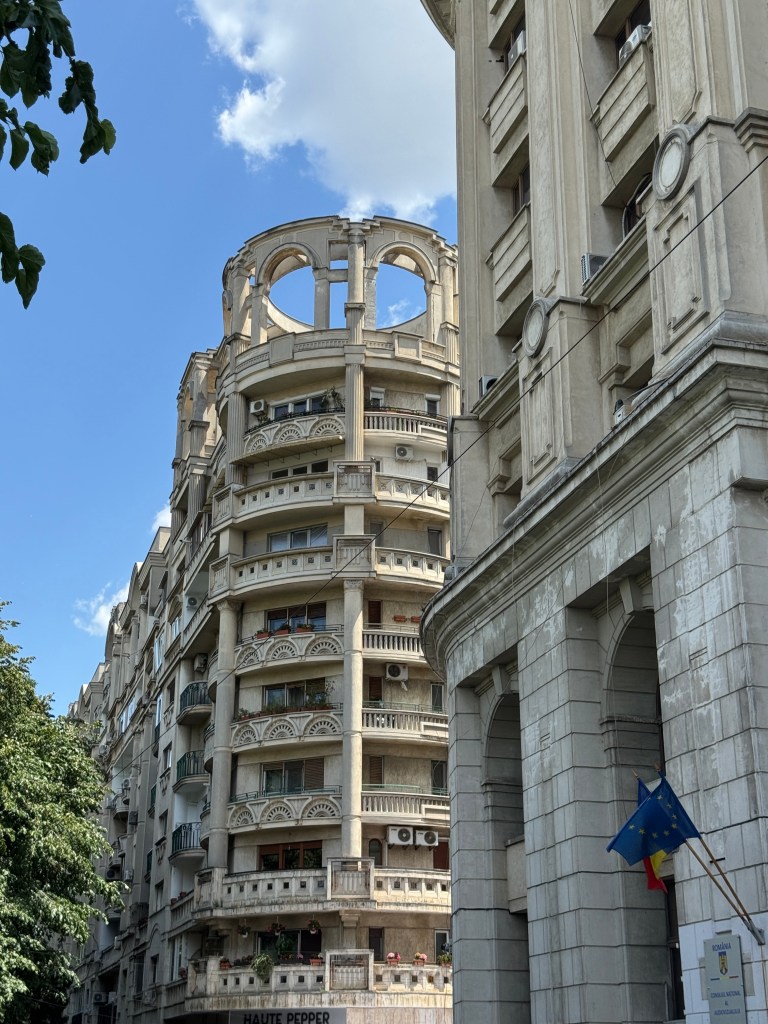

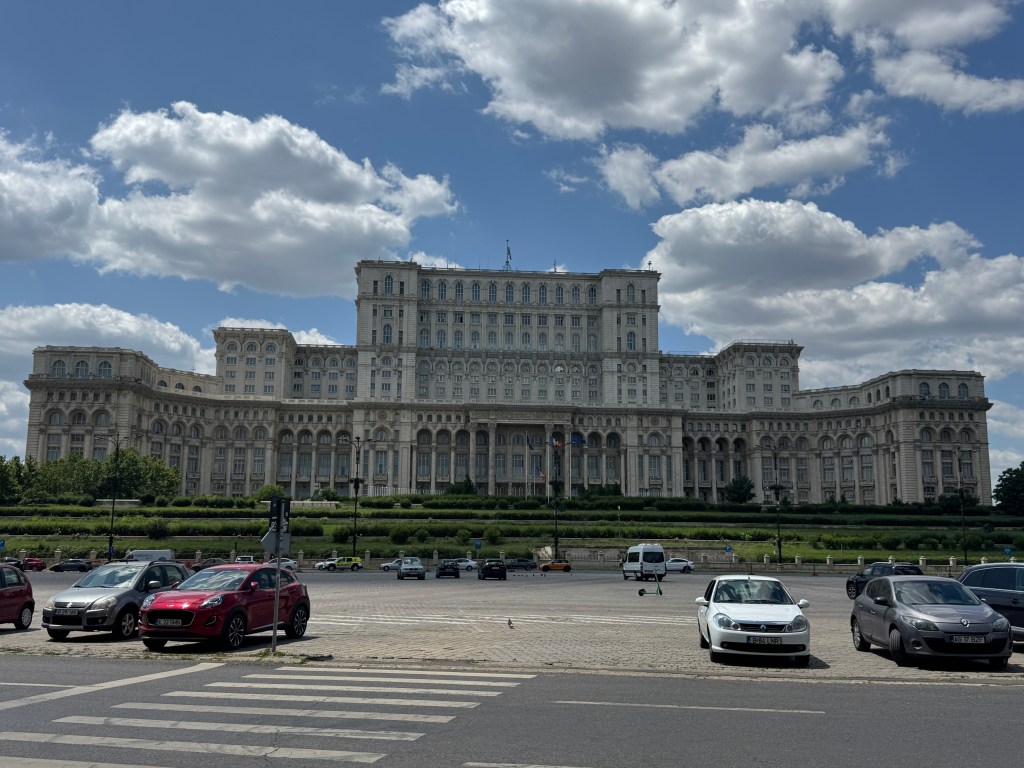
After the tour, we wandered back to the historic area and enjoyed a quick bite.
Sunday morning, we said la revedere si multumesc (goodbye and thank you) to Bucharest as we headed to the airport and back to Napoli.
Final Thoughts
I enjoyed my time, learned a lot about Romanian history and culture, but I don’t foresee myself going back to Bucharest. There was nothing there that really inspires me to return, even though, as many, many people pointed out, it’s cheap to visit because the currency (Lei or RON) value is 5 RON to 1 euro. Although apparently, Bucharest has one of the largest spas in Europe that people rave about because it’s cheap. And while a spa is a delightful experience, I don’t foresee myself returning to Bucharest just for a cheap spa when there’s a terme (hot springs) right down the road from me and other termes and spas in Italy I’d rather visit.
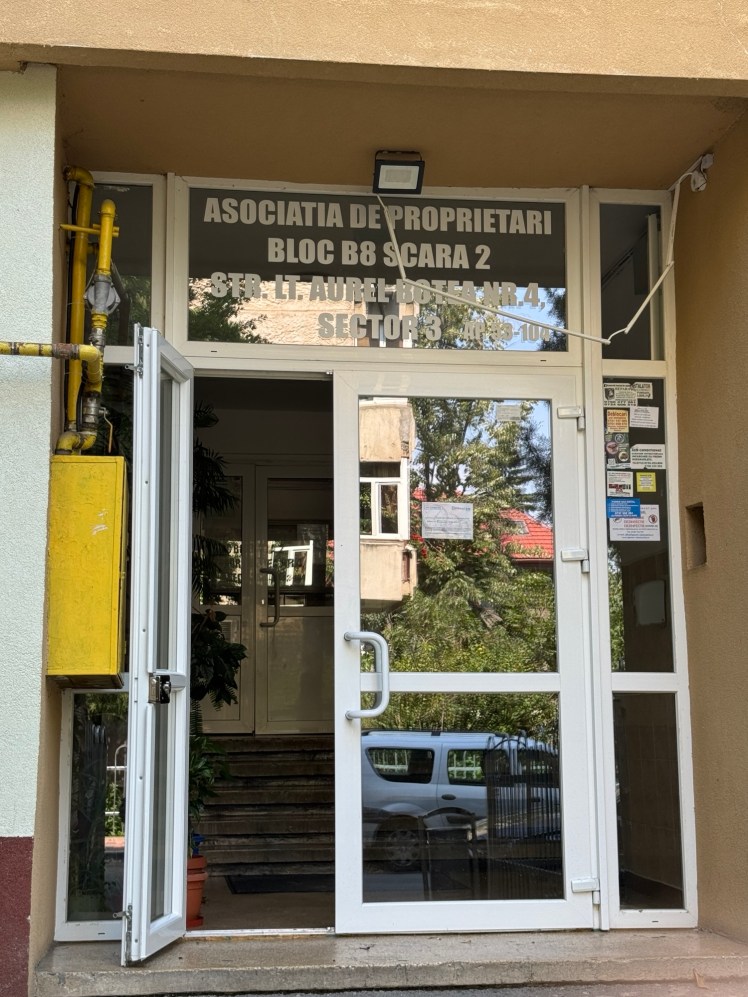
an apartment building sign stating the sector and blocHonestly, I found Bucharest to be a bit sad. Between the fire in the mid-1800s that wiped out about 90% of the city and the devastation from communist era, Bucharest has very few actual historical buildings. The scars of communism remain today, starting with the fact they still call the 6 city areas “sectors”.
The signs on buildings still refer to the Sector number and a “bloc” number. Combined with the gray rectangle boring communist-era buildings, all of which seemed to be covered in graffiti, it has a prison-like feel, even with the remaining neo-classical buildings and the wide streets and sidewalks with all the fountains and trees.
So while I do recommend visiting Bucharest and I’m glad I visited Bucharest, I have marked it off the list. That being said, I do have plans to return to Romania. I want to see the Transylvania side and the Carpathian Mountains, which are said to have some wonderful castles (and, of course, the whole Dracula lore).
Next up, well who knows. I currently have nothing booked. So check back to see where my adventures take me next!
Travel Tips
1: How I “spin the Skyscanner wheel” to find new places to visit without breaking the bank. (1) Select “flights”. (2) Enter your home airport. (3) Click on the destination box and select “everywhere”. (4) Add dates (or be flexible). (5) Skyscanner shows you the cheapest flights.
It’s super easy. My personal preference is also to select “direct flights” but direct flight availability depends on a variety of factors.
2: Budget airlines sometime seem to have the best price, but always check with the non-budget carriers. The “flight” price of a budget airline (here, these include Wizz, EasyJet, and Ryanair) often do not include the following:
- baggage except the underseat bag (yep, they will charge even putting a bag in the overhead bin)
- selecting seats
- checking in at the airport / paper boarding passes
- auto-checking in
- priority boarding – and be prepared for mass chaos
- entertainment – there is none except what you bring with you
- drinks/food – no in-flight service unless you pay for it
So while the price may seem cheap, it can quickly add up with the various “extras”.
I will say that we flew Wizz to Romania. While I didn’t care for the mass chaos of boarding (which also involved walking out to the tarmac), the plane was clean and as comfortable as economy class can be. Since our flight was only 2 hours, it was tolerable, but I wouldn’t want to fly a budget airline for longer than 2 hours.
 wanderinglynn.com