In June, we took a weekend trip to Matera, Italy. I wanted to visit Matera because where else can you now sleep in a room that was first occupied 9,000 years ago?
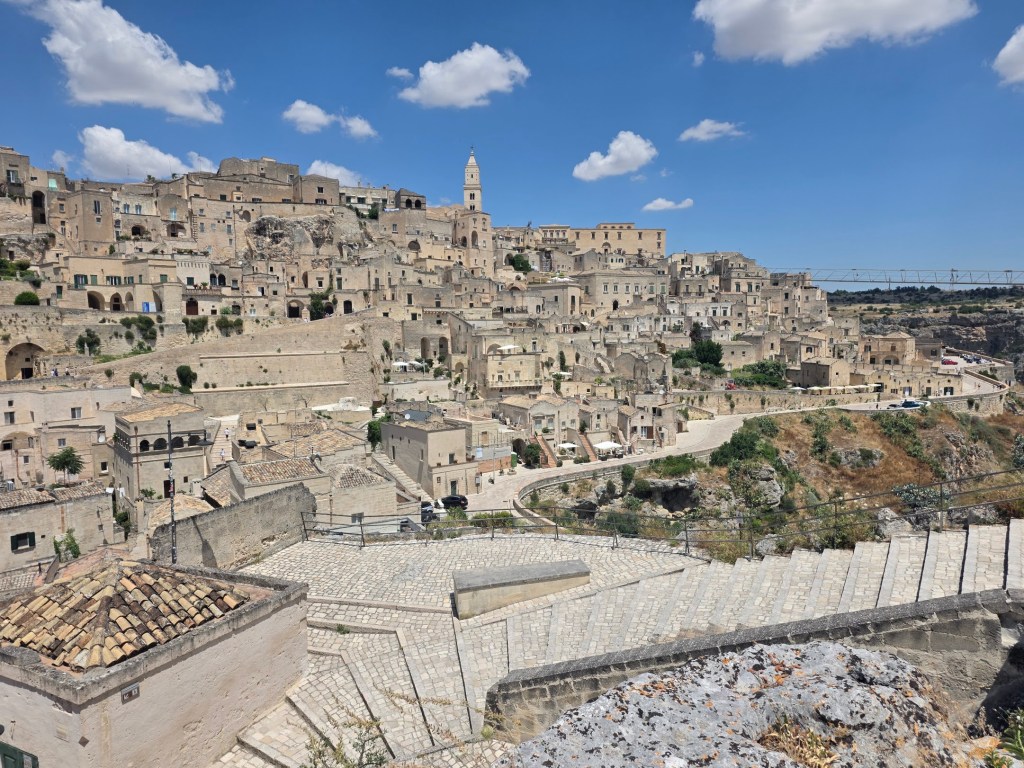
Matera, in the region of Basilicata, in Southern Italy, is thought to be the third oldest continuously inhabited settlement in the world (after Jericho and Aleppo). Renowned for its rock-cut urban core, its twin cliffside zones are known collectively as the Sassi (Italian for stone).
The Basilicata region borders Campania, where Naples is. But Naples is on the farwest side of Campania and Matera is on the far east side of Basicicata on the border with Puglia, and so, it took us about three hours to drive there.
(Not interested in History? Skip to the next section or even to my final thoughts.
A Little History
Matera is one of the oldest living cities in the world in terms of continuity. It’s like an open-air museum. While there are more ancient towns, most of those are no longer inhabited, whereas Matera has about 59,000 residents today.
Lying on the right bank of the Gravina river, the canyon forms a geological boundary between the hill country to the southwest and the Murgia plateau to the northeast. Consisting of some 1,500 cave dwellings honeycombed in the flanks of a steep ravine, the town was first possibly occupied in the Paleolithic Age (to approx. 10,000 BCE). While estimates of the earliest occupation of the site vary, archaeologists have found artifacts in local caves dating to the Neolithic period (10,000 – 2,000 BCE).
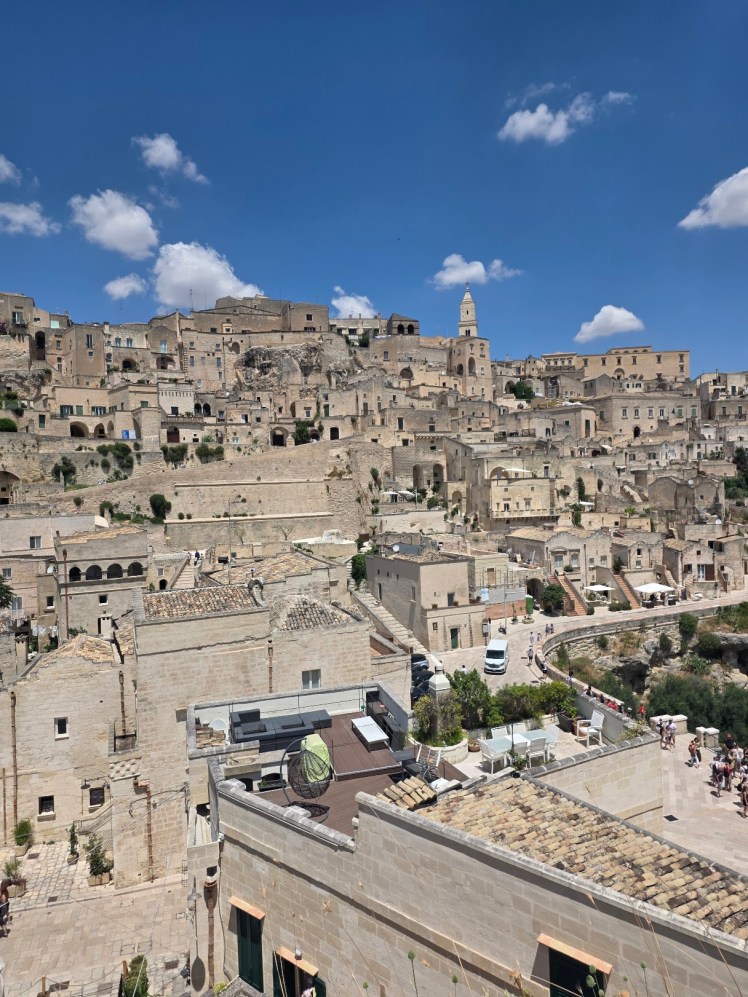
Divided into two districts, Sasso Ceveoso and Sasso Barisano, the Sassi is separated by the central rocky spur of Civita. This central high ground, or acropolis, supports the city’s cathedral and administrative buildings. Then the two settlement districts scale down and burrow into the sheer rock faces as the Sassi.
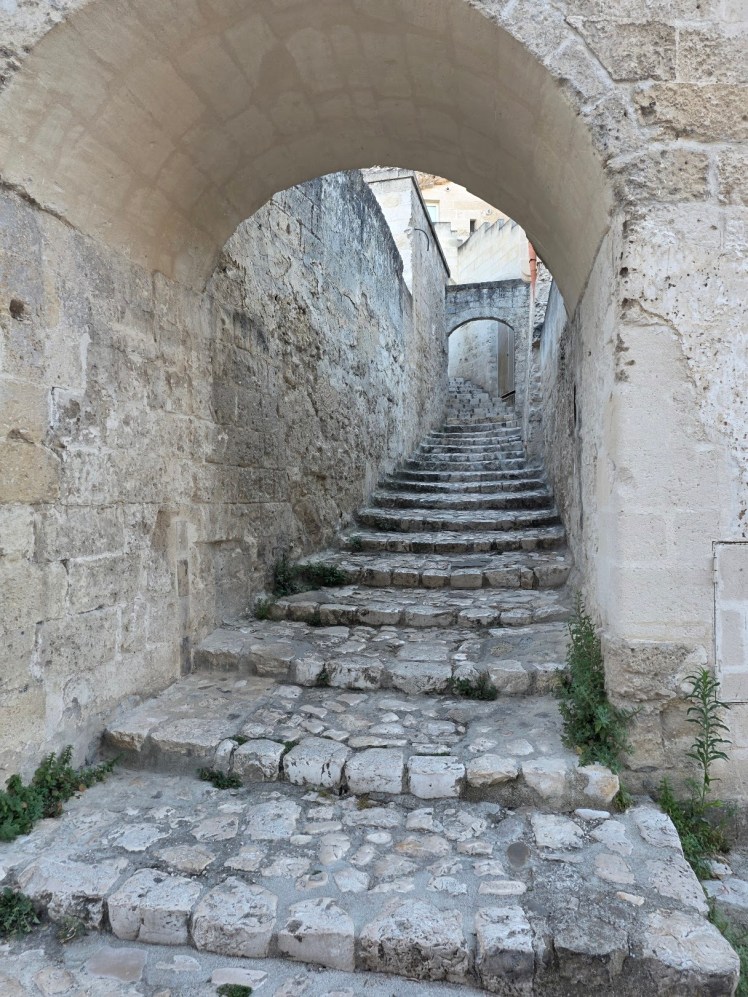
The Sassi consist of approximately twelve levels spanning the height of 380 m (1,246 ft.), connected by a network of paths, stairways, and courtyards (vicinati). The myriad natural limestone caves were gradually burrowed deeper and expanded into living spaces by peasants and artisans throughout the classical and medieval eras.
Writer Carlo Levi exposed the Sassi’s overcrowding and unsanitary conditions with no electricity or running water in his book. This lead to a national law in 1952, which called for the evacuation of the Sassi, considered the “shame of Italy”. The entire population of roughly 16,000 people, mostly peasants and farmers, were relocated from the Sassi to new housing projects in an ill-conceived government program, leaving the Sassi an empty shell.
In the 1980s, a local group of former residents started restoring the Sassi. In 1993, the Sassi was named a UNESCO world heritage site, and attention to the city’s complex past and extraordinary appearance has been steadily growing ever since, now culminating in a veritable renaissance. Matera was even designated the European Capital of Culture in 2019.
Once abandoned cave dwellings have been carefully renovated to cave homes, boutique cave hotels, and cave restaurants, and a surge of people have moved back to the Sassi.
Matera has also transformed into a favorite Hollywood filming location due to its ancient, rock-carved Sassi architecture. Movies like No Time to Die (2021), The Passion of the Christ (2004), Wonder Woman (2017), and Ben-Hur (2016) all have scenes featuring Matera.
Road Trip to Matera
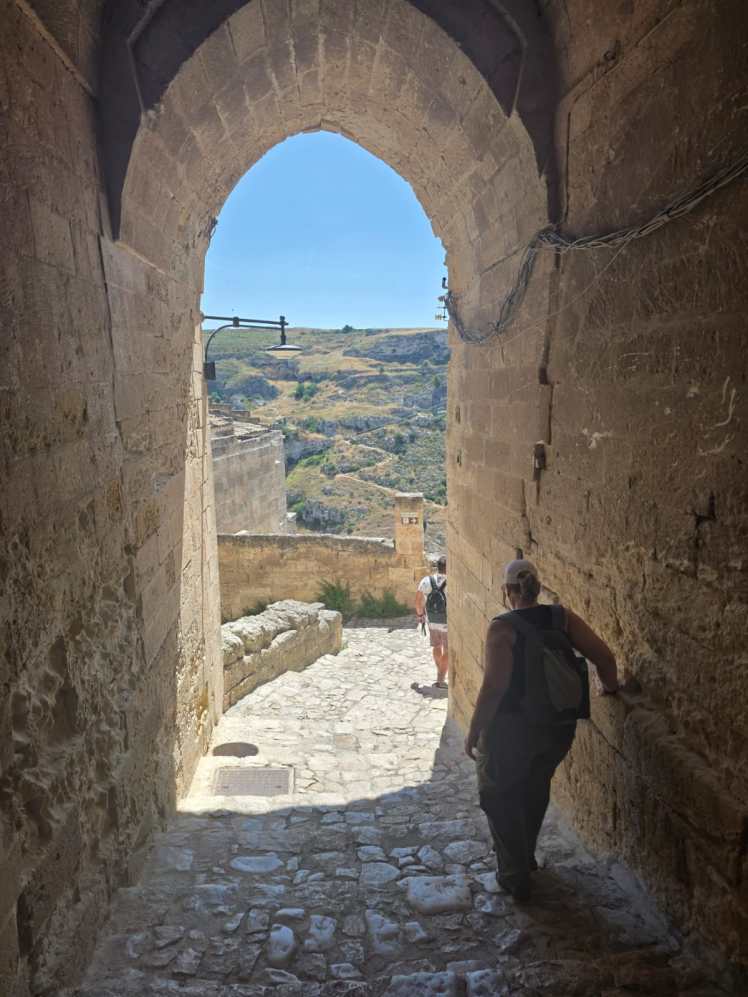
We drove into the upper part of Matera (“New Town”), the part built largely after the 1952 relocation project, which looks like any other newer Italian town. While there are cars allowed in the Sassi, parking is challenging, and so we opted to park in the New Town and walk down.
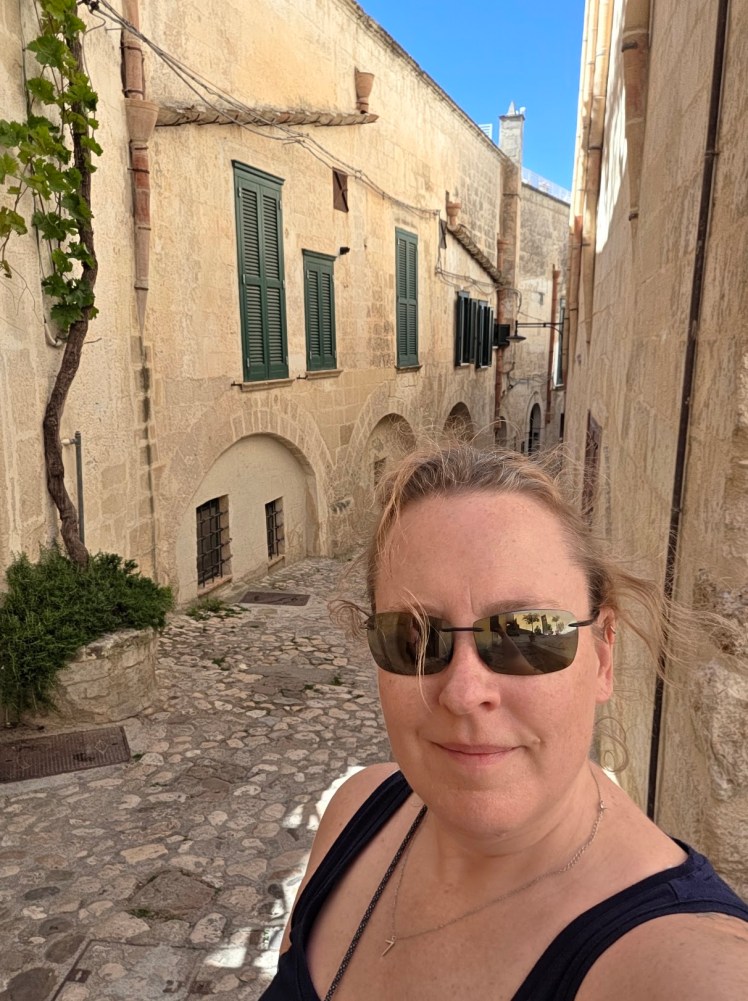
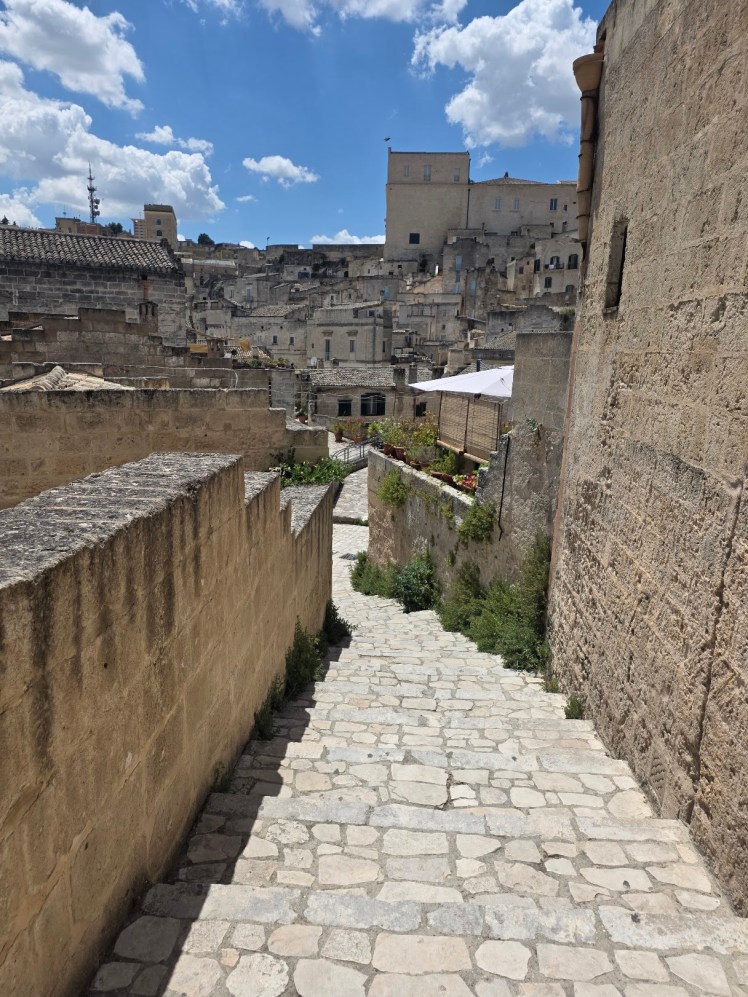
Walking into the Sassi is an experience. The view is incredible as you see the tiers and the winding path down to the bottom. Then across the gorge, the remaining caves on the other side.
We stayed in a cave hotel, L’Artiere Dimore Nei Sassi. Wiith only 5 rooms, L’Artiere is a family-owned and operated boutique hotel. All of the hotels in the Sassi are small, and likely all family-owned. We met the owner’s daughter and son-in-law, who were a lovely, welcoming couple. They made us feel at home and provided us with a delicious breakfast each morning including fresh peach juice, which was my favorite.
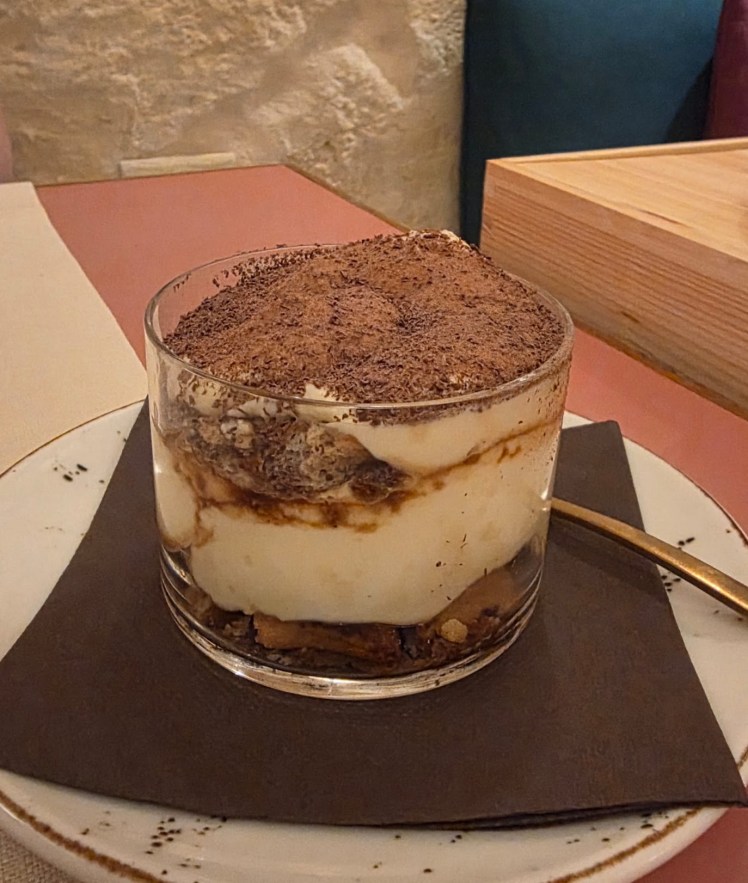
The first evening we just wandered around enjoying the view. Then we had dinner at Retròbottega Matera, one of the cave restaurants. I had a delcious pasta dish with black truffles, a special of the region, followed by a delicious tiramisu.
Day two, we opted to do a walking history tour. There are numerous tour operators. The one we chose had local guides and our guide happened to be a historian. She gave us a fantastic tour of the Sassi, including ancient history as well as more modern history. She even pointed out the spot where Passion of the Christ was filmed (the Sassi being a stand in for ancient Jerusalem).
The highlights of the tour included Matera Cathedral, the Casa Grotta del Casalnuovo, and Chiesa di Santa Lucia alle Malve.
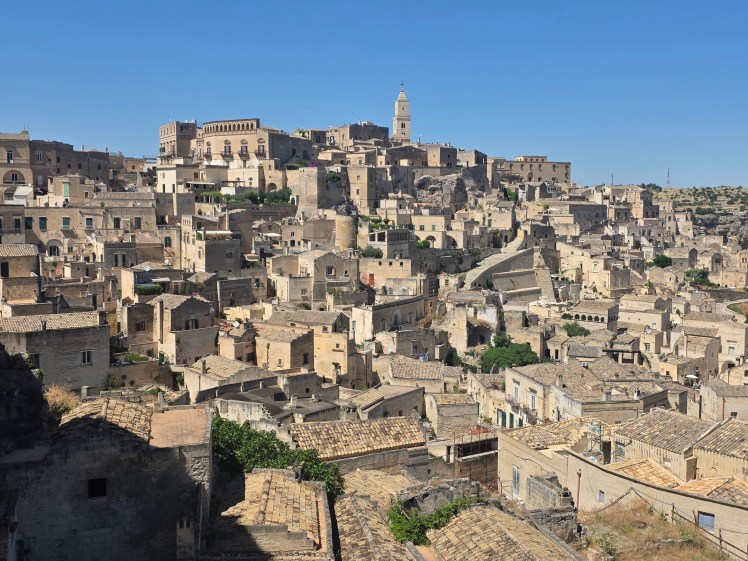
Matera Cathedral, located at the highest point of the city, was built between 1230 and 1270 and is dedicated to the Madonna della Bruna and Sant’Eustachio. Built in Apulian Romanesque style, the main façade features include the portal surmounted by a niche containing the statue of the Madonna della Bruna and the Romanesque rose window at the center of the façade. The Matera Cathedral complex is completed by the Bell Tower, which topped with a spire supporting a sphere and a cross.
The Casa Grotta del Casalnuovo is an authentic cave house museum. Preserved exactly as it was when a large peasant family abandoned it in 1958, the rooms are simply furnished and large families of up to ten people lived, often with their animals i cluding donkeys.
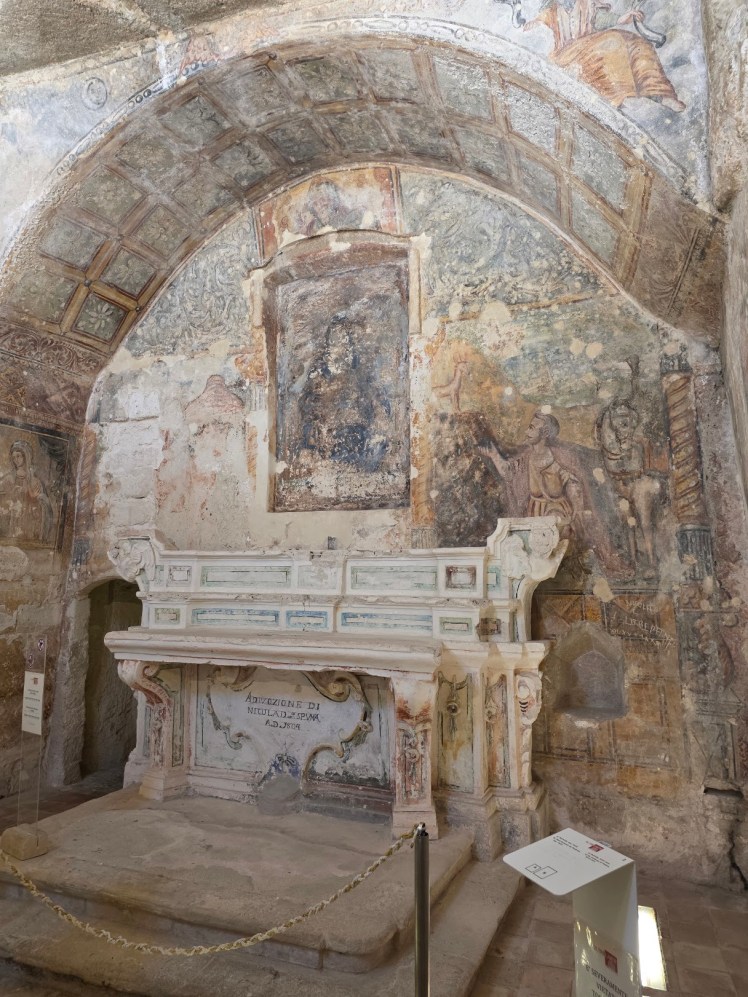
Chiesa di Santa Lucia alle Malve is an 8th-century rock-hewn church and former Benedictine nunnery carved directly into the cliffs of Sasso Caveoso. The walls hold well-preserved medieval frescoes dating from the 12th to the 14th centuries. Nuns left the complex in 1525, and locals later turned parts of the old monastery into homes. In 1977, workers restored the church to its original three-nave layout.
Because it was super hot, we spent the early afternoon inside guzzling water and resting. We went out again in the later afternoon and walked around, mostly to scope out restaurants.
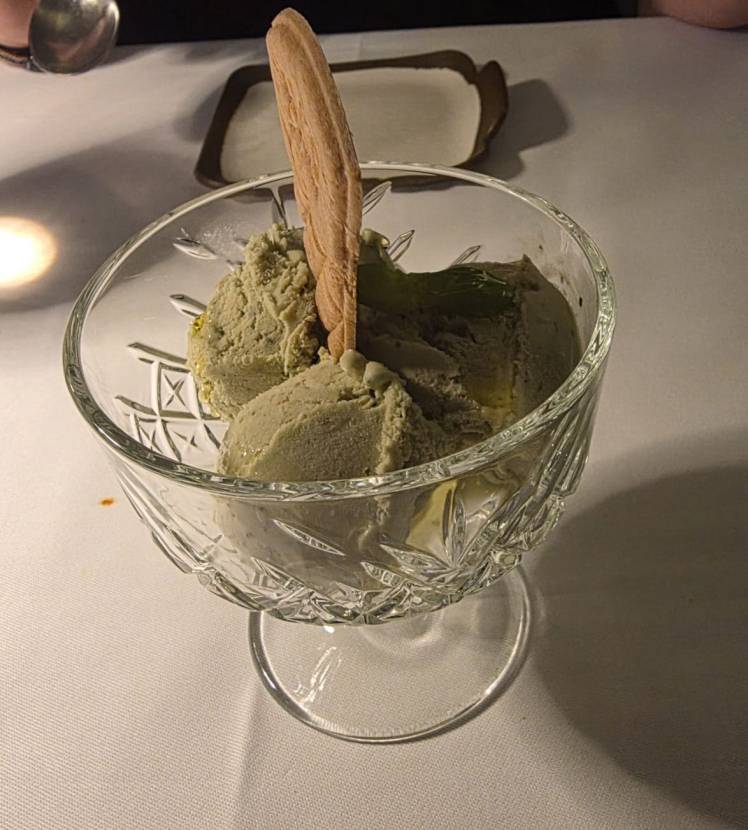
That evening we dined at Radino, where again I had a delicious meal followed by an incredible mint gelato.
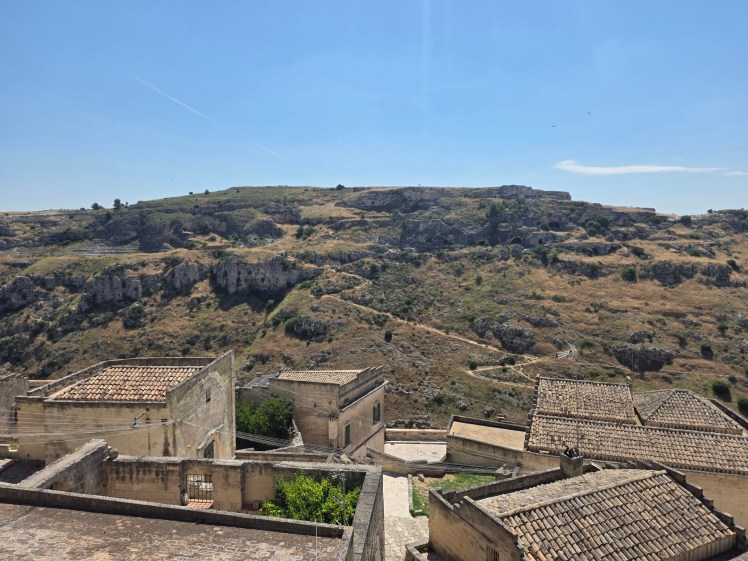
The next day we thanked our hosts and headed back to Napoli. One thing we didn’t do because of the heat was go across the gorge to the Murgia Materana Park. The Park offers the best views of the Sassi and there are hiking trails and other Paleolithic caves, including the Bat Cave. But that will have to wait for cooler weather!
Final Thoughts
I really enjoyed staying in the cave hotel and walking around the Sassi. The food was delicious and the whole experience is unique and fun. While two nights were sufficient to explore the Sassi, I definitely want to go back to hike in the park.
If you have the chance, I highly recommend stopping for at least one night to experience this fascinating piece of ancient history.
Where else have I been? Stay tuned to find out!
All content, including photos, © 2026 L. Long/wanderinglynn.com. All Rights Reserved. No part of this website or its contents may be reproduced, copied, modified, adapted, or used to train AI without prior written consent of the owner.
Any links are merely for reference or for your convenience.
 wanderinglynn.com
My spouse has been wanting to visit Italy, but aside from an interest in the Dolomites, I’ve not been very enthusiastic about prioritizing that part of Europe (I almost always opt to visit mountains before anything else). But now that I’ve read about your visit to Matera, which I’d not heard of before today, I have another part of Italy I’m interested in visiting. Your second sentence hooked me, and I got more enthusiastic the more I read. On the list Matera goes!
LikeLike