Despite my promise, I once again got knocked off course. This time by an asteroid strike. So, totally not my fault. But that means I read another book not on my #SciFiMonth TBR.
I had read Simak’s Way Station a couple of years ago and absolutely loved it. It was easy to see why Simak won 3 Hugos and was a Grand Master of Sci-fi & Fantasy writers.
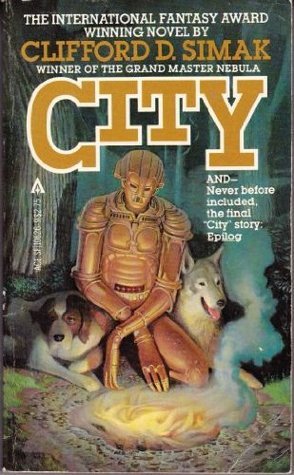
City was originally a series of 8 short stories published from 1944 to 1951, and it was published as a book in 1952. The story features Jenkins, a robot who was the companion of the Webster family. One generation of the Websters then mutated dogs so that dogs could talk. And as the Dogs developed and advanced, aided by robots, humans ceased to be the dominant species on Earth and became creatures of legend.
The first question, of course, is whether there ever was such a creature as Man. At the moment, in the absence of positive evidence, the sober consensus must be that there was not, that Man, as presented in the legend, is a figment of folklore invention. Man may have risen in the early days of Doggish culture as an imaginary being, a sort of racial god, on which the Dogs might call for help, to which they might retire for comfort.
Simak connects his 8 stories with a series of introductory “scholarly notes” that summarize the opinions of Doggish critics through the centuries. These Doggish critics analyze the significance of ancient folktales and conjecture that mankind itself may be nothing but a canine myth.
The 8 stories stretch from 1990 to more than ten thousand years in the future, which is quite a feat for a book that’s right around 250 pages. For such a short book, it is an expansive story that covers a broad range of ideas from drastic social change to technology and science. From the downfall of cities to mutations and robots to planetary expansion and parallel dimensions.
This vastness of time and change dealt with in the book combined with the short story framework lends itself to skimming the surface of the characters and the action. While there is one common character throughout (Jenkins), and a common family (the Websters), we never really learn enough about them to become invested.
Of course, a deep dive into the characters is not the point.
What Simak does in only 250 pages is provide a nuanced and subtle examination of family, home, and human nature. It is clear throughout that he has a strong connection to nature and is a humanist. And this soft spoken style is where his genius shines.
The pacing and tone tend to be contemplative and the philosophical questions he raises more than make up for the absence of action or hard science. If philosophical science fiction was a subgenre, then Simak would be the at the top.
All that being said, while I absolutely appreciated this book, it didn’t capture me as much as Way Station. It is worth nothing the impressive feat that all 8 stories connect so well considering they were written over the course of 8 years.
In sum, City is definitely worth reading.
If Man had taken a different path, might he not, in time to come, have been as great as Dog?
Two books down. Now, will I attempt to get back on course and will next report on one of the books from my #SciFiMonth TBR.
Links to Bookshop.org are affiliate links, which you can read more about on my Terms page. Any other links are merely for reference or for your convenience.