I teased the location of my October trip with 3 clues and then a photo. We went to Morocco!
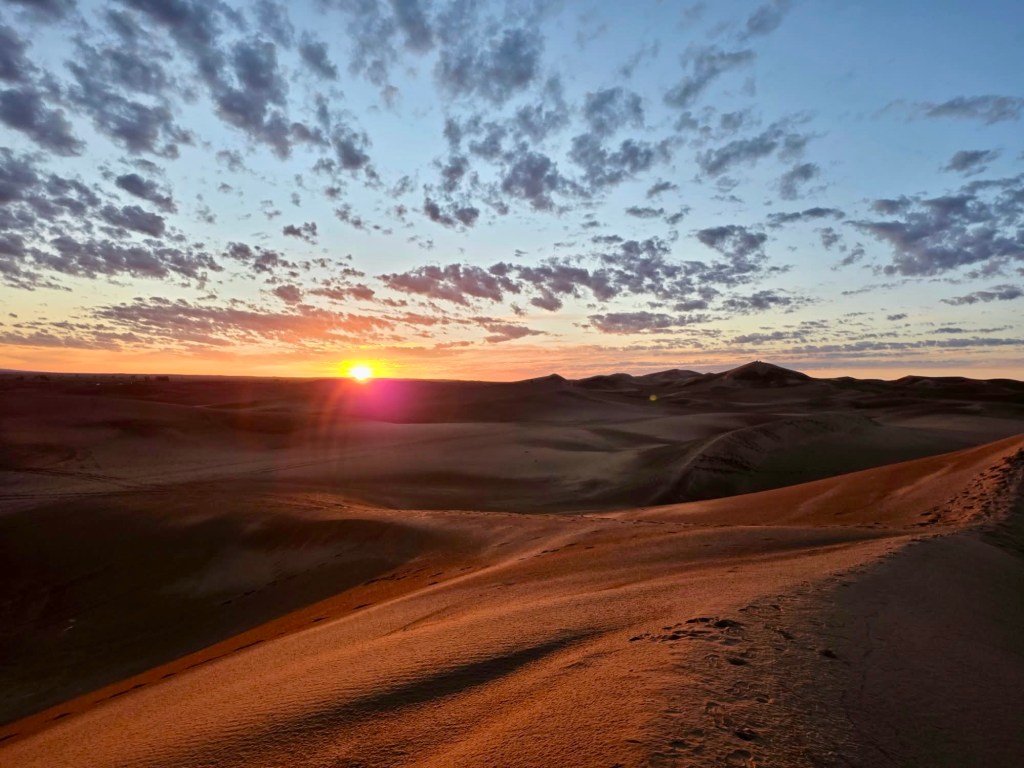
Sahara sunriseFor this trip, I decided to go with a local Moroccan tour company. I normally plan and book trips all on my own, but this trip I wanted to be able to completely enjoy without worrying about getting from one place to the next or how to get to the hotels or just where to go.
I used Morocco Shiny Days, who planned a fantastic trip. I told them what I wanted to see (primarily the Sahara and Legzira) and they took care of everything from booking hotels to arranging tours to providing us with a driver/guide (Omar, who was the absolute best). But more on that below.
(Not interested in History? Skip to the next section or even to my final thoughts.
A Little History
Long before the Romans, Arabs, French, and Spanish, Morocco was home to the Amazigh people. Often referred to as “Berbers”, the Amazign tribes having been living in North Africa at least 10,000 years.
The term “Berber” was historically used by outsiders, mostly the Greeks and Romans. But the preferred term is Amazign, which means “free people.”
Not a homogeneous people, the Amazign are made up of many tribes and communities across the Maghreb region, which includes Morocco, Algeria, Tunisia, Libya, Mali, and Niger. The Amazign lived as farmers, traders, and warriors and their societies formed the deep foundation of Moroccan identity.
Starting around 1100 BCE, Phoenician traders created coastal settlements in Morocco and later expanded its influence until it was annexed to the Roman Empire in 40 CE.
Rome built major cities across northern Morocco. Like the rest of the Roman Empire, Roman rule brought roads and infrastructure, agricultural development, city planning, and even cultural exchange with the Amazigh. Rome withdrew in the 5th century and Amazigh kingdoms re-emerged.
In the 7th and 8th centuries, Islam spread into North Africa. Like most colonizers, the spread if Islam involved conquest, resistance, alliances, and gradual conversion. While Morocco’s tribes eventually adopted the new religion, they also maintained their independence.
Everything changed in the late 8th century with the arrival of Idris I. He gained support among local Amazigh tribes. The Idrisdis founded one of the world’s oldest universities, Al Qarawiyyin, in Fez and gave Morocco a lasting political foundation. They also helped establish the importance of sharifian legitimacy, meaning rule based on descent from the family of the Prophet Muhammad.
In the 11th century, the Almoravids rose from the Saharan and Amazigh world and built a powerful empire that connected Morocco, the Sahara, and al-Andalus. They ruled from 1040 to 1147 and founded Marrakech, which became one of the great capitals of Moroccan history.
Then there were 3 more family dynasties until the 17th century when the Alaouite family took power. The Alaouite dynasty restored national unity, defended Moroccan sovereignty, and still govern today.
By the late 19th century, Morocco found itself caught in the crosshairs of European imperial ambitions. As a result, in 1912, Morocco was divided into two protectorate zones (French and Spanish) under the 1912 Treaty of Fez.
In 1956 under Sultan Mohammed V, Morocco gained independence following a nationalist movement that sought to end colonial rule. Morocco celebrates its Independence Day on November 18 and Mohammad VI, the current ruler, became king in 1999.
Moroccan Adventure
Now for the good stuff. We spent 11 days and 10 nights in Morocco.
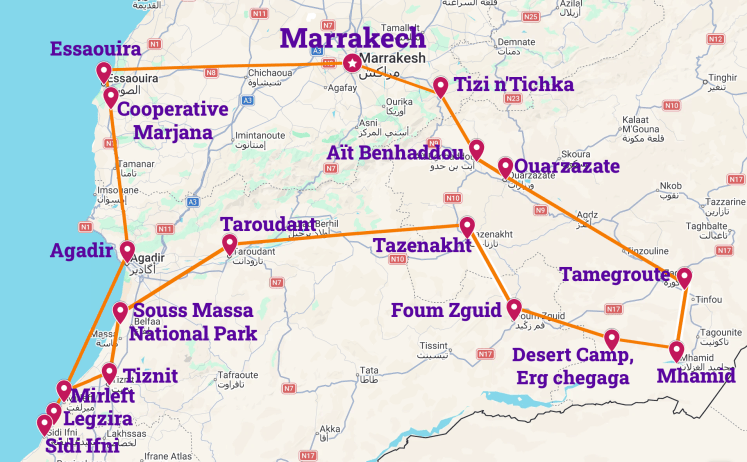
our general route around Southern MoroccoDay 1 – 3: Marrakech
Our trip started in Marrakech. Only a 3 hour flight from Naples and we gained 2 hours, we landed in Marrakech early afternoon and met our guide Omar, who took us to the medina where our riad was located.
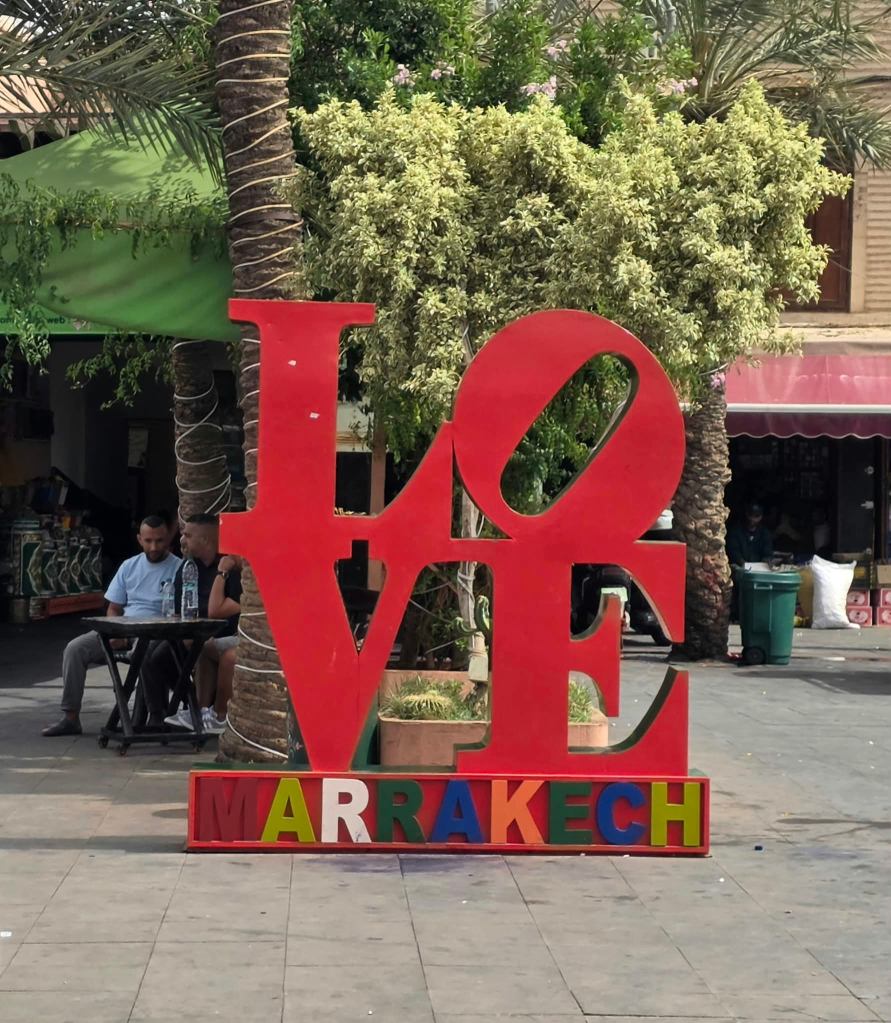
A medina is a historical district, often corresponding to an old walled city. The term comes from the Arabic word simply meaning “city” or “town.” A riad is or riyad is a type of garden courtyard historically associated with house and palace architecture in the Maghreb and al-Andalus. Today, many of these houses have been turned into hotels.
Our riad was stunning. The windows in our room looked out onto the courtyard. (The windows are inward focused, which allowed for family privacy and protection from the weather.)
After dropping our bags, we headed out to start exploring on our own.
The medina of Marrakech has been a UNESCO World Heritage site since 1985 and is home to a maze-like network of souks (a market, or part of a market, in an Arab city) selling everything from spices and carpets to leather goods and jewellery.
When we came back to the riad later that evening, we had our first taste of tagine at our riad.
Tagine or tajine is a Maghrebi stew, named for the earthenware pot in which it is cooked. The tagine pot consists of two parts: a shallow, circular clay skillet and a tall cone- or dome-shaped cover. The dome cover captures and returns condensation during cooking, so the ingredients are braised with minimal water. The stew typically combines spiced meat, poultry or fish with vegetables or fruit.
After breakfast, our local tour guide Khalid met us at 9:30 for what turned out to be a nearly 5 hour tour!
We saw all of the old medina, the palace, the school, both souks, and Jemaa el-Fna Square, one of the busiest squares in North Africa. During the day, the square is predominantly occupied by orange juice stalls, and men with chained macaques and snake charmers (despite the protected status of these species under Moroccan law). In the evening, more peddlers come out, along with henna artists, storytellers, musicians and dancers.
During the tour, we learned that Khalid was of Amazign origin. He told us history as well as cultural information. We had a blast with him.
After we bade Khalid goodbye, we headed back to the riad for a rest before going back out for dinner.
The next day, we said arrivederci to Marrakech and headed to the High Atlas Mountains.
Day 3 – 4: High Atlas Mountains & Ouarzazate
Now, in Marrakech, we wore t-shirts and shorts. But as we traveled east, and the land went from flat to hilly to going up a mountain, the weather also got chilly. Needless to say, I not only wore pants and a fleece coat but also wore a vest over the coat as well as a scarf.
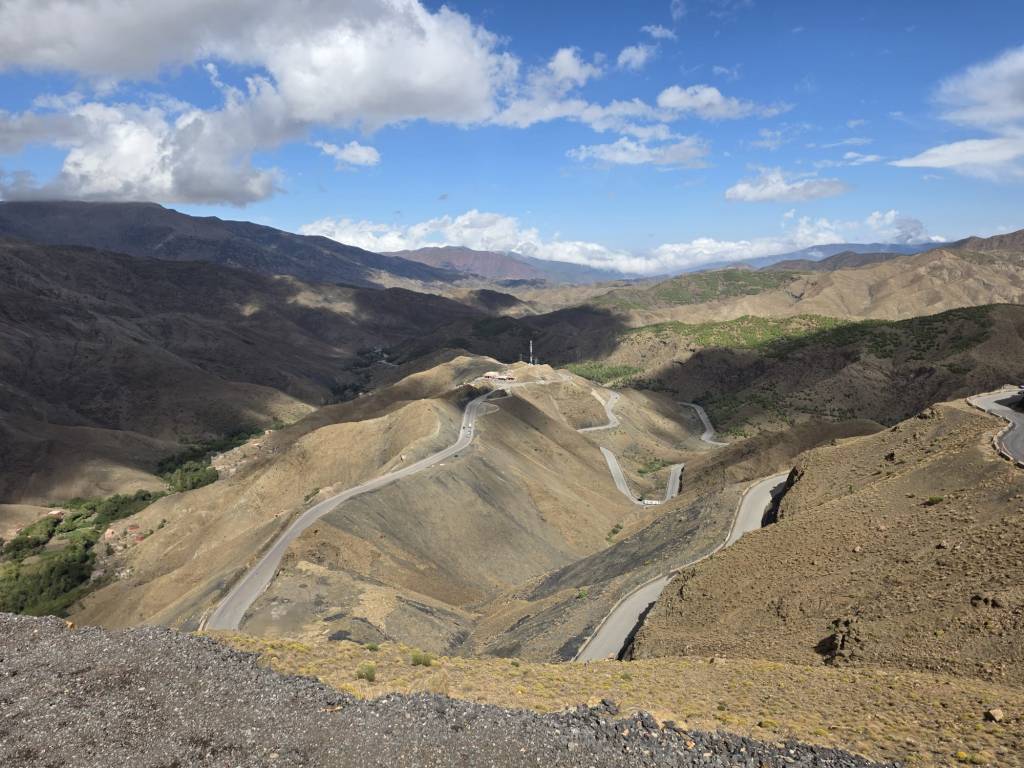
view of the mountains and the road we were onAfter a stop at Tizi n’Tichka pass, we headed on towards Ouarzazate. On the way, we stopped at the fortified village Aït Benhaddou, a UNESCO World Heritage Site, and Télouet Kasbah, located by the small Berber village of Télouet. Our tour guide at the kasbah was Berber (the term he used). This village had been a strategic position in the High Atlas, on the caravan route as well as near salt mines, which at the time, was more valuable than gold.
Then we continued on to Ouarzazate, a noted film-making location, often called the Hollywood of Africa. Films such as Lawrence of Arabia (1962), The Last Temptation of Christ (1988), The Mummy (1999), Gladiator (2000), and The Odyssey (2026) were shot here. One of the people we met proudly told us he had seen Denzel Washington when he was filming Gladiator II (2024).
We were supposed to go onto the Draa Valley to stay in a kasbah in Oulad Yahia Lagraire. But Morocco roads have many low points. One such low point had become quite the raging stream and cars were stopped on both sides waiting.
Now, while almost every other vehicle was waiting, one car decided to chance it.
Let me just say this is never a good idea.
The car didn’t make it far before the water quickly swept it downstream. We watched in horror as the water swept the car downstream. Several men ran down both sides of the makeshift river to aid the vehicle.
Omar told us the next day that the couple had climbed onto the top of their car and a village further downstream had rescued them.
A good rule of thumb: when big trucks aren’t crossing the roaring stream, it’s a good idea to just stay put.
We waited about an hour and when the water didn’t seem to even be close to receding, Omar suggested we return to Ouarzazate, which we agreed.
The benefit of doing a tour is that Omar called his office and they immediately arranged new accommodations for us in Ouarzazate. I was disappointed we didn’t get to stay in Draa Valley, but it’s a good excuse to return.
Day 4 – 6: Tamegroute Pottery, Mhamid, & The Sahara
The next day we headed back towards Draa Valley. By that time, the water had all but disappeared and only some muddy patches remained.
On the way to the Sahara, we stopped in the village of Tamegroute, which is known for it green pottery. These green-glazed ceramics are crafted using clay sourced from the River Draa and shaped by artisans whose skills have been passed down through generations. Each piece is sun-dried, hand-glazed, and fired in one of the seven traditional village kilns, each one used by a different family.
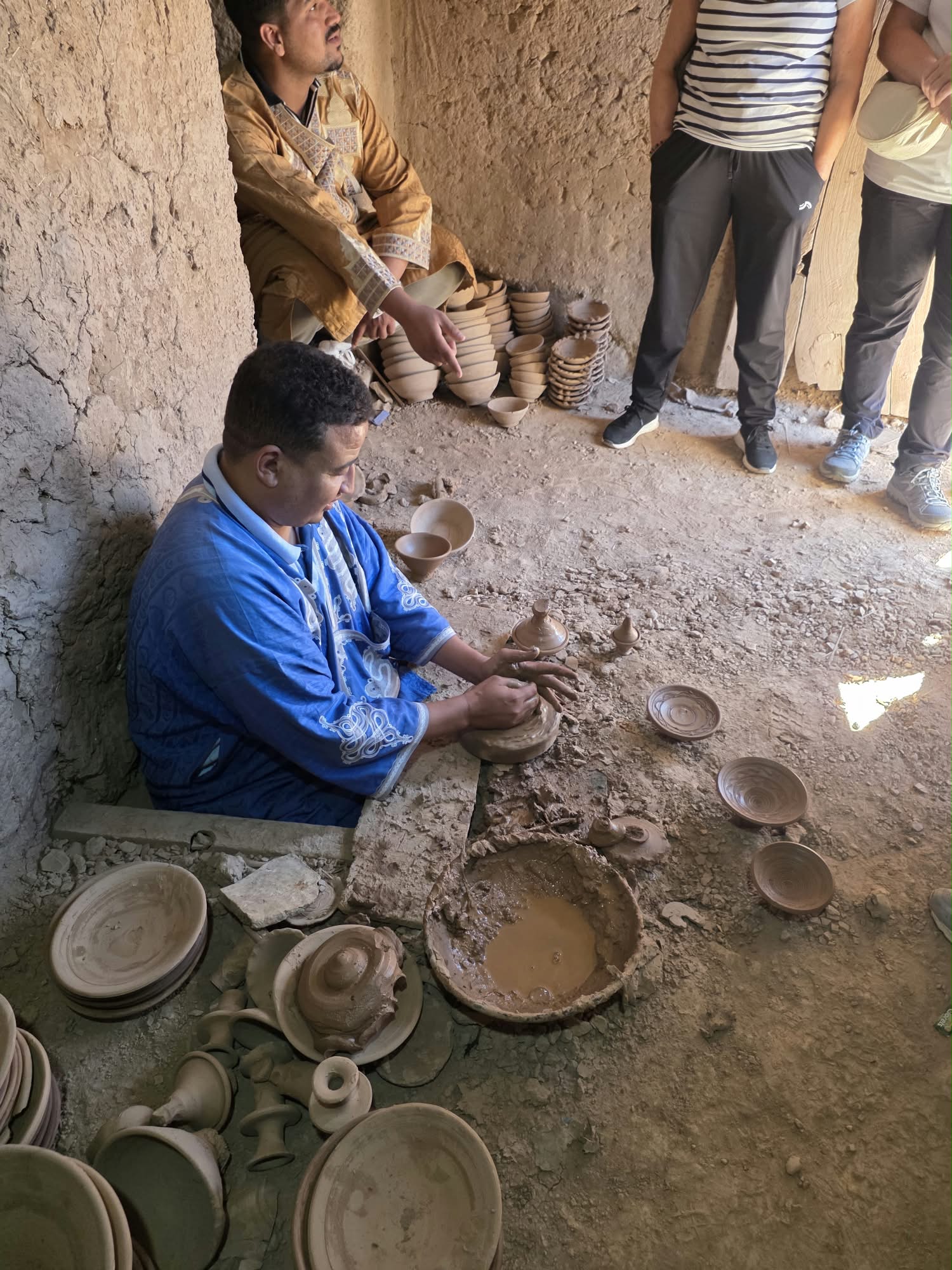
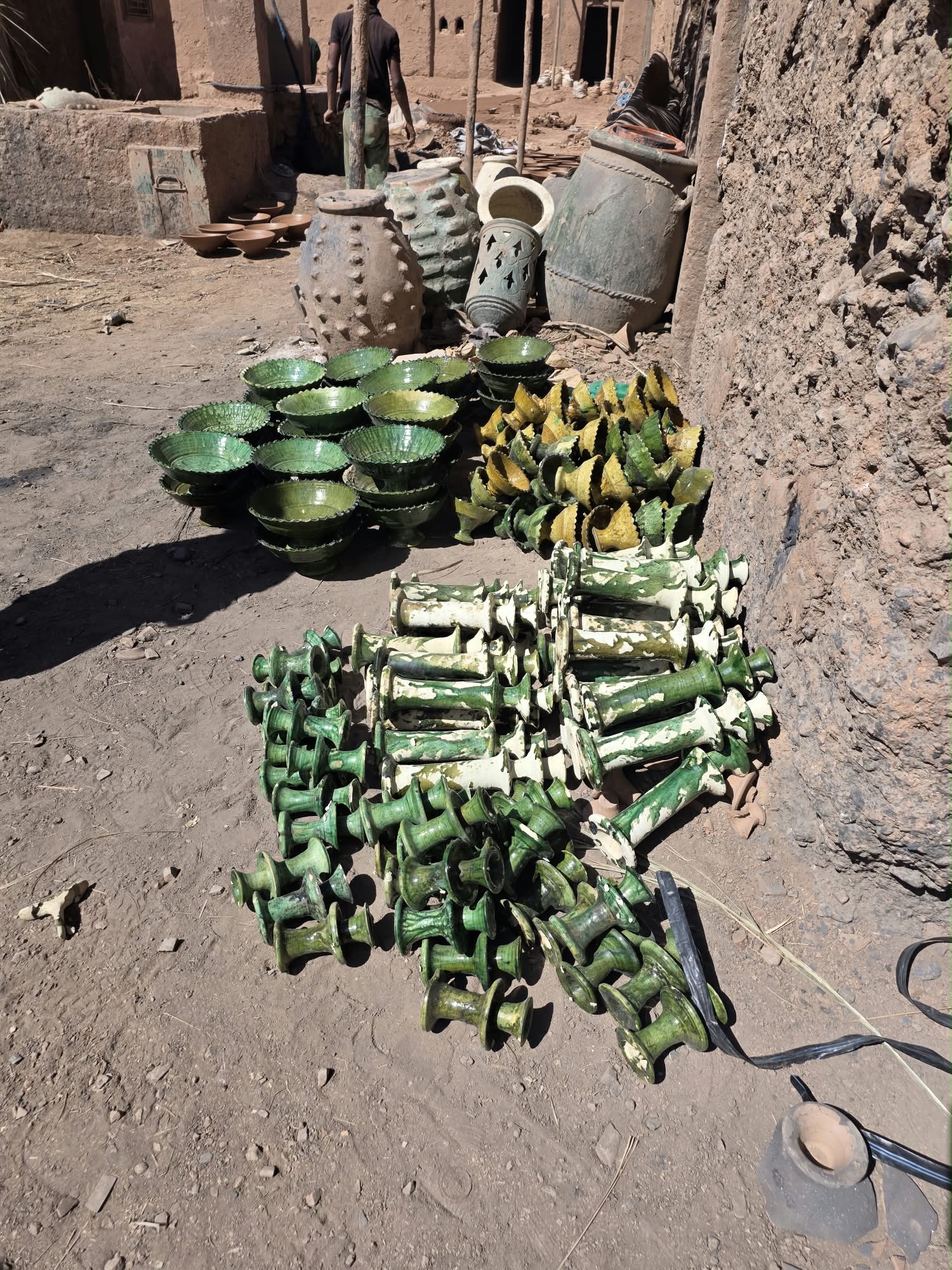
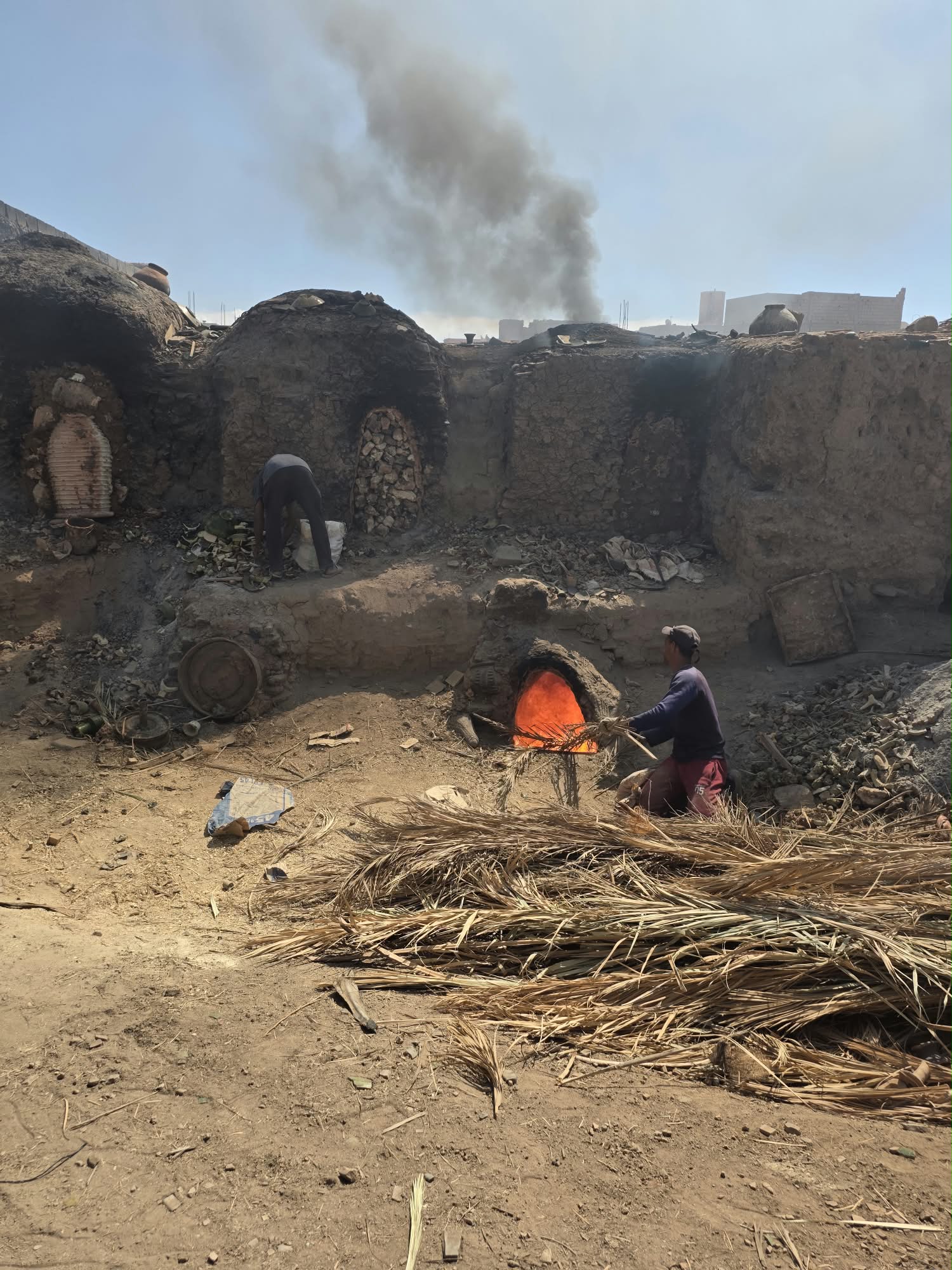
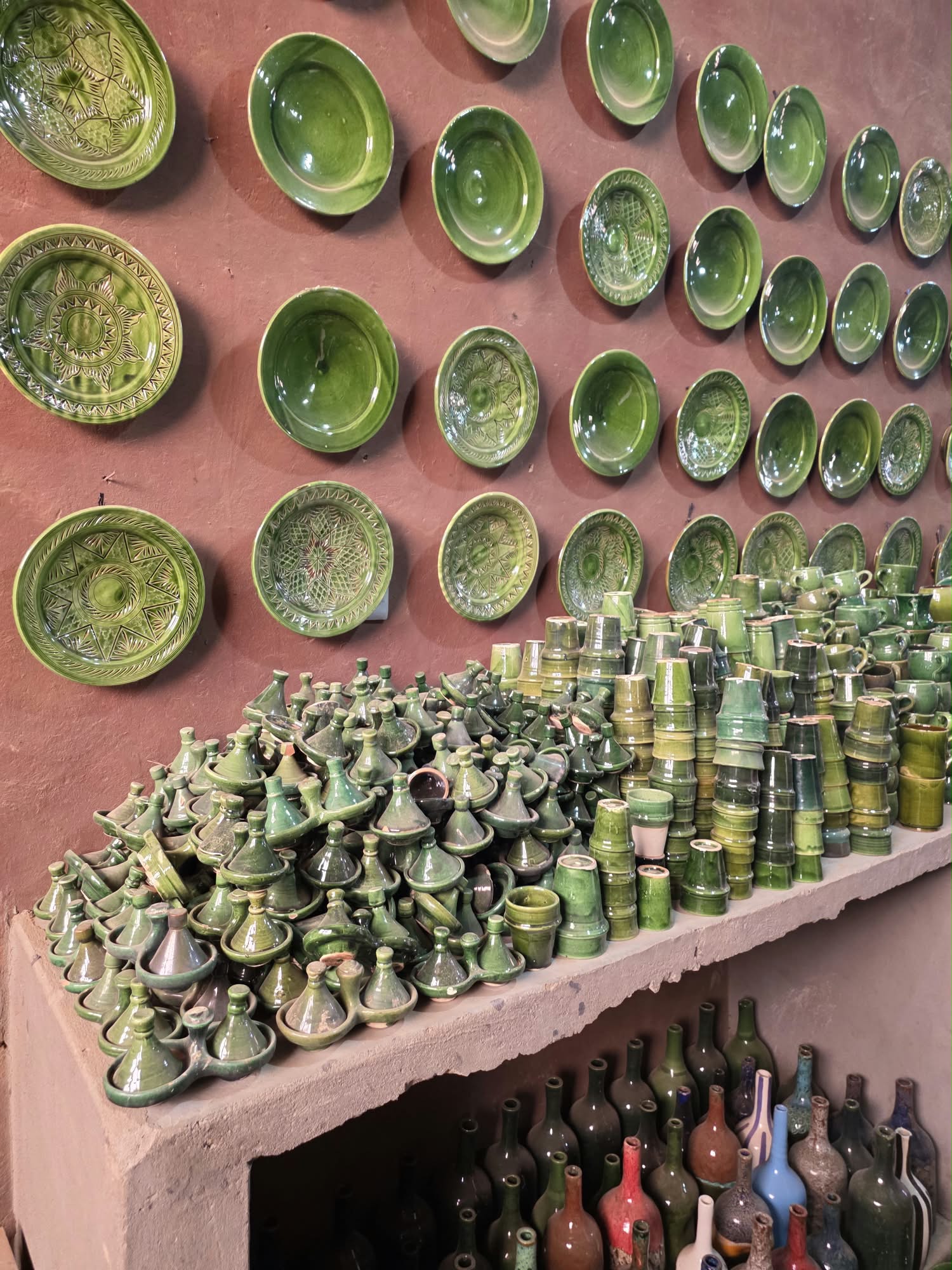
Our guide showed us the village and then demonstrated making the pottery and showed us the traditional kilns, which reach temperatures of 1100°C. The heat from the kilns was hot in October, so I can’t imagine what it would be like in summer when temperatures exceed 45°C.
I purchased a small green bowl (could only pack so much in my bag). We then continued onto Mhamid.
Mhamid is a small oasis town on the edge of the Sahara—the Gateway to Erg Chigaga, the largest of the major ergs (dune seas) in Morocco.
Mhamid is also the home of Omar, who graciously invited us to meet his family and have lunch with them. We had delicious couscous with beef and vegetables. For dessert, we had fresh pomegranates (yum!).
After lunch, we headed into the Sahara.
It took us about three hours to reach the desert camp where we were staying. This was all off-road (we were in a Toyota 4×4). Along the way, we saw another 4×4 that was stuck in the mud. The storm the day before had left it’s mark with low areas that still were damp enough to be somewhat muddy.
We arrived at the desert camp, which had 8 tents—4 on each side of a walkway, two shelters/outdoor seating areas and a large tent at the end of the walkway, which was the dining area.
Our tent had a floor and a bathroom with running water. Yep, running water in the desert. It also had a screen door, and a small window on the side.
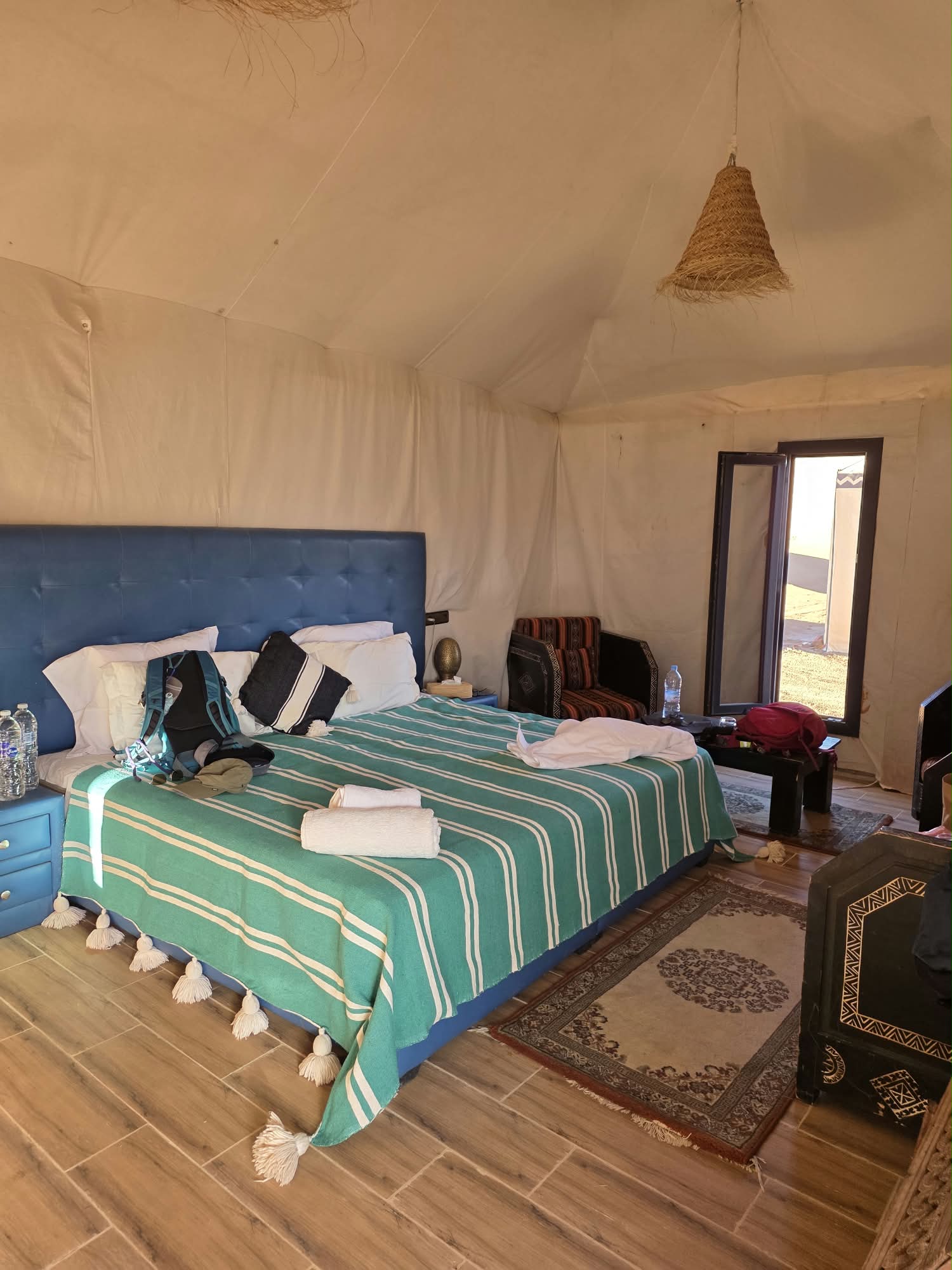
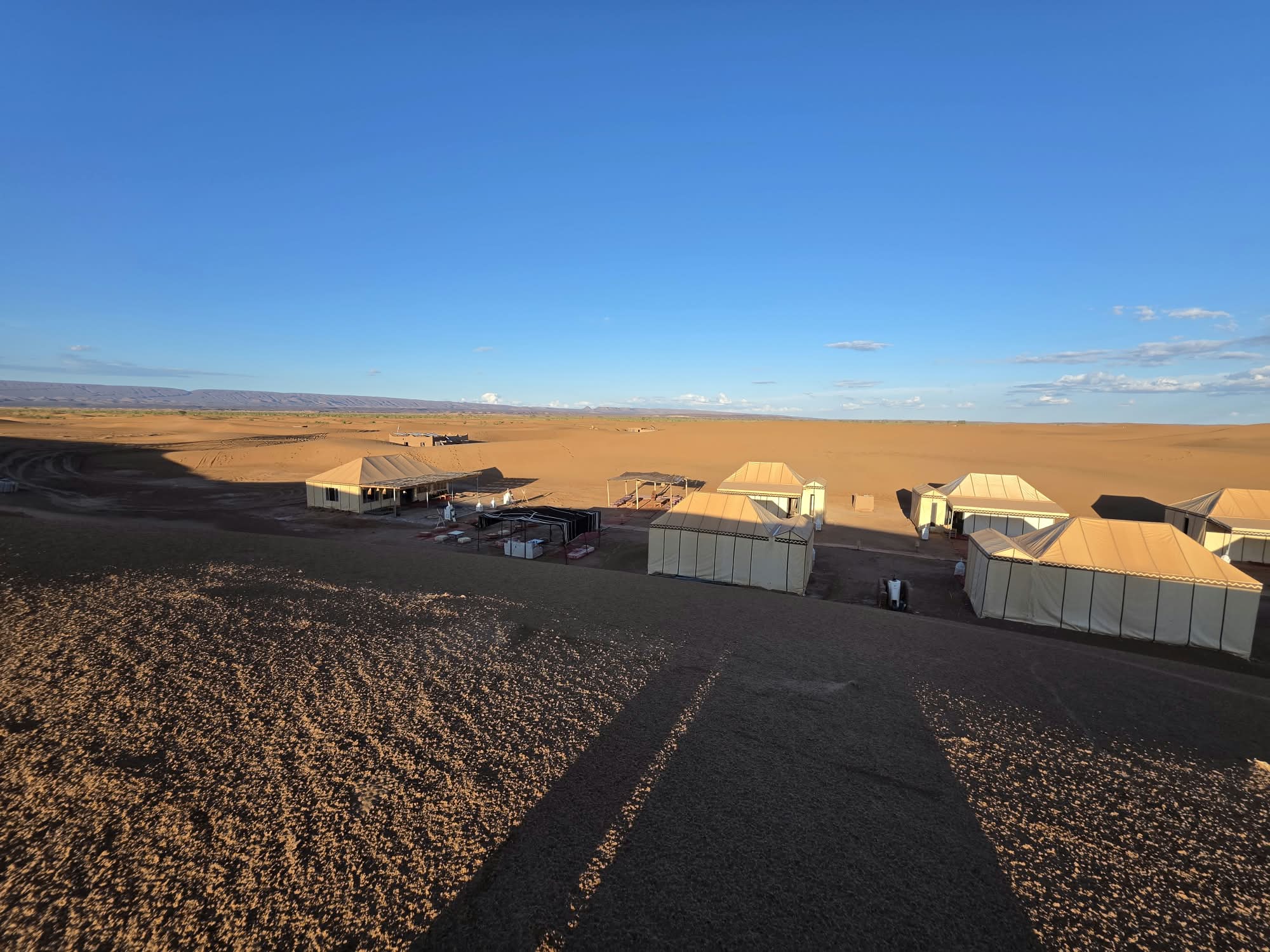
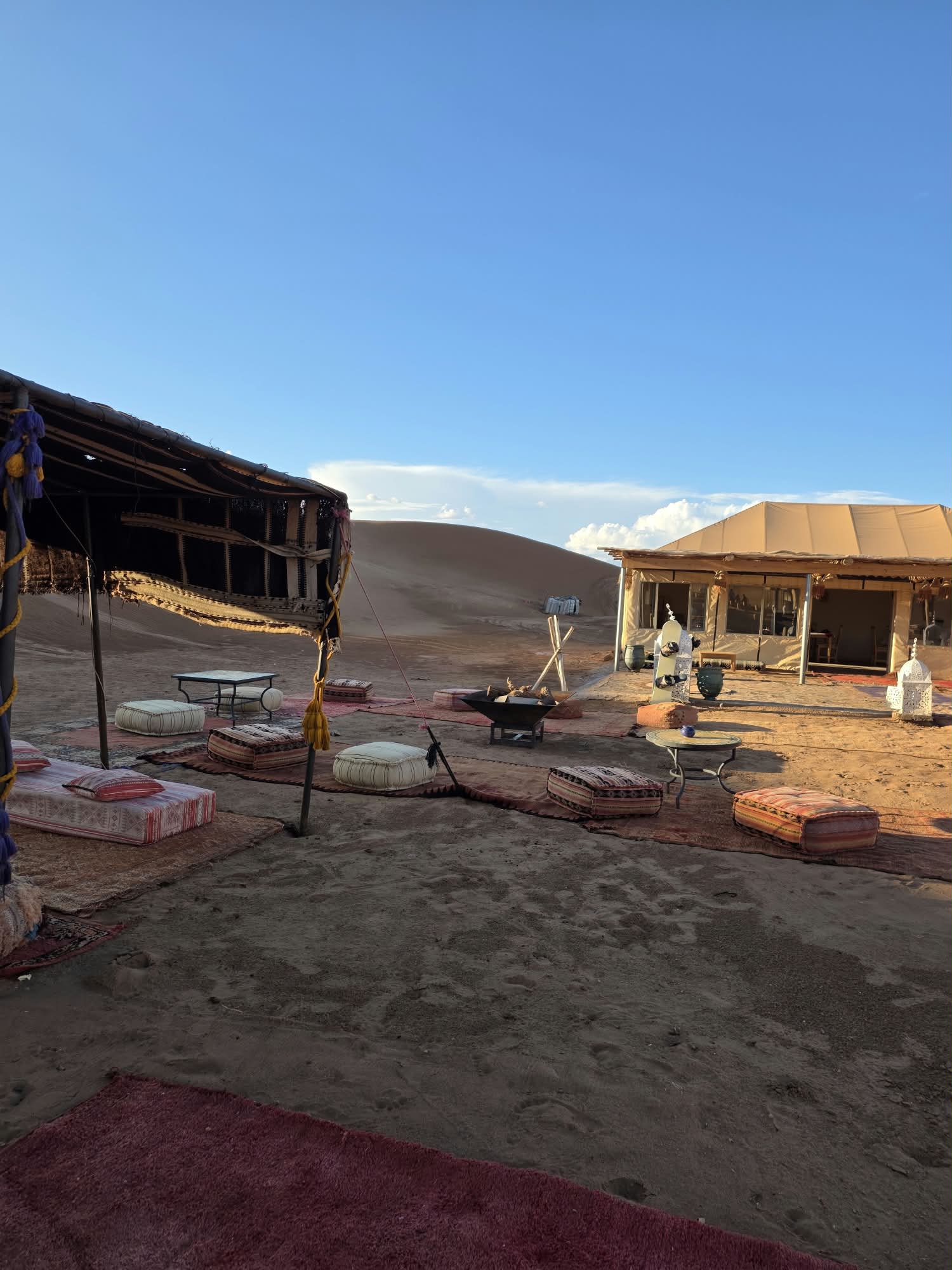
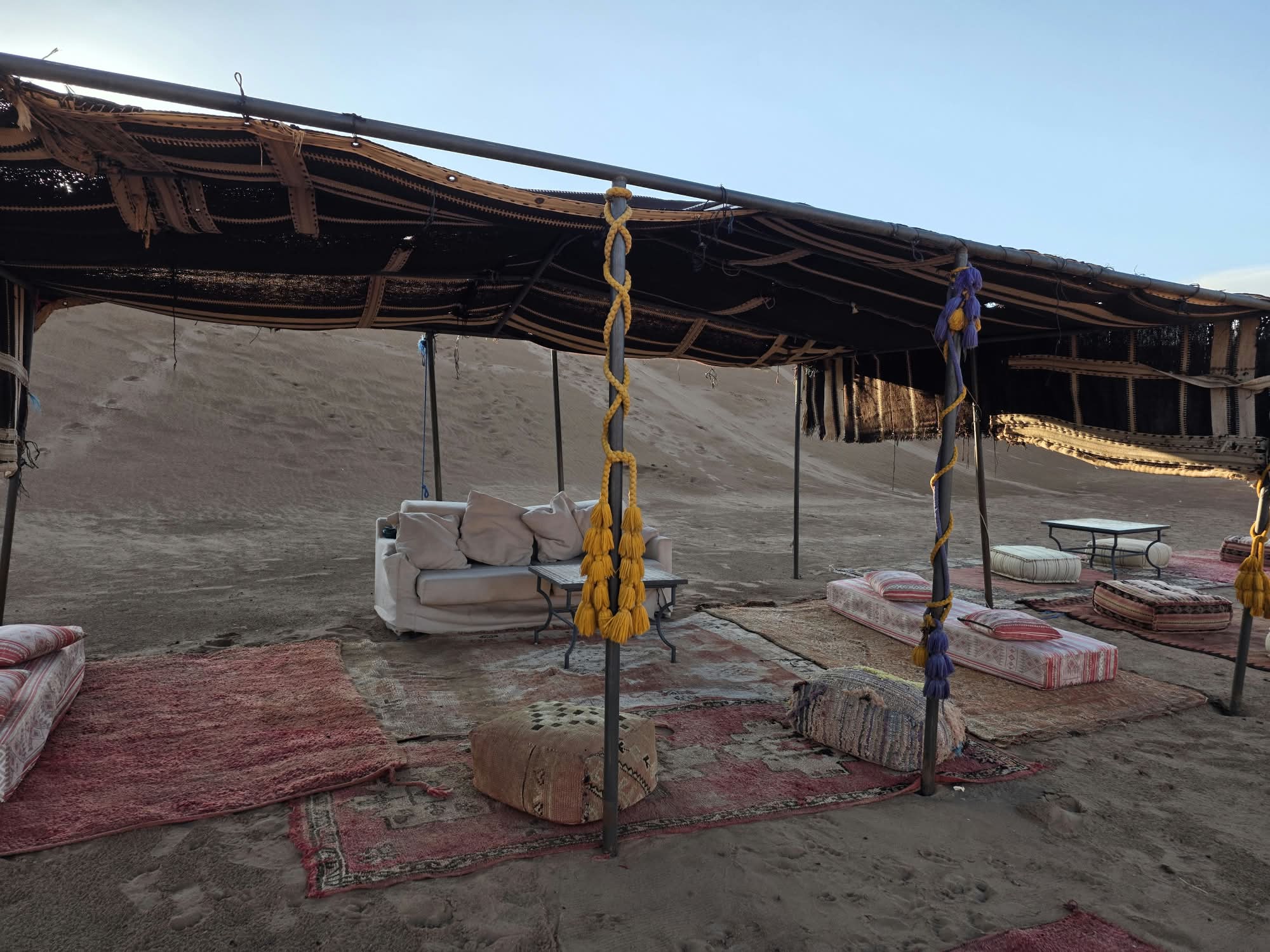
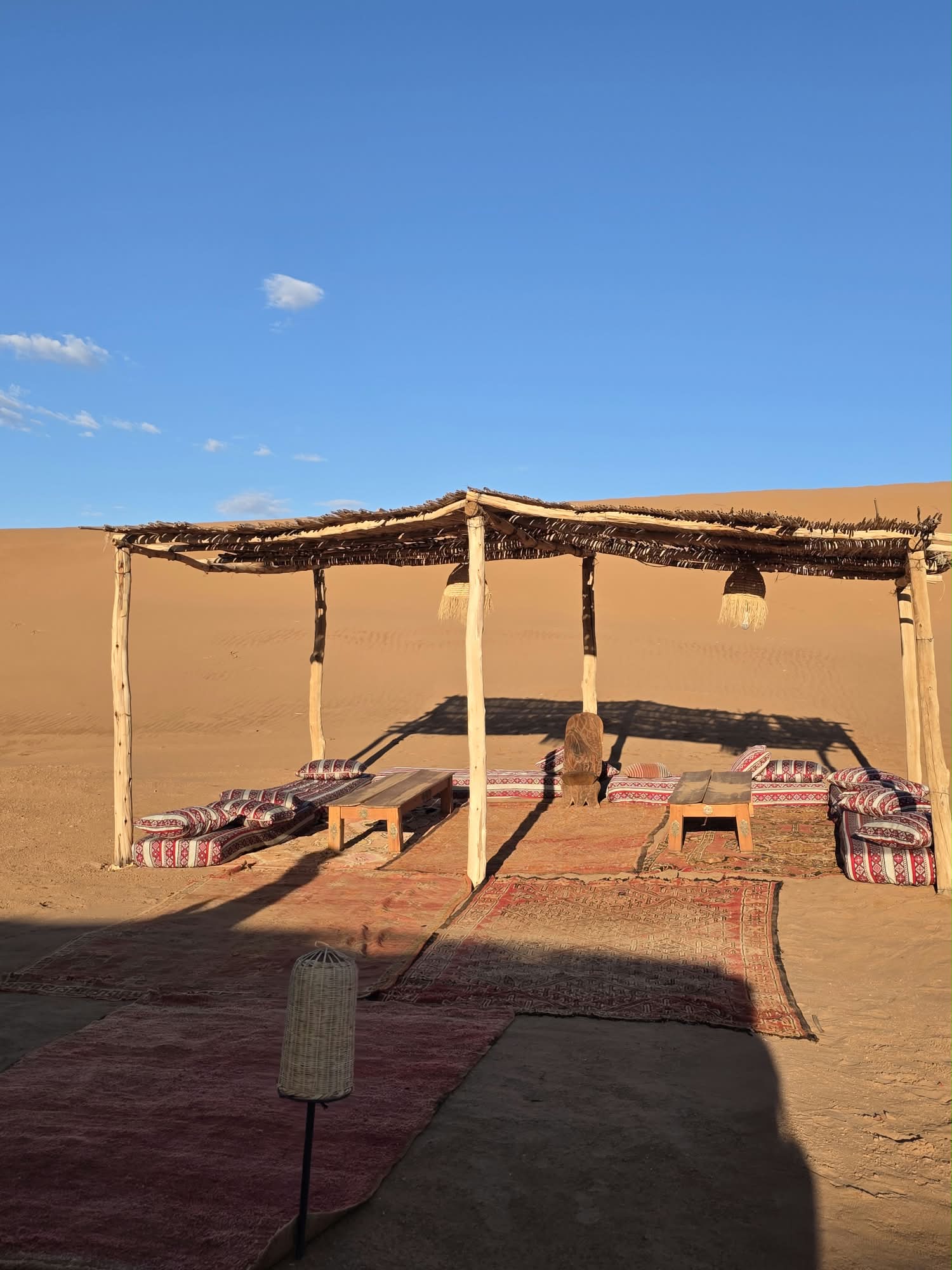
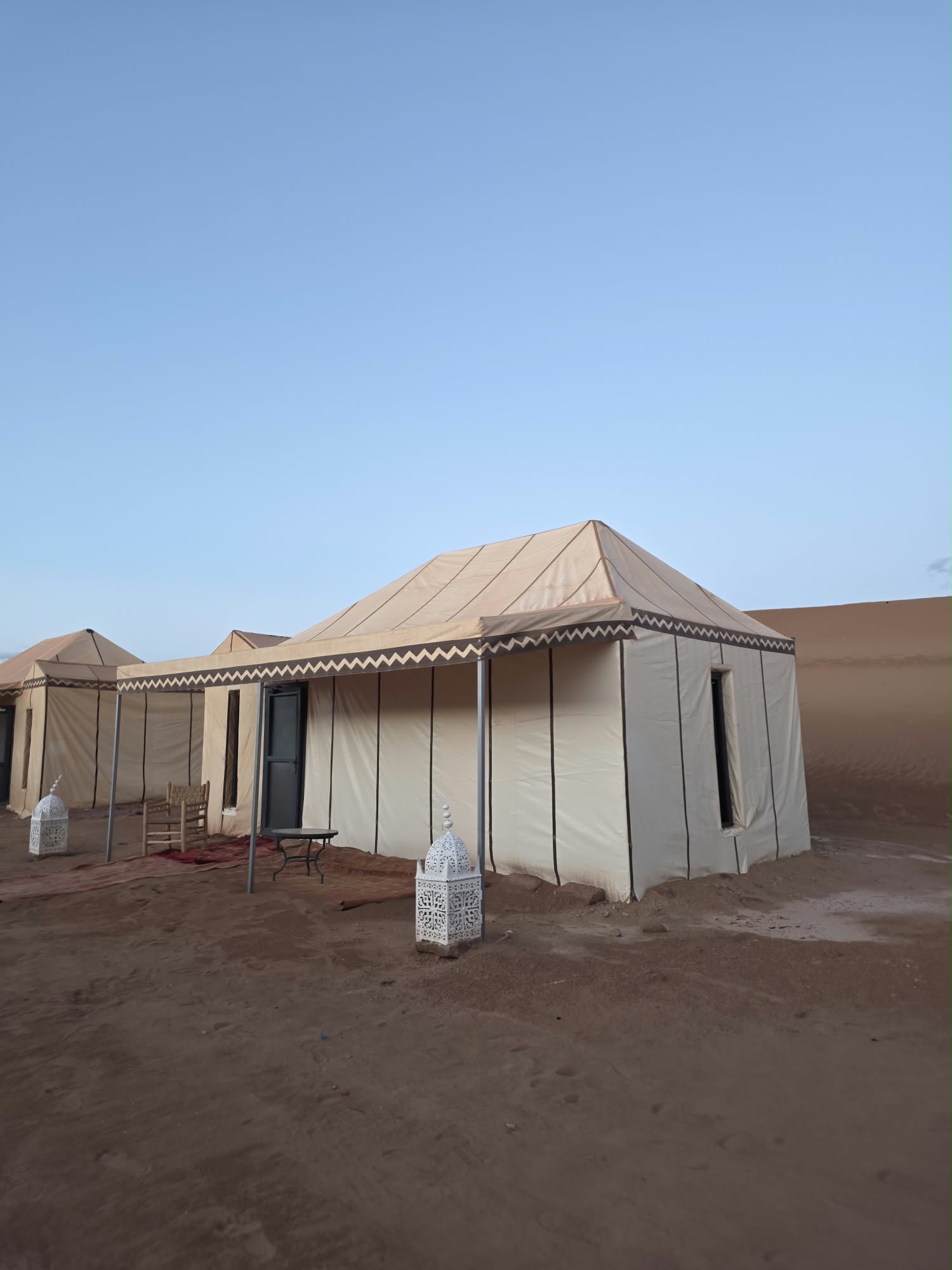
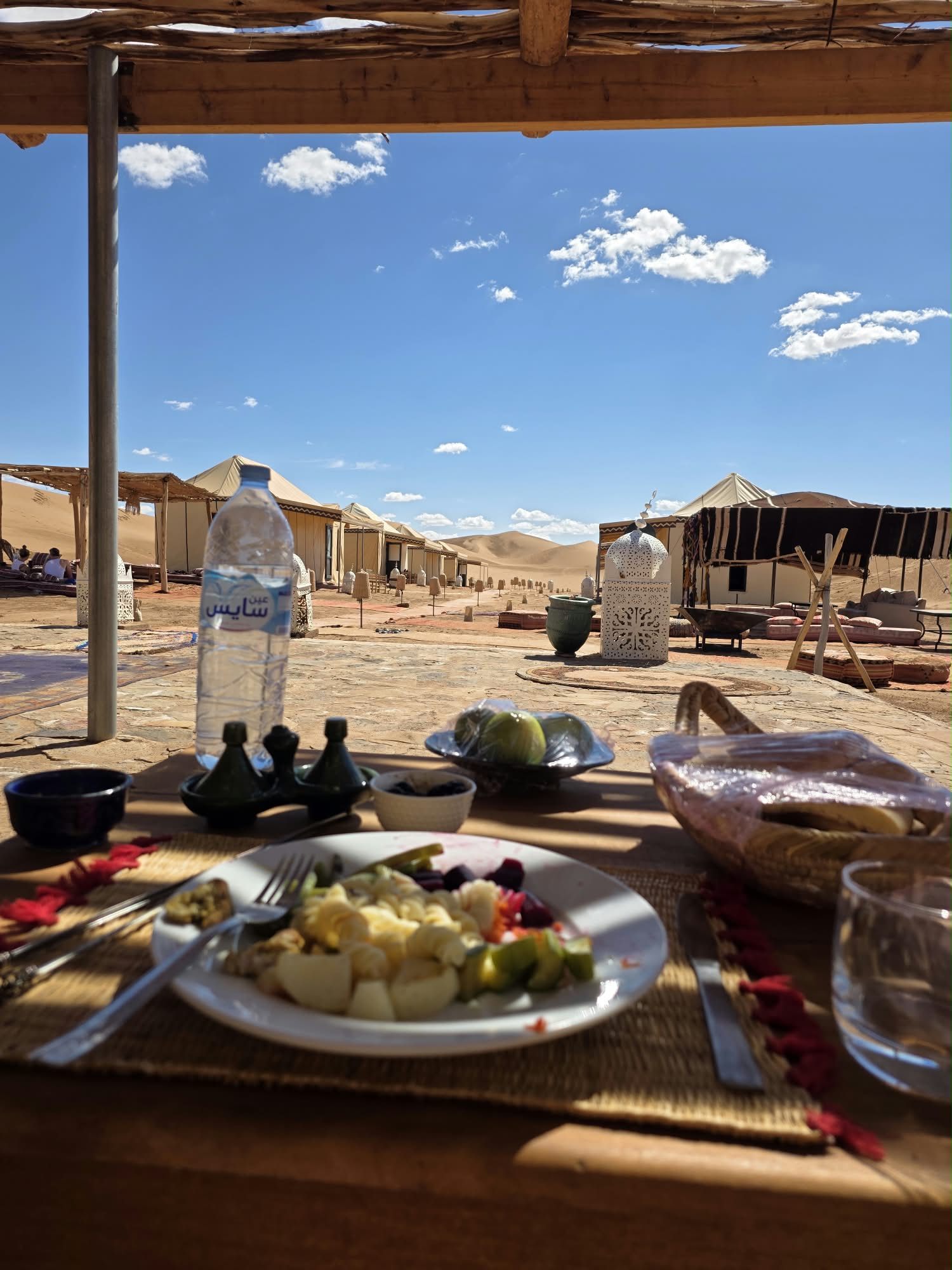
The sand was soft and we took our shoes off to walk up the nearest dune. The view was simply incredible—words are just inadequate to describe it.
After dinner, our desert camp hosts lit the fire in the fire pit and played traditional Amazigh music with drums and some metal clappers (which I didn’t get the name of). After the trio played a couple of songs, they engaged the whole camp. The drums and clappers were passed around and then we danced. It was such a fun evening.
Later that night, I laid on top of the dune and gazed at the sky. I could see the Milky Way and the millions of stars. With no light pollution, the view was magnificent.
The next day, Omar took us further into the desert to visit a nomadic family.
The desert nomad life is a dwindling one. Omar told us that today, most nomad families send their children into the villages for school, where they stay, only coming back to the desert during school breaks. Omar himself came from a nomad family. But he said when he was 6, his family moved to Mhamid, where he grew up and still lives with his wife, mother, and children.
Our second evening, we took a sunset camel ride. We rode about 20 minutes to one of the largest dunes, which we hiked up to watch the sun set. Then returned again on camel. While it was a unique experience, I can say that it was my first and last camel ride! I’ll stick to horses as camels are not comfortable to ride.
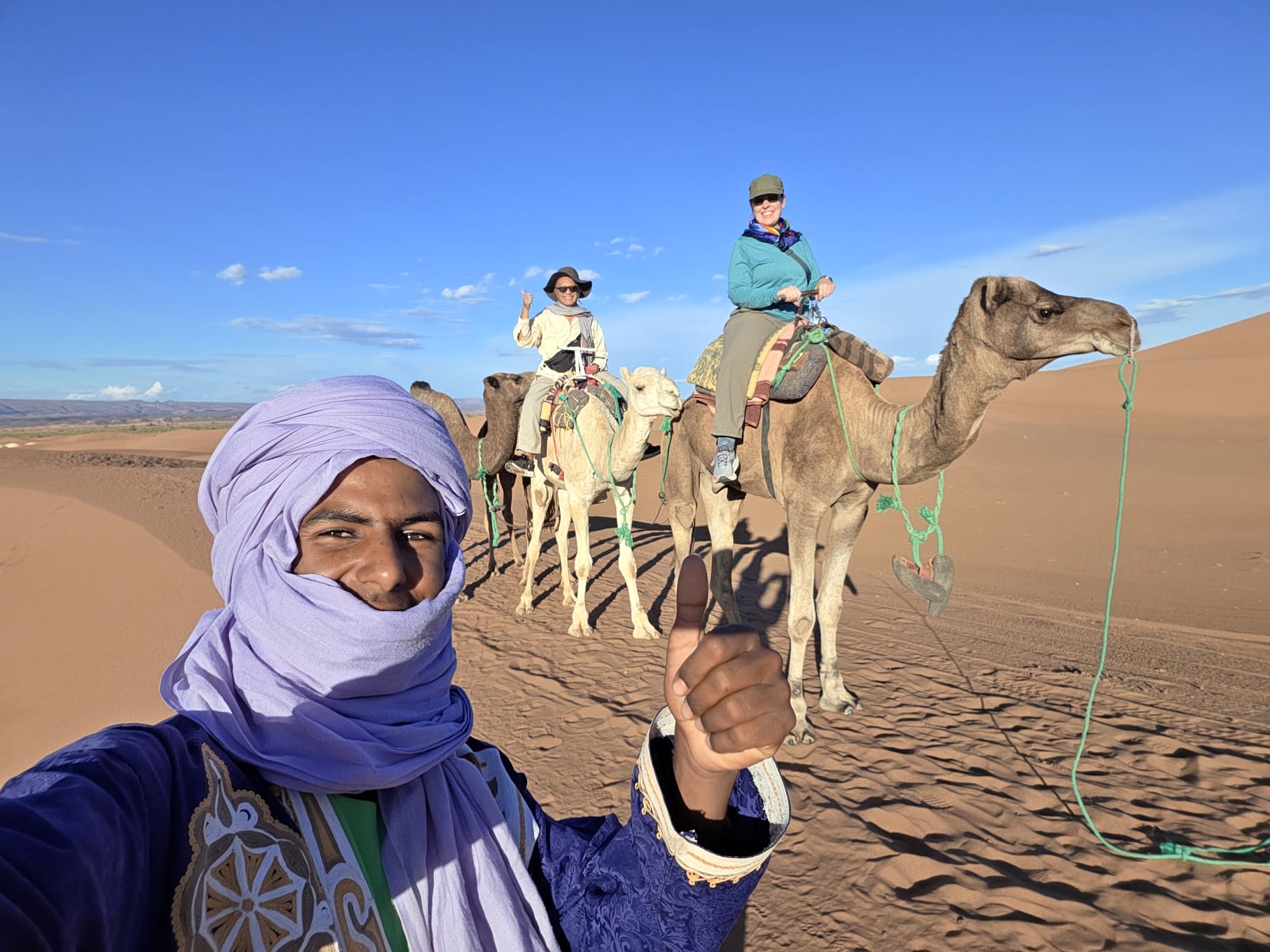
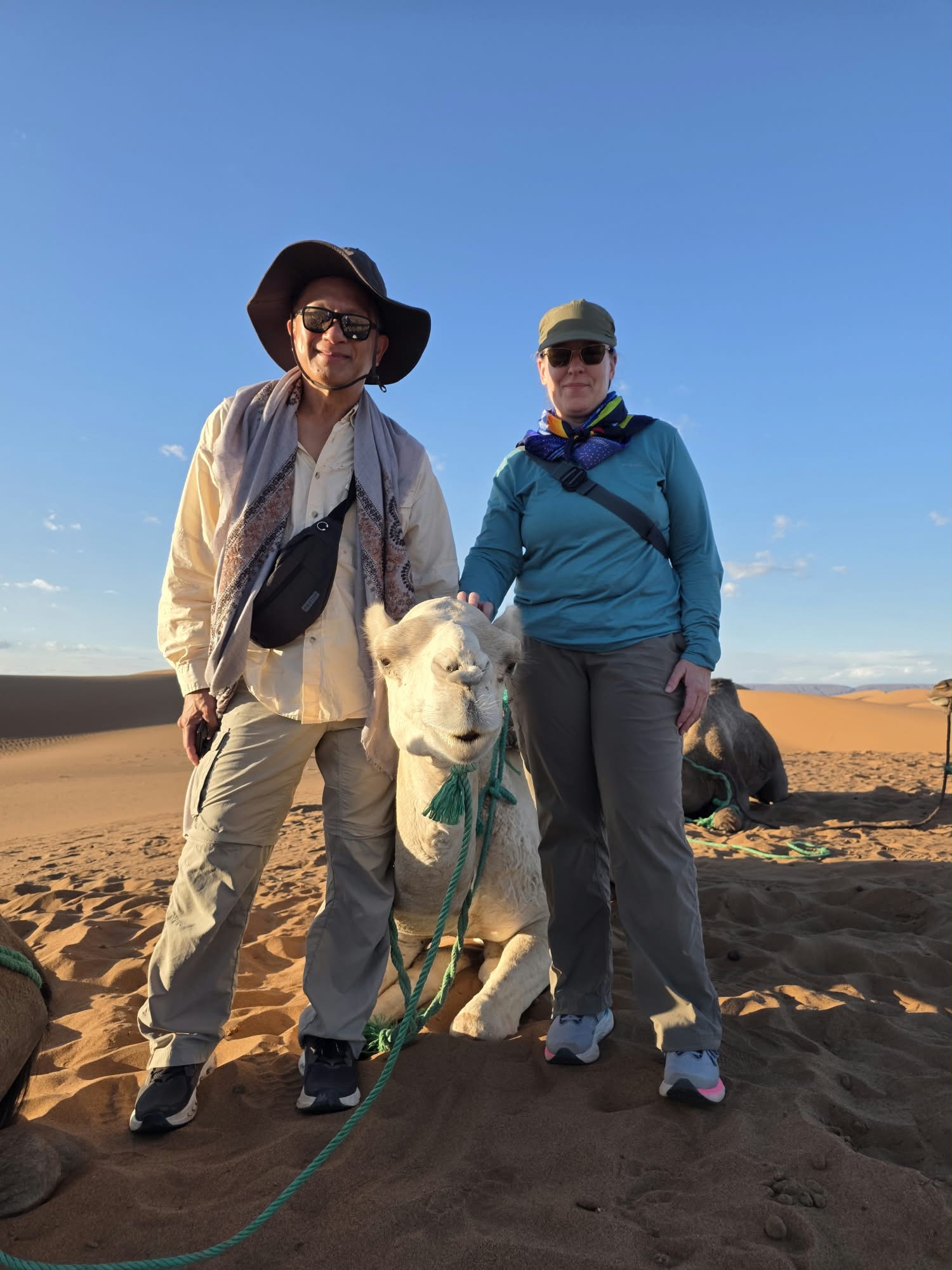
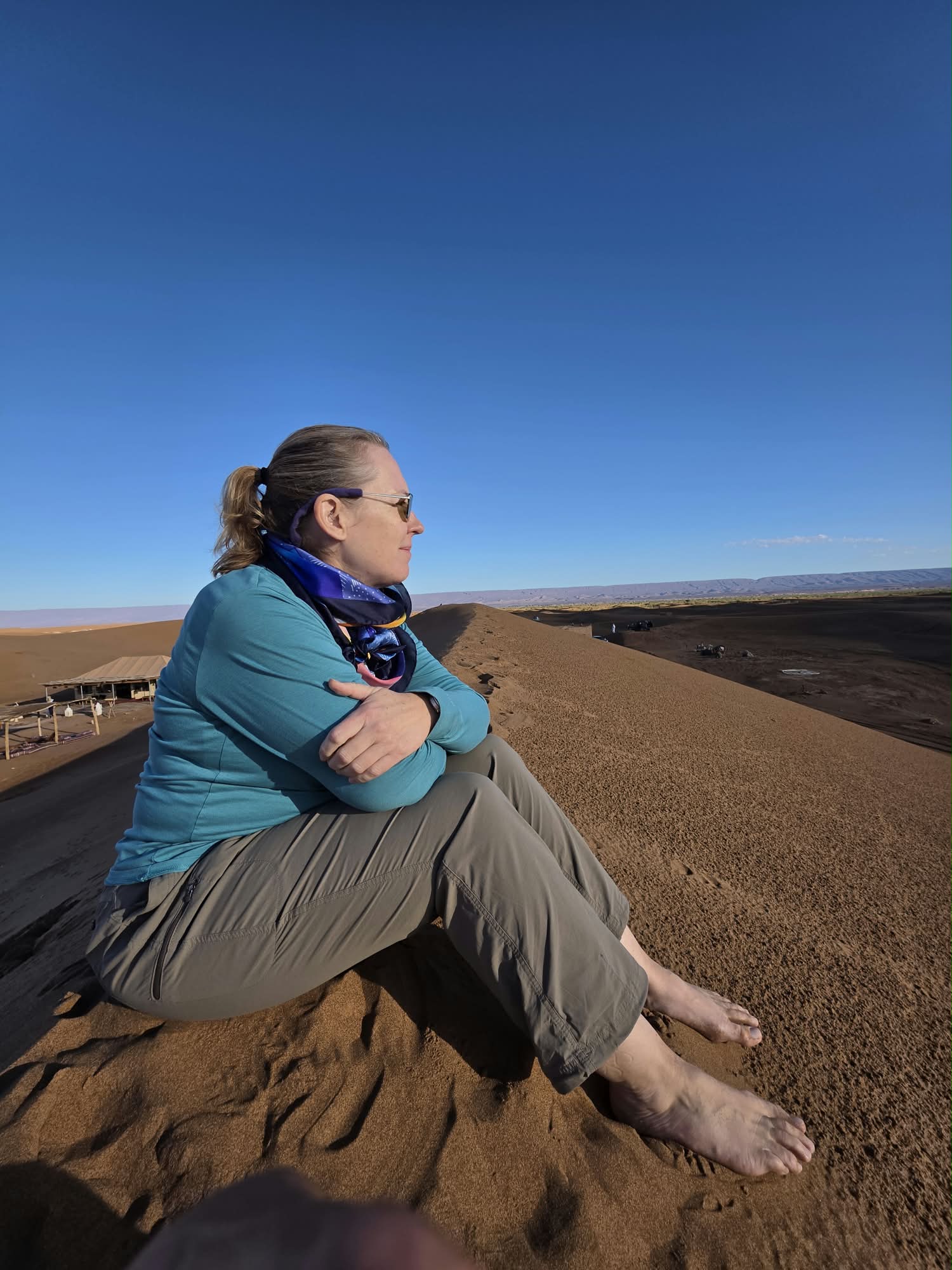
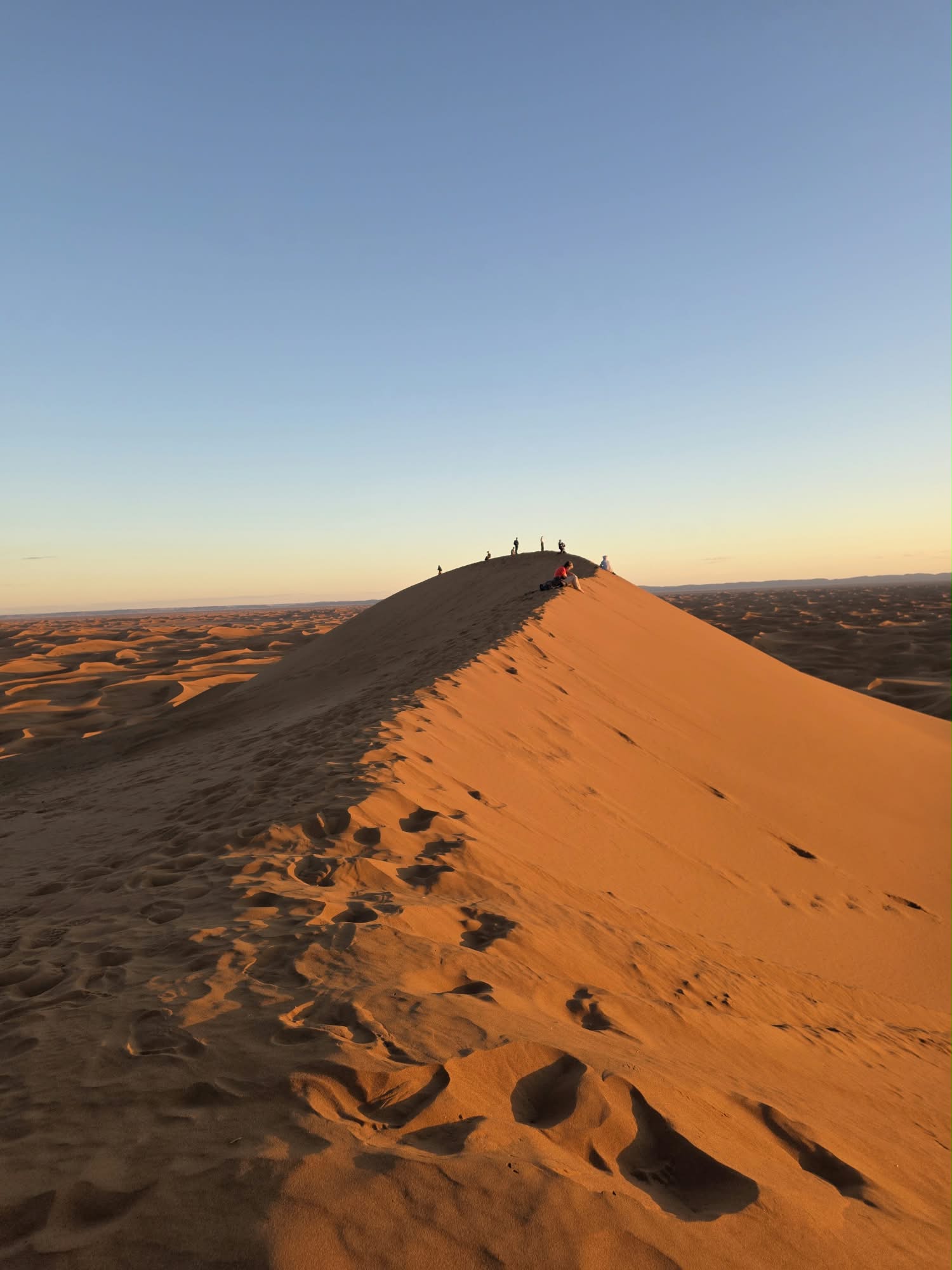
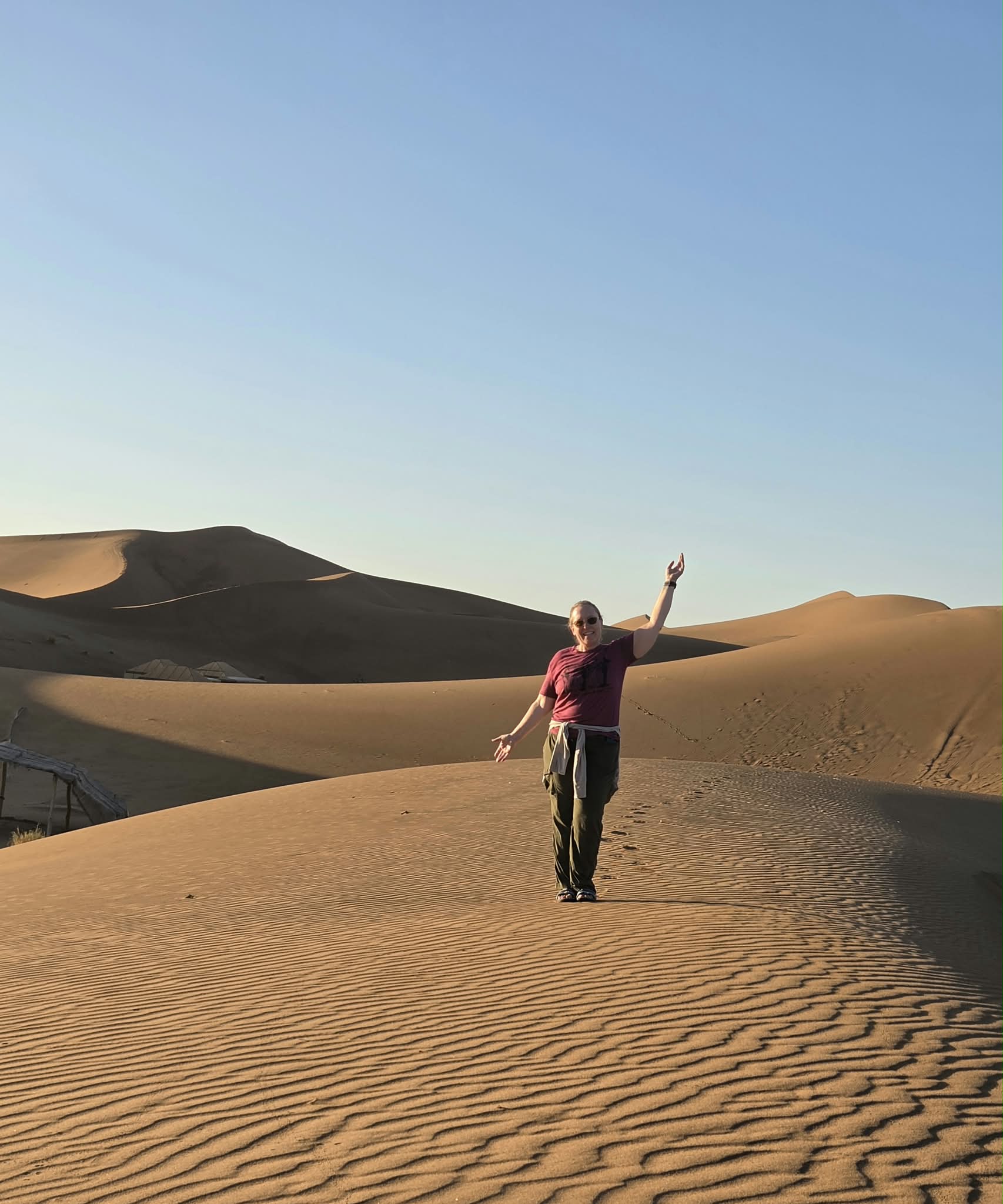
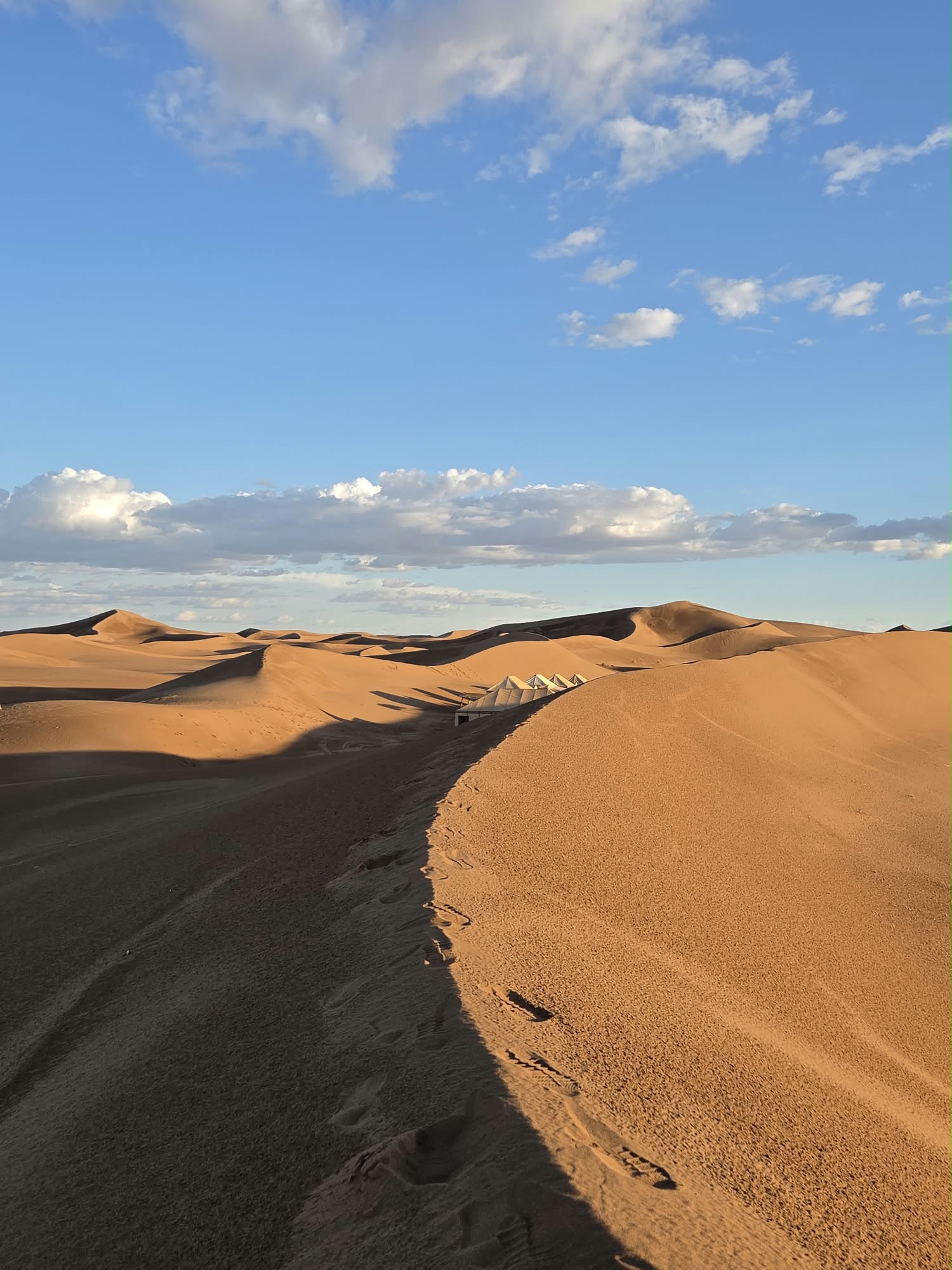
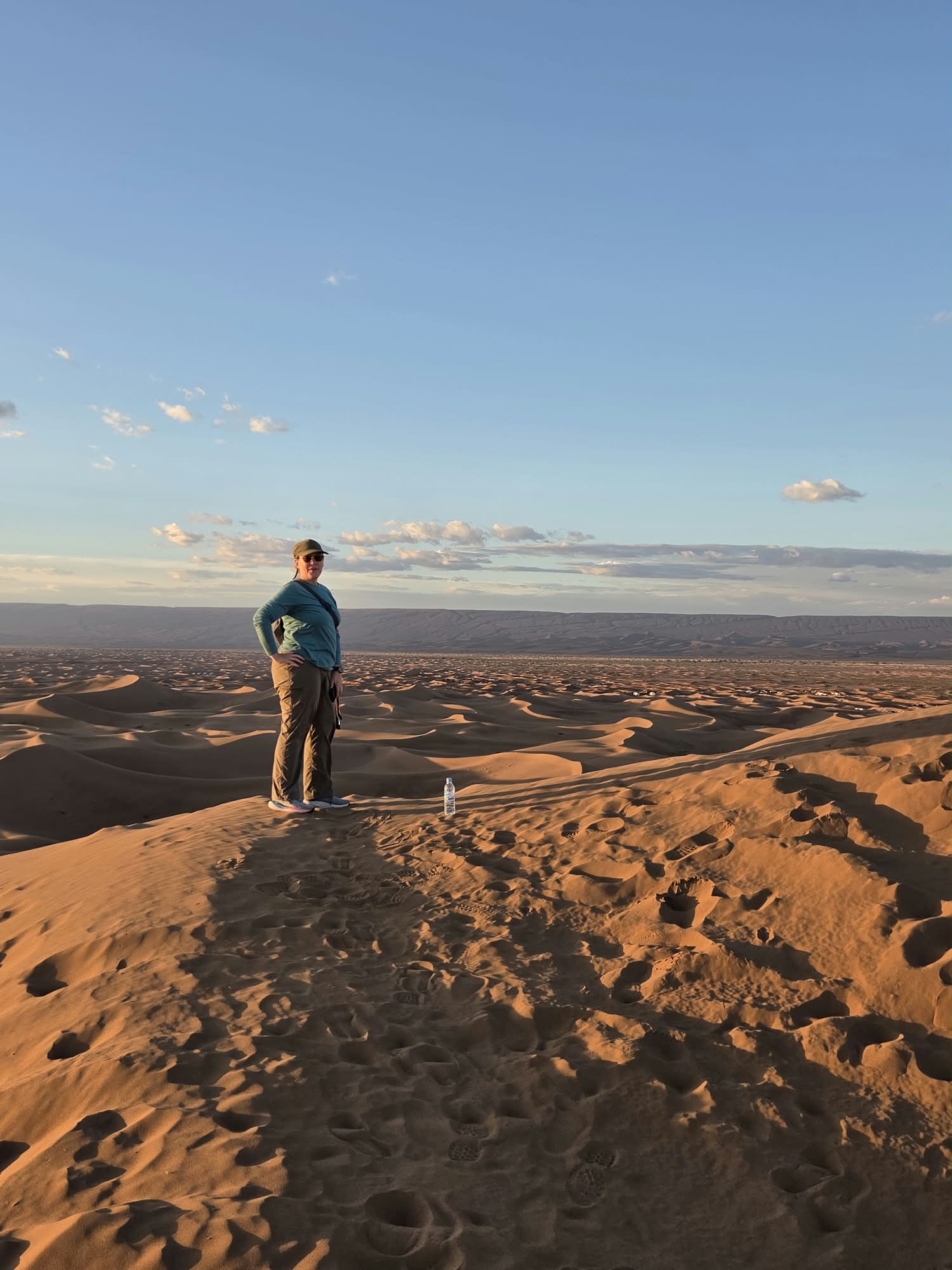
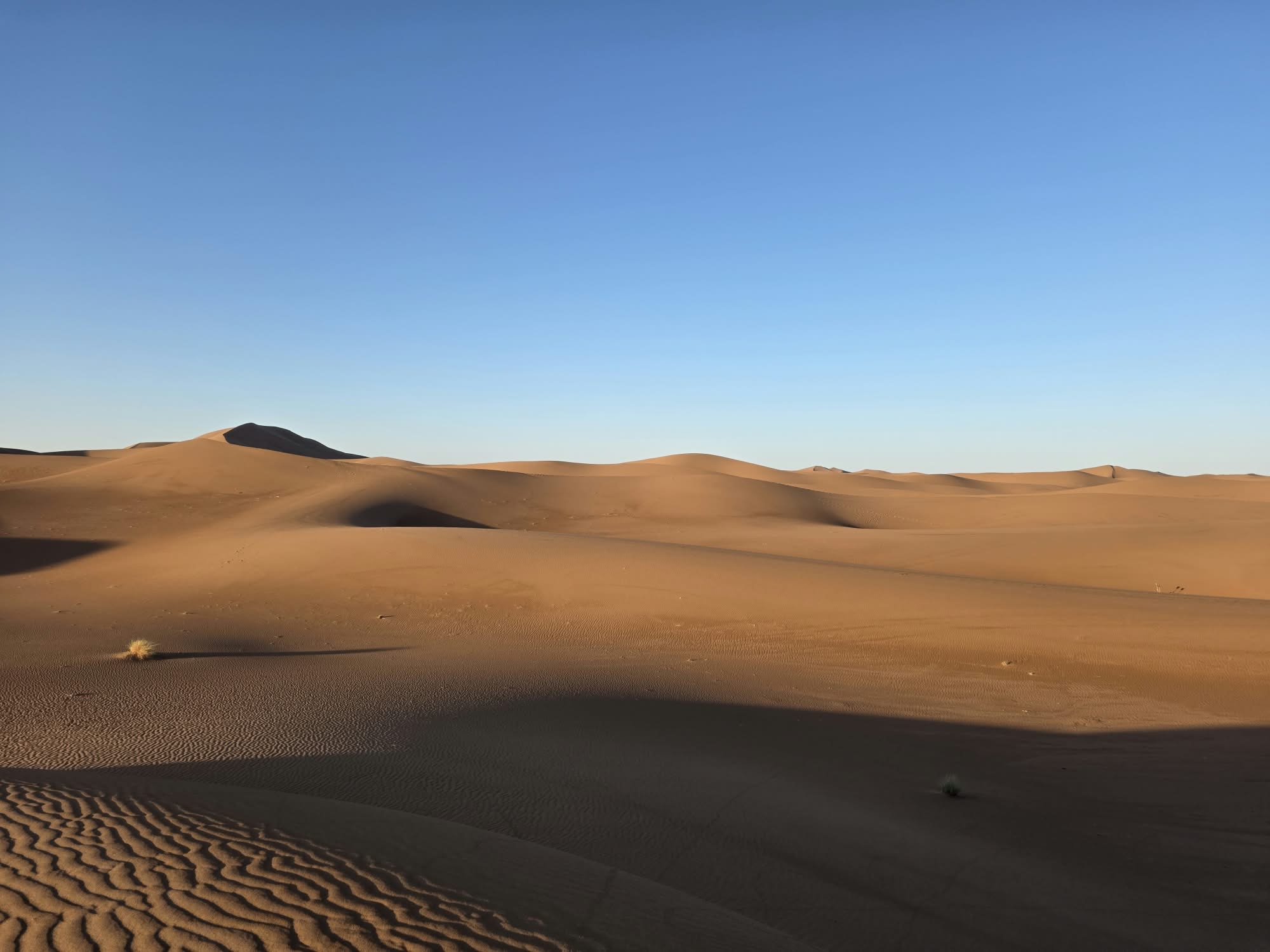
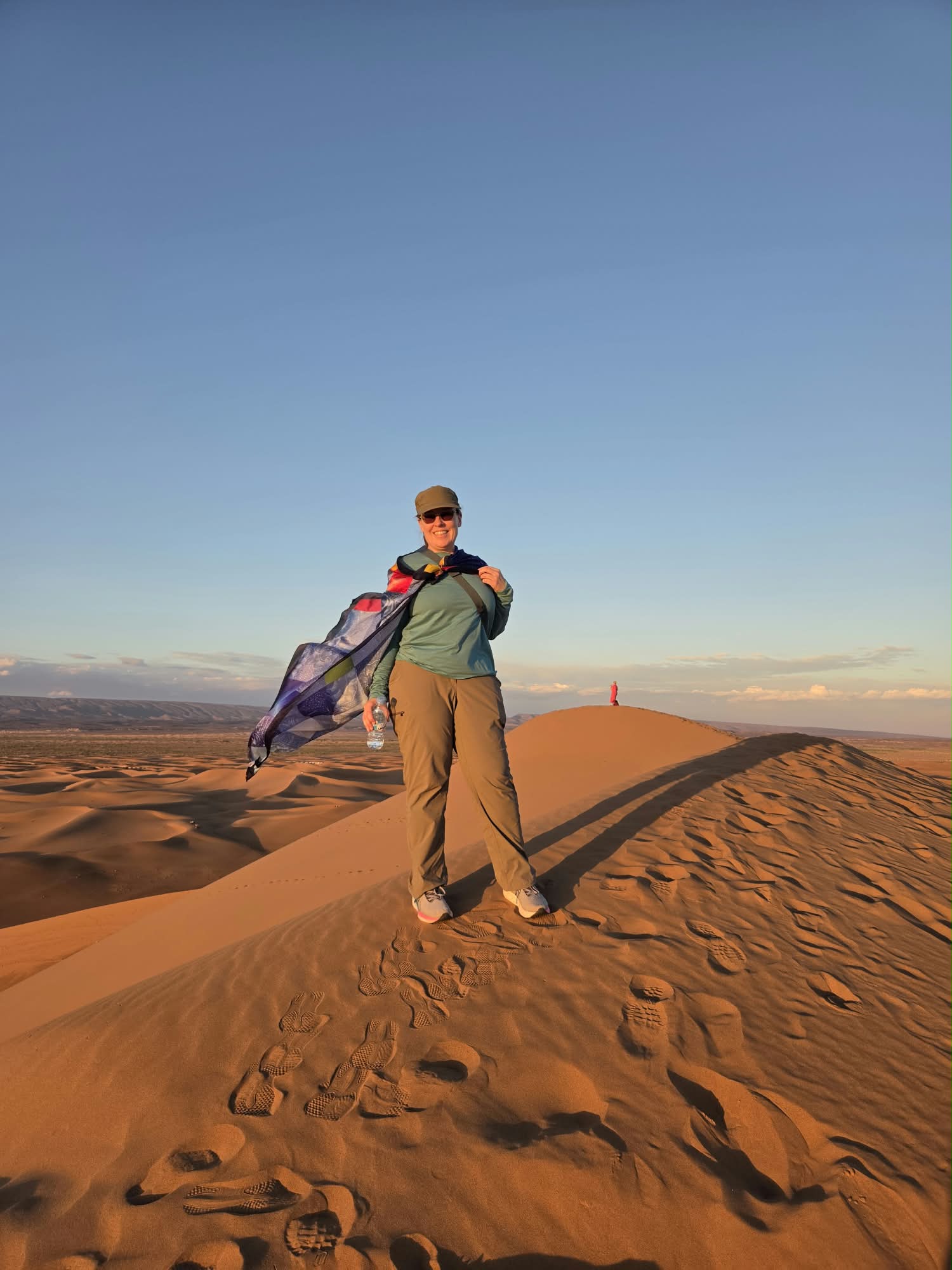
I have never slept better in my life than I slept in the desert camp. No noise, no light, just perfect stillness and peace.
I definitely left a piece of my heart in the Sahara.
Day 6 – 8: Taroudant, Mirleft, Legzira, & Sidi Ifni
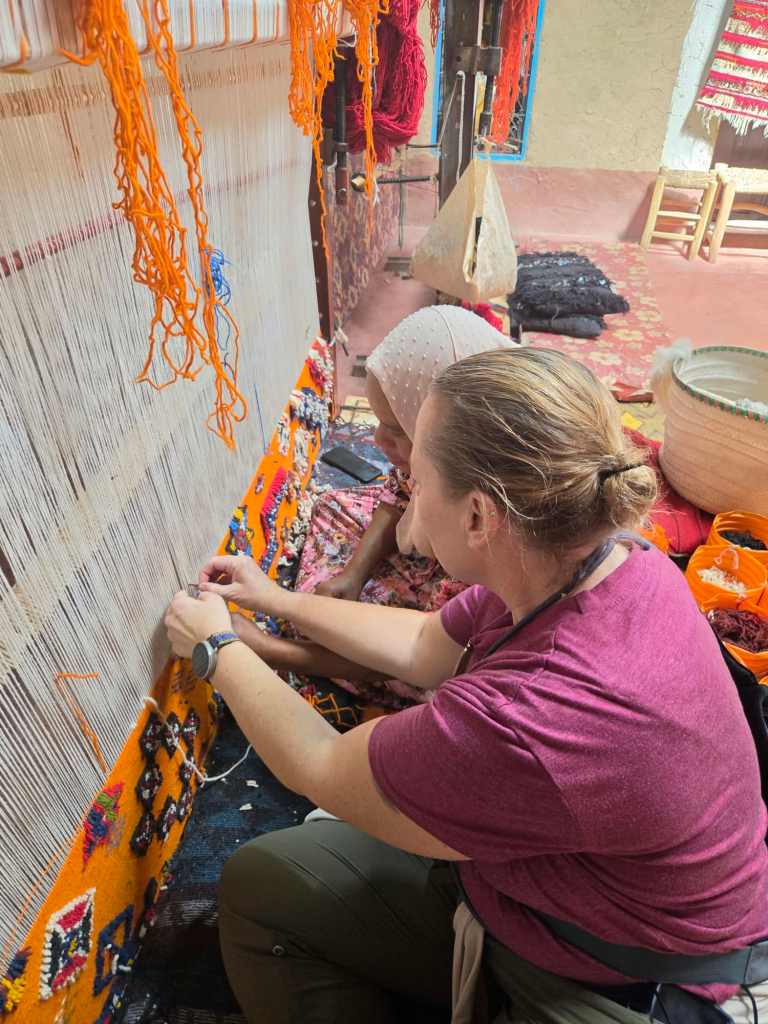
making a carpetAfter two nights in the desert, we sadly sad farewell. We crossed the dry bed of Lake Iriki and approximately 110 km of remote desert terrain toward Foum Zguid, which took a good couple of hours.
Because the drive from the Sahara to the west coast is over 9 hours, we spent one night in Taroudant, an area particularly known for traditional Berber carpets.
We stopped at a Berber carpet cooperative called Cooperative IKlane Taloussste, where we learned how the carpets are made and I even got to try my hand at it!
The Iklan rug cooperative was founded in 2005 by locals in collaboration with the Ministry of Culture and Artisanal Crafts.
And of course, we both bought small carpets. They were so incredible.
The next morning, we continued on to Mirleft with a stop at Souss Massa National Park, which is Morocco’s last wild sanctuary for the Northern Bald Ibis.
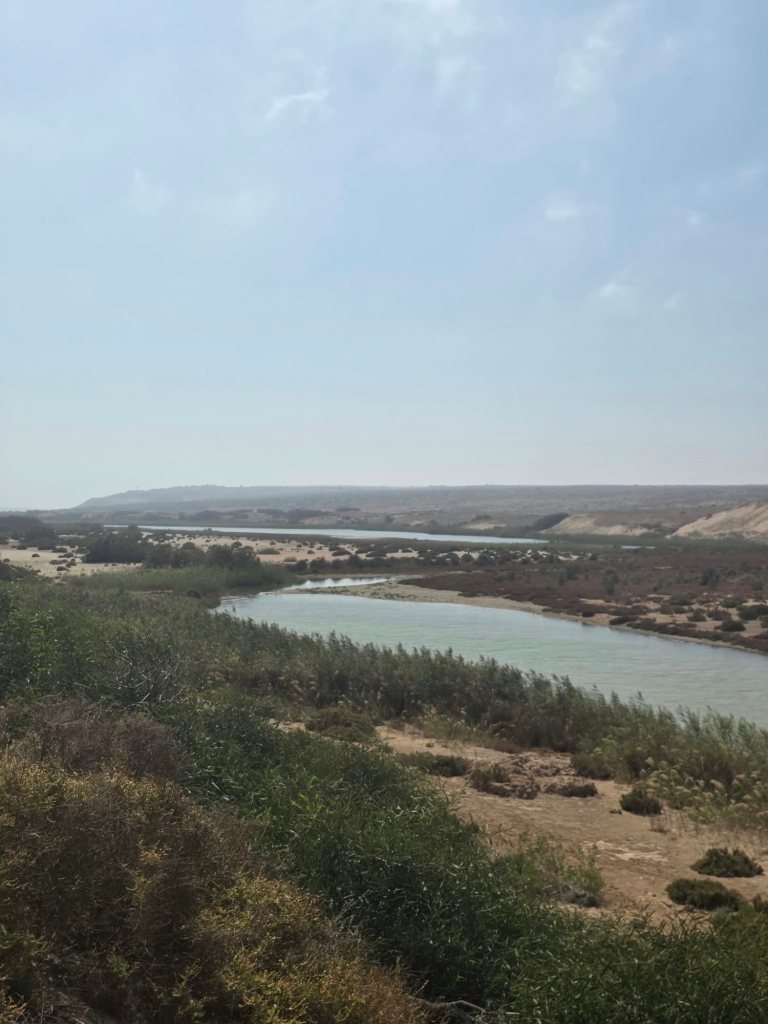
Souss MassaWe unfortunately did not get to see the Ibis, but we saw so many other birds from pipers to egrets to flamingos. Our guide was incredible at pointing out and naming all the different birds.
We spent a couple hours in Souss Massa, walking approximately 3km. It was a lovely day and the park is beautiful.
Continuing on to Mirleft, our hotel was on a hill above a small beach. The first thing I did after settling in was walk down to the beach and step in the Atlantic.
Growing up on the East Coast of the United States, I am use to seeing the sun rise on the Atlantic. Being on Morocco’s west, I watched the sun set on the Atlantic, which was a bit surreal to think about.
Although the beach was sand, there were also rocks, varying from small pebbles to large fist-sized rocks to boulders. I also watched a group of surfers enjoy the waves.
The next day Omar took me to Legzira. (Unfortunately, C was down and out from some raw veggies he had eaten the day before. We knew it was the veggies because the salad was the one thing I didn’t eat. Likely, it wasn’t the veggies, but the water they were grown and/or washed in. So travel tip: don’t eat raw veggies and always pack Immodium.)
Legzira beach stretches for about a kilometer and a half and has the dramatic red sandstone cliffs that meet the endless blue ocean. The rock formations are absolutely breathtaking—weathered by centuries of ocean waves. And the weathering continues as one best-known arches collapsed in 2016.
We got there right at low tide. I walked the entire length of the beach, going under the big arch, which would be flooded during high tide. In fact, there is a sign warning not to swim there.
I had an amazing morning exploring the beach and looking at all the rock formations and beautiful cliffs.
Day 8 – 9: Cooperative Marjana & Essaouira
After two days in Mirleft, we headed north towards Essaouria. We briefly stopped in Agadir and then had a second stop at Cooperative Marjana.
One of Morocco’s best known products is argan oil. Argan oil is a plant oil produced from the kernels of the argan tree, which is indigenous to Morocco and southwestern Algeria.
The cooperative is a social enterprise employing local women to produce Argan oil (edible) and derivative argan oil products, like soap, shampoo, and moisturizer.
It was fascinating to see how the women take the argan nut and turn it into oil. The nut is within a small yellow-green fruit, which the goats eat. And yes! We saw the goats in the argan trees eating the fruits. Here is a site that explains the entire process.
Of course, I had to purchase some argan serum.
Back on the road, we continued onto Essaouira. Known until the 1960s as Mogador, Essaouira is a port city on the Atlantic coast nearly due west of Marrakech.
In Essauoria, we stayed at a beautiful riad owned by a lovely family. The riad was right on the wall, and so the view from the rooftop was of the ocean.
Our afternoon and evening in Essauoria was calm. The Essauoria souk is much smaller than Marrakech and it is mostly open air (whereas the souks in Marrakech have a roof).
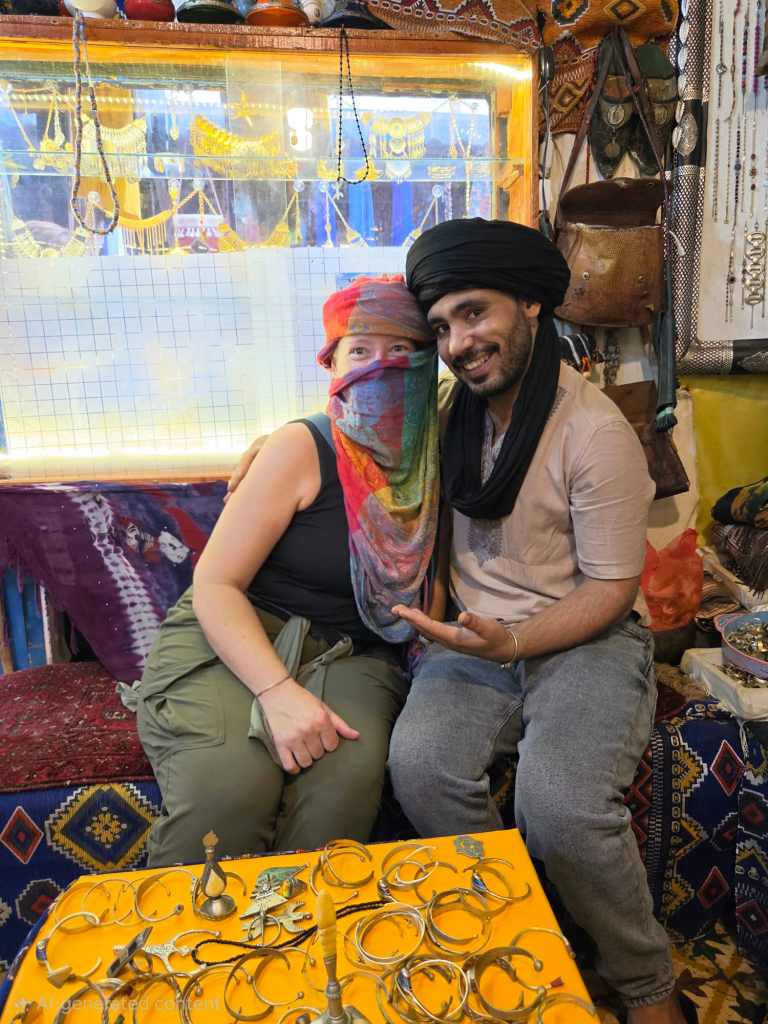
We met a delightful trader at La Caverne d’Ali Baba, who was quite taken with me. He offered C “all the camels in the Sahara” for me. We sat and had mint tea with him before continuing our exploration of Essauoria.
Day 10 – 11: Back to Marrakech
Essauoria to Marrakech is only a 3 hour drive—the shortest of our trip! This time we stayed in a different riad in a different section of the medina. We enjoyed one last night in Morocco before we left super early the next morning.
Final Thoughts
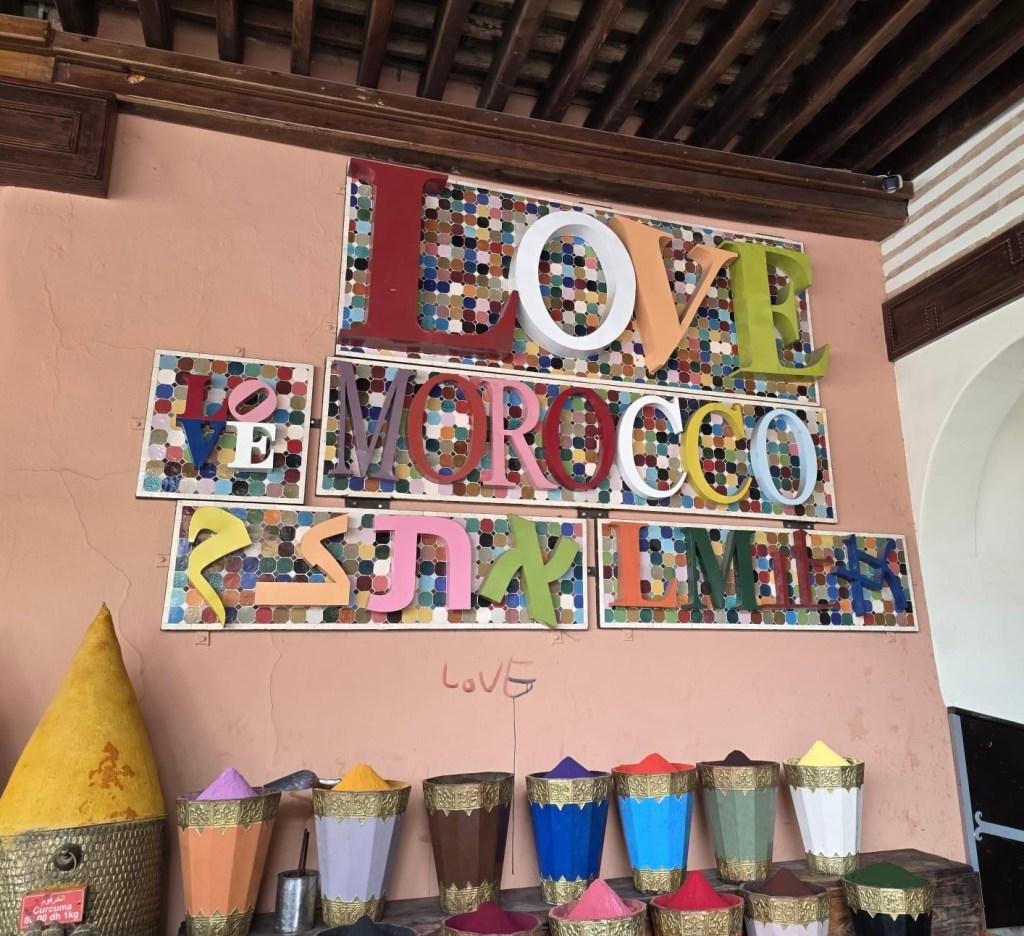
The above is only a snapshot of our trip and a handful of photos. Distilling this experience into a single blog post was incredibly difficult, if not nearly impossible. I took over 1700 photos and videos, if that gives you any indication of how absolutely fantastic this trip was. And full kudos to Morocco Shiny Days for making my trip idea a reality.
I loved Morocco—the people, the food, the climate—from the coast to the desert, Morocco was simply amazing. Everyone was welcoming and always offering mint tea (which is delicious).
Only one negative—plastic waste. Even in the Sahara, we saw plastic waste. So sad and so preventable. Leave no trace, take your trash with you.
My absolute favorite part was the Sahara. I already want to return. No light pollution—I could see the Milky Way and the millions of stars. No noise pollution—it was so peaceful at night, not even the sound of an insect. It was simply incredible to climb the dunes to watch the sun rise and set.
Words are simply inadequate to describe my beautiful Moroccan experience.
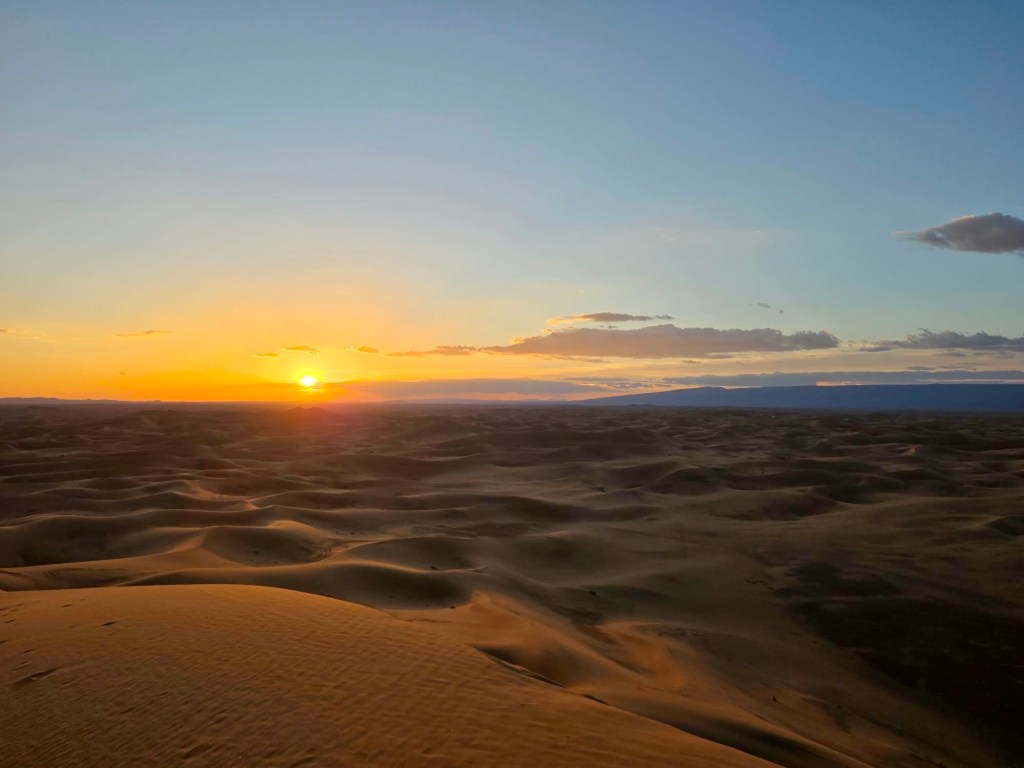
Sahara sunsetI would go back to Morocco in a heartbeat. In fact, I’m already trying to schedule a return trip, this time to see the northern part of the country, inshallah.
If you have the opportunity, I highly recommend going.
Where am I going next? Stay tuned to find out!
All content, including photos, are created by me and © 2026 L. Long/wanderinglynn.com. All Rights Reserved. No part of this website or its contents may be reproduced, copied, modified, adapted, or used to train AI without prior written consent of the owner.
Any links are merely for reference or for your convenience. All views expressed in this content are my own and I have not been compensated for any recommendations made.

